

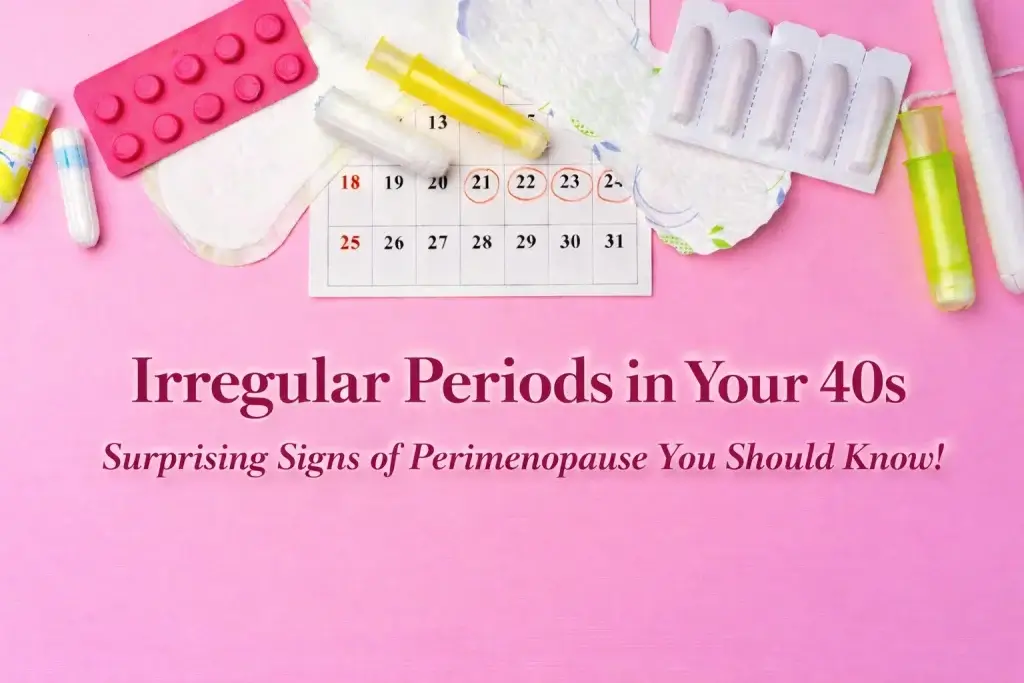
Many women notice something subtle but unsettling as they move through their forties.
A period arrives later than expected.
The next cycle comes earlier.
Then suddenly a month passes with no bleeding at all.
Irregular periods can feel confusing, even alarming, especially for women who have spent decades with predictable cycles.
You may find yourself asking questions that millions of women search online every month.
Why is my period late?
Are irregular periods normal in your 40s?
Could this be perimenopause?
The answer is often yes. But the story behind irregular periods is more complex and more fascinating than a simple hormonal shift.
Understanding why menstrual cycles change in your forties can transform uncertainty into clarity and empower you to approach this life stage with confidence rather than anxiety.
This guide explores the science behind irregular periods, the biological transition of perimenopause, and how to recognize when a delayed period is part of normal hormonal change or a signal that medical evaluation is needed.
The most common cause of irregular periods in the forties is perimenopause.
Perimenopause is the transitional phase before menopause when ovarian hormone production begins to fluctuate.
Unlike menopause, which is defined as twelve consecutive months without a menstrual period, perimenopause can last several years.
During this stage, estrogen and progesterone levels do not decline smoothly. Instead they rise and fall unpredictably.
This hormonal variability affects ovulation, which in turn alters the timing and length of menstrual cycles.
A study published in the journal Menopause by the North American Menopause Society reports that menstrual irregularity is one of the earliest signs of the menopausal transition and may begin as early as the late thirties for some women.
When ovulation becomes inconsistent, cycles naturally become irregular.
This is why a late period or delayed period becomes increasingly common during this stage of life.
(Cleveland Clinic).
A normal menstrual cycle typically lasts between 21 and 35 days in adult women.
However, as reproductive hormones fluctuate in the forties, cycles may vary significantly from month to month.
Doctors generally consider a period irregular when one or more of the following patterns occur.
| Pattern of Cycle Change | What It May Mean |
|---|---|
| Cycles shorter than 21 days | Hormonal fluctuations affecting ovulation |
| Cycles longer than 35 days | Delayed ovulation or skipped ovulation |
| Skipped periods | Ovulation did not occur that cycle |
| Very heavy bleeding | Hormonal imbalance affecting uterine lining |
| Sudden cycle unpredictability | Common sign of perimenopause |
According to the NHS, menstrual variability becomes increasingly common during the menopausal transition due to irregular ovulation.
For many women, irregular periods are the first biological signal that reproductive hormones are shifting.
To understand irregular periods in your forties, it helps to understand the role of ovarian hormones.
Every menstrual cycle is orchestrated by a carefully coordinated hormonal rhythm involving the brain, ovaries, and uterus.
The two key reproductive hormones are estrogen and progesterone.
During perimenopause, this rhythm becomes less predictable.
| Hormone | Normal Role | What Changes in Perimenopause |
|---|---|---|
| Estrogen | Stimulates growth of uterine lining | Fluctuates dramatically |
| Progesterone | Stabilizes cycle after ovulation | Often decreases due to irregular ovulation |
| FSH | Signals ovaries to mature eggs | Levels gradually rise as ovarian reserve declines |
When ovulation becomes inconsistent, progesterone production also becomes inconsistent.
Without predictable progesterone signals, menstrual cycles can lengthen, shorten, or skip altogether.
This is why a late period does not necessarily mean something is wrong. In many cases, it simply reflects a cycle where ovulation occurred later than usual.
(Max Healthcare).
Although perimenopause is the most common cause of irregular periods in women over forty, it is not the only possibility.
Several other biological and lifestyle factors can influence cycle timing.
Chronic stress affects the hypothalamus, the region of the brain that regulates reproductive hormones. Elevated cortisol can delay ovulation and lead to a late period.
Both hypothyroidism and hyperthyroidism can disrupt menstrual cycles. Thyroid hormones play a significant role in reproductive regulation.
Rapid weight loss or weight gain can influence estrogen production and ovulatory function.
Although usually diagnosed earlier in life, PCOS can also cause irregular cycles in some women.
Certain medications, including antidepressants and hormonal treatments, may affect menstrual patterns.
Even in the forties, pregnancy remains possible until menopause occurs. Any unexplained delayed period should include pregnancy as a consideration.
An article published in Temple Health emphasises that menstrual irregularity can reflect systemic health changes, not only reproductive aging.
Irregular cycles are often accompanied by other subtle changes that signal the beginning of perimenopause.
Many women notice symptoms such as:
• Night sweats
• Sleep disturbances
• Mood variability
• Breast tenderness
• Increased menstrual flow
• Fatigue
• Shorter or longer cycles
Research shows that menstrual irregularity and vasomotor symptoms frequently appear together during the menopausal transition.
These symptoms occur because estrogen fluctuations affect multiple body systems including the brain, blood vessels, and metabolism.
(Alloy).
Perimenopause is not a brief phase.
For many women it lasts between four and eight years before menopause occurs.
The average age of menopause globally is approximately 51 years, though it can vary depending on genetics, health, and environmental factors.
In India, research reports that the average age of menopause is slightly earlier, often around 46 to 48 years.
This means irregular periods in the early forties may represent the beginning of a gradual hormonal transition that unfolds over several years.
Understanding this timeline can reduce anxiety when cycles begin to change.
(LifeCell).
While irregular periods are common in perimenopause, certain patterns require medical attention.
You should consult a clinician if you experience:
• Bleeding after menopause
• Extremely heavy bleeding soaking pads hourly
• Bleeding lasting longer than ten days
• Bleeding between periods
• Severe pelvic pain
• Sudden menstrual changes accompanied by dizziness or fatigue
These symptoms may indicate conditions such as uterine fibroids, endometrial hyperplasia, thyroid disease, or anemia.
A doctor may evaluate irregular periods using:
• Medical history and menstrual pattern review
• Hormone tests including FSH and estradiol
• Thyroid function tests
• Pelvic ultrasound
• Endometrial evaluation when indicated
Medical assessment ensures that irregular periods are part of normal hormonal transition rather than another underlying condition.
(JMCH).
Although irregular periods can feel disruptive, many women also discover that their forties become a time of deeper self awareness and physiological transformation.
Supporting hormonal health during this stage can improve both physical and emotional wellbeing.
Evidence based strategies include:
• Maintaining consistent sleep patterns
• Regular physical activity
• Balanced nutrition rich in iron, calcium, and omega three fats
• Stress management through mindfulness or yoga
• Regular gynecological care
Studies from Harvard Medical School and the North American Menopause Society emphasise that lifestyle interventions can significantly improve quality of life during the menopausal transition.
Rather than viewing irregular periods as a problem to fear, many women find that understanding the biology behind these changes brings a sense of reassurance.
Menstrual cycles are often treated as mechanical schedules that should behave predictably forever.
But the female body is not static.
It evolves.
Irregular periods in your forties are often the body’s way of signaling that a profound hormonal transition has begun.
Perimenopause is not merely the end of fertility. It is a stage of biological recalibration, preparing the body for a new hormonal equilibrium.
When understood with knowledge and compassion, the changes of this decade become far less mysterious and far more empowering.
Your body is not failing.
It is simply changing its rhythm.
And with the right information and care, that rhythm can still be understood, supported, and respected.
Yes, irregular periods are very common in your 40s because of perimenopause, the transition phase before menopause. Hormone levels such as estrogen and progesterone fluctuate, which can cause cycles to become shorter, longer, or occasionally skipped.
A late or delayed period can be one of the earliest signs of perimenopause. Ovulation becomes less predictable as ovarian hormone levels change, which may cause menstrual cycles to vary from month to month.
Perimenopause typically lasts 4 to 8 years before menopause occurs. During this time, women may experience irregular periods, hot flashes, sleep disturbances, and other hormonal symptoms.
Common early signs of perimenopause include:
Irregular menstrual cycles
Hot flashes or night sweats
Mood changes
Sleep disturbances
Breast tenderness
Heavier or lighter periods
These symptoms occur due to fluctuating estrogen levels.
You should seek medical advice if you experience:
Extremely heavy bleeding
Bleeding between periods
Periods lasting longer than 10 days
Bleeding after menopause
Severe pelvic pain or unusual fatigue
These symptoms may indicate conditions such as fibroids, thyroid disorders, or other gynecological issues.




 ×
×