

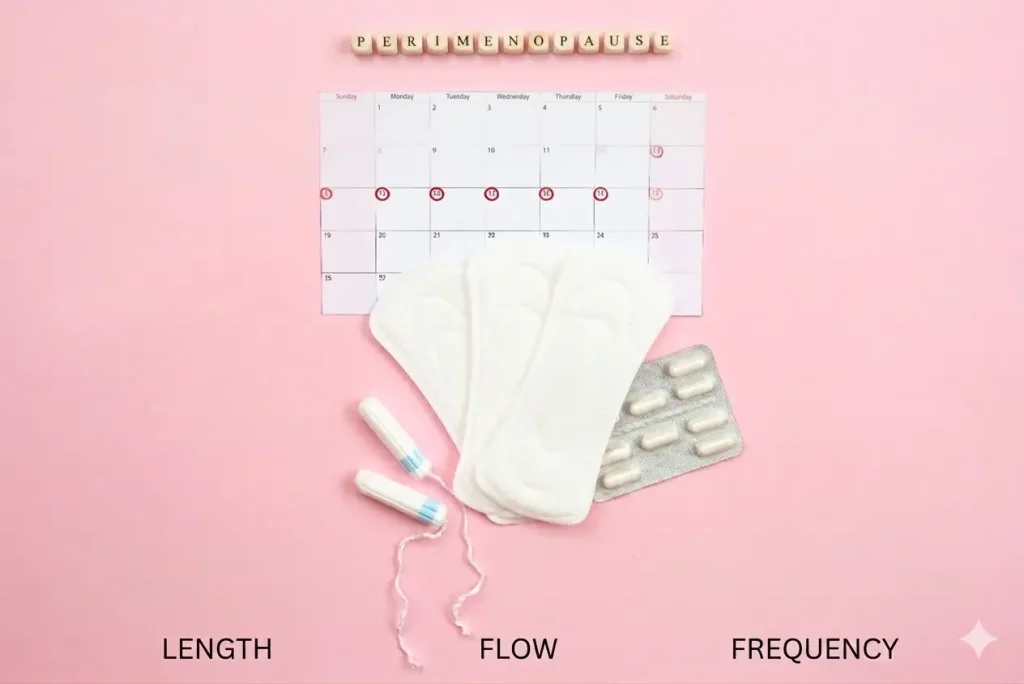
There comes a stage when your once-predictable periods begin to feel unfamiliar.
A cycle that used to arrive every month on time may suddenly show up a week early. Bleeding that lasted four days may now stretch longer. Some months feel heavier than usual, while others are so light that you barely need protection.
For many women in their late 30s and 40s, this is often the first noticeable sign of perimenopause.
And with these shifts comes one very common question: What is still considered a normal period cycle, and when does it become irregular?
This confusion happens because perimenopause does not stop menstruation overnight. Your body continues to have periods, but the pattern starts changing as hormone levels become less stable.
The reassuring part is that many of these menstrual changes are expected. But that does not mean every change should be ignored.
Understanding what a normal period cycle looks like during perimenopause can help you tell the difference between natural hormonal fluctuation and signs that may need medical attention.
What Is Considered a Normal Period Cycle?
A menstrual cycle is counted from the first day of one period to the first day of the next. While many women grow up hearing that a 28-day cycle is “ideal,” that is not the only healthy pattern.
A normal period cycle can vary from woman to woman.
In general, a normal cycle includes:
| Menstrual Feature | Normal Range |
|---|---|
| Cycle length | 24 to 38 days |
| Bleeding duration | 4 to 8 days |
| Cycle variation | A few days of difference month to month |
| Flow amount | Light to moderate without excessive flooding |
So if your periods are not exactly 28 days apart, that does not automatically make them abnormal.
The key is whether your body is following a somewhat consistent rhythm.
During the reproductive years, hormones usually work in a predictable monthly pattern. Estrogen rises, ovulation happens, progesterone follows, and menstruation begins.
In perimenopause, this hormonal pattern becomes less reliable, which is why the normal period cycle may start looking different than it did a decade ago.
Why Does the Normal Period Cycle Change During Perimenopause?
Perimenopause is the transition phase leading up to menopause, and it can begin several years before periods stop completely.
During this time, the ovaries do not release hormones as steadily as before.
Some months ovulation may happen late. Some months it may not happen properly at all. Estrogen may rise unpredictably, while progesterone may not increase enough to balance it.
This hormonal inconsistency directly affects:
- when your period starts,
- how long it lasts,
- how heavy it becomes,
- and whether you skip a month.
This is why many women suddenly notice that the cycle they have known for years no longer feels dependable.
Your body is still menstruating, but it is no longer following the same monthly hormonal rhythm.
Common Changes in the Normal Period Cycle During Perimenopause
The phrase “normal period cycle” during perimenopause can feel confusing because normal no longer means identical every month.
Instead, it means understanding which changes are commonly seen during this transition.
1. Your Cycle May Become Shorter
One of the earliest changes many women notice is getting periods sooner than expected.
A cycle that was once every 28 to 30 days may begin arriving every 21 to 24 days.
This can happen because ovulation timing becomes inconsistent, shortening the gap between periods.
Many women assume this means something is wrong, but in early perimenopause, shorter cycles are often one of the first menstrual changes.
2. Your Periods May Start Coming Further Apart
As perimenopause progresses, the opposite can also happen.
You may suddenly notice:
- a 35-day cycle,
- a 40-day cycle,
- or a skipped month.
This usually reflects the fact that the ovaries are no longer ovulating regularly.
A delayed period in your 40s does not always mean pregnancy or illness. Sometimes it simply means the body is entering a different reproductive stage.
However, periods may still return after long gaps, which is why this phase often feels so unpredictable.
3. Flow May Become Heavier or Much Lighter
Hormonal changes do not only affect timing. They also affect how much you bleed.
Some women notice periods becoming significantly heavier than before, with clots and prolonged bleeding.
Others experience the opposite — very light bleeding that barely resembles their old pattern.
This happens because the uterine lining is no longer building and shedding in the same organized way every month.
One month may feel intense. The next may feel minimal.
That inconsistency is one of the hallmarks of perimenopause.
4. Bleeding Days May Last Longer Than Usual
A woman who always had a neat four-day period may suddenly bleed for seven days.
Some may also experience:
- a day or two of spotting,
- followed by several days of proper flow,
- ending with brown discharge that lingers.
Occasional longer bleeding can happen during this stage because hormone shifts change how the uterine lining sheds.
What matters is whether this is occasional variation or a persistent exhausting pattern.
Common Perimenopause Changes vs Period Changes That Need Attention
| Common Perimenopause Changes | Changes That Should Be Evaluated |
|---|---|
| Periods arrive earlier or later occasionally | Periods repeatedly less than 21 days apart |
| One skipped month now and then | Very long gaps followed by extremely heavy bleeding |
| Flow changes from heavy to light between months | Soaking through pads every hour |
| Bleeding lasts up to a week occasionally | Bleeding beyond 8 to 10 days regularly |
| Mild spotting before a period | Frequent spotting between periods or after intercourse |
This distinction matters because women are often told that “irregular periods are normal in perimenopause,” but no one explains where the line should be drawn.
Yes, change is expected.
But severe or persistent abnormal bleeding should never be brushed aside as just age.
What Actually Counts as an Irregular Period in Perimenopause?
An irregular period is not simply a period that feels different from your old routine.
Doctors usually become concerned when the menstrual changes move outside broad normal limits or begin affecting your health significantly.
According to gynecological guidance, bleeding between periods, very heavy menstrual flow, or bleeding that lasts longer than usual should not be dismissed as a routine age-related change and may need proper evaluation.
This includes:
- periods coming too frequently,
- very long delays followed by flooding,
- bleeding lasting well over a week,
- very large clots,
- frequent spotting between cycles,
- bleeding after sex.
Sometimes women assume every period problem after 40 must be hormonal.
That is not always true.
Fibroids, uterine polyps, thyroid imbalance, endometrial thickening, and anemia can also contribute to abnormal bleeding.
This is why observing the pattern matters more than dismissing every change as “just perimenopause.”
How to Tell If Your Period Changes Are Still Within the Normal Period Cycle Range
One of the most useful things you can do during perimenopause is start tracking your periods instead of relying on memory.
Keep note of:
The date your period starts
How many days bleeding lasts
Whether the flow is light, moderate, or heavy
Spotting, clots, severe cramps, or skipped cycles
Do this for at least three to four months.
You will often begin to notice that what feels random actually follows a pattern:
- shorter cycles for a few months,
- then one delayed cycle,
- alternating heavy and light bleeding,
- or prolonged PMS before periods.
This information also makes it easier for a doctor to understand whether your normal period cycle is simply changing or becoming medically irregular.
When Should You See a Doctor for Period Changes?
Not every unusual cycle needs panic.
But certain symptoms deserve proper evaluation.
Please speak to a doctor if:
- you are soaking through a pad every hour,
- bleeding lasts beyond 8 to 10 days often,
- you feel weak or dizzy during periods,
- you pass very large clots,
- spotting happens frequently between periods,
- or bleeding occurs after intercourse.
Perimenopause may explain many changes, but it should not become a blanket excuse for ignoring excessive blood loss or persistent menstrual disruption.
The Bottom Line
A normal period cycle in perimenopause is often not the same normal period cycle you had in your 20s or early 30s.
Your periods may become shorter, further apart, heavier, lighter, or simply harder to predict because the ovaries are no longer releasing hormones in a perfectly steady pattern.
Many of these shifts are a natural part of the menopause transition.
But natural does not mean you should stay confused.
Knowing what kinds of cycle changes are expected — and which ones cross into irregular territory — helps you respond with awareness instead of anxiety.
Your period may be changing, but your understanding of it should become clearer, not more uncertain.
FAQs
Yes, many women notice their periods arriving earlier than usual in early perimenopause. A cycle that shortens to around 21 to 24 days can happen because ovulation becomes less predictable. Occasional shorter cycles are common, but if periods become too frequent with very heavy bleeding, a medical check is advisable.
Yes, sudden heavy bleeding is one of the most commonly reported menstrual changes during perimenopause. Hormone fluctuations can make the uterine lining build up differently each month, leading to heavier shedding. While occasional heavy flow can happen, extremely excessive bleeding should not be ignored.
Yes, skipped periods can happen because the ovaries may not ovulate regularly every month. You may miss one cycle and then get a normal or heavy period later. This is common during the menopause transition, although menopause itself is only confirmed after twelve consecutive months without periods.
Periods may last slightly longer than they used to, sometimes stretching to seven or eight days. Some women also notice spotting before or after the main flow. Occasional longer bleeding can be part of perimenopause, but consistently prolonged periods should be assessed.
Irregular bleeding should be evaluated if you are soaking pads very quickly, bleeding for more than a week repeatedly, passing large clots, spotting frequently between periods, or bleeding after intercourse. These signs may still be hormonal, but they can also point to other uterine or hormonal conditions that need attention.