
If you’re in your 40s and your periods have started to feel… different, you’re not imagining it.
Heavier flow. Longer cycles. Sudden clots.
That quiet exhaustion that lingers longer than it used to. This experience has a name: perimenopausal menorrhagia and it’s far more common than most women are told.
What’s often dismissed as “just hormones” can quietly affect your iron levels, energy, mental clarity, and overall quality of life. And yet, many women normalize it for far too long.
This guide is here to change that.
We’re going to unpack what’s actually happening inside your body, what science says about perimenopausal menorrhagia, and most importantly; what you can do about it.
Perimenopausal menorrhagia refers to abnormally heavy or prolonged menstrual bleeding during perimenopause, the transitional phase before menopause.
Clinically, heavy menstrual bleeding is defined as:
Blood loss greater than 80 ml per cycle
Periods lasting longer than 7 days
Needing to change protection every 1–2 hours
But let’s be honest, most women don’t measure blood loss in milliliters.
Instead, you might notice:
Soaking through pads or tampons quickly
Passing large clots
Feeling unusually fatigued after your cycle
Periods that disrupt daily life
Perimenopause is not a steady decline, it’s hormonal chaos before stability.
| Hormone | What Changes | Impact on Periods |
|---|---|---|
| Estrogen | Fluctuates unpredictably | Thickens uterine lining |
| Progesterone | Often decreases | Less control over shedding |
| FSH (Follicle Stimulating Hormone) | Increases | Irregular ovulation |
👉 Result: The uterine lining builds up more than usual and when it sheds, bleeding becomes heavier and longer.
Studies show that up to 30% of women in perimenopause experience heavy menstrual bleeding
Research highlights hormonal imbalance as the primary driver of menorrhagia in women aged 40–50
Indian clinical data suggests heavy periods are among the top 3 gynecological concerns in midlife women
This isn’t rare. It’s under-discussed.
(Healthline).
While perimenopausal menorrhagia is often hormonal, it can sometimes signal underlying conditions.
| Condition | What It Does |
|---|---|
| Fibroids | Non-cancerous growths causing heavy flow |
| Adenomyosis | Thickened uterine walls |
| Polyps | Tissue growth leading to irregular bleeding |
| Thyroid Disorders | Hormonal imbalance affecting cycles |
| Endometrial Hyperplasia | Excess uterine lining growth |
👉 This is why persistent heavy bleeding should never be ignored.
(Cleveland Clinic).
Heavy periods are not just inconvenient, they are physiologically draining.
Iron deficiency anaemia
Chronic fatigue
Brain fog and reduced focus
Mood swings and irritability
Lower productivity and quality of life
A 2020 study found that women with heavy menstrual bleeding report significantly reduced daily functioning and mental well-being.
There is no one-size-fits-all solution. But the most effective approach is layered and intentional.
Heavy bleeding depletes nutrients faster than you realize.
Key nutrients to prioritize:
Iron (to prevent anaemia)
Magnesium (for muscle relaxation and cramps)
Vitamin D3 (hormonal support)
Omega-3s (anti-inflammatory effect)
Certain botanicals have shown consistent benefits in managing hormonal imbalance.
| Ingredient | Benefit |
|---|---|
| Ashwagandha | Reduces stress-driven hormonal disruption |
| Shatavari | Supports estrogen balance |
| Lodhra | Traditionally used for heavy bleeding |
| Evening Primrose | Helps regulate cycles |
These are not quick fixes but when used consistently, they support long-term balance.
For severe cases, medical support becomes essential.
Options may include:
Tranexamic acid (to reduce bleeding)
Hormonal therapy
IUDs for localized hormone delivery
Surgical options in extreme cases
👉 The goal is not to jump to intervention, but to know when it’s needed.
(NIH).
This is where thoughtfully designed supplements can play a meaningful role, not as magic pills, but as structured support systems.
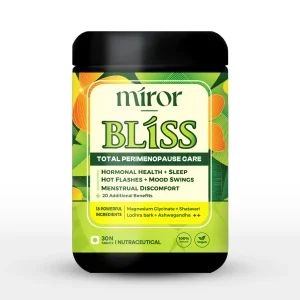
For example, formulations like Miror Bliss are designed specifically for women in their 40s navigating perimenopause.
Instead of isolated ingredients, they combine:
Adaptogens for stress regulation
Hormone-supportive herbs like Shatavari
Nutrients that support sleep, mood, and cycle balance
The intention is simple: Support the body’s natural rhythm instead of overriding it.
And that distinction matters.
| Approach | Short-Term Relief | Long-Term Balance |
|---|---|---|
| Painkillers | Yes | No |
| Hormonal Pills | Yes | Variable |
| Nutritional + Herbal Support | Moderate | Strong |
| Combined Approach | Best | Best |
You don’t need to wait until it gets unbearable.
Bleeding lasting more than 7–8 days
Large clots frequently
Severe fatigue or dizziness
Periods interfering with daily life
Sudden change in bleeding pattern
Early action is not overreaction, it’s self-respect.
(NWH).
Heavy periods can feel isolating.
You plan your day around your cycle. You carry extra supplies everywhere. You quietly push through exhaustion. And because it’s “common,” it rarely gets the attention it deserves.
But common does not mean normal.
And it certainly does not mean you have to tolerate it.
Perimenopausal menorrhagia is not a minor inconvenience—it’s a signal.
A signal that your body is transitioning.
A signal that your hormonal rhythm needs support.
A signal that deserves attention, not dismissal.
The good news?
With the right combination of awareness, science-backed support, and timely care, this phase can feel far more manageable and far less overwhelming.
And that shift, from confusion to clarity; is where real empowerment begins.
Perimenopausal menorrhagia refers to heavy or prolonged menstrual bleeding during perimenopause, typically caused by hormonal imbalance. Fluctuating estrogen levels and declining progesterone can lead to excessive thickening of the uterine lining, resulting in heavier, longer periods.
Heavy periods in your 40s are common but not always normal. While hormonal changes during perimenopause can cause heavier bleeding, persistent or extreme bleeding may indicate conditions like fibroids, adenomyosis, or thyroid disorders and should be evaluated by a doctor.
The most common causes of perimenopausal menorrhagia include hormonal imbalance, uterine fibroids, polyps, adenomyosis, and thyroid dysfunction. In some cases, thickening of the uterine lining or endometrial changes may also contribute to heavy bleeding.
Managing heavy periods naturally involves a combination of iron-rich nutrition, stress regulation, and herbal support like ashwagandha and shatavari. Supplements designed for perimenopause can also help support hormonal balance, reduce fatigue, and improve overall cycle health.
You should consult a doctor if your bleeding lasts more than 7 days, includes large clots, requires frequent pad changes, or causes fatigue and dizziness. Sudden changes in your menstrual pattern during perimenopause should always be checked to rule out underlying conditions.


 ×
×