

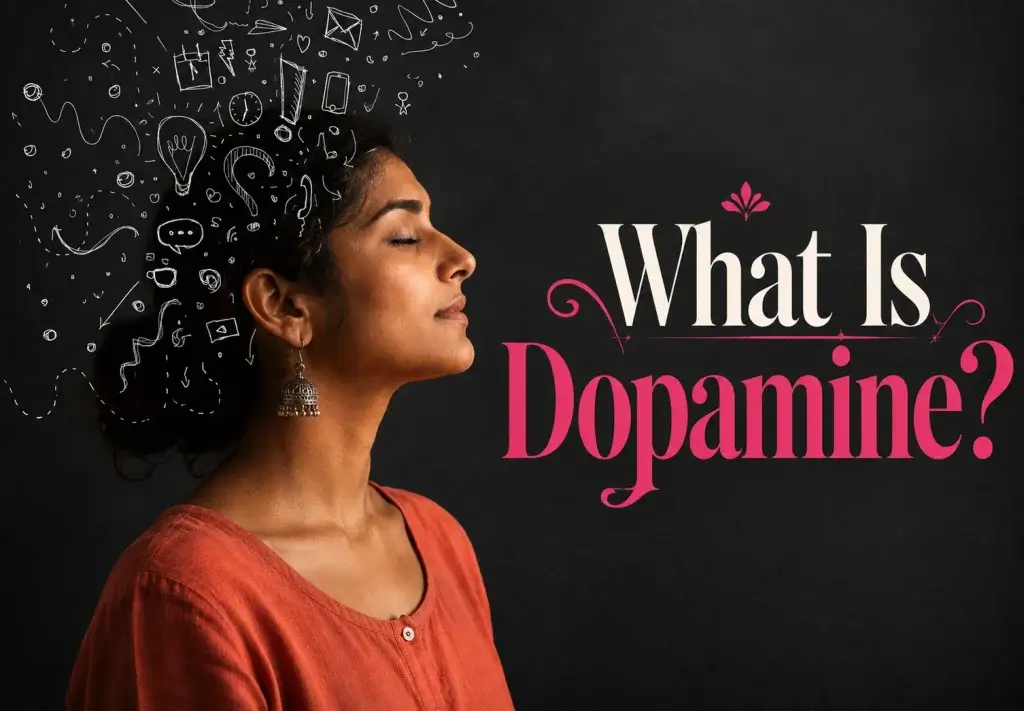
There is a particular kind of exhaustion that does not show up on any lab report.
You are not depressed. You are not sick. You are doing everything right, on paper. And yet something vital feels switched off. The things that once excited you feel strangely flat. Starting a task requires enormous effort. Even good news lands without the spark it used to.
Women in their 30s, 40s, and 50s describe this constantly. And almost universally, they blame themselves.
“What nobody tells you is that this isn’t a character flaw. It may be a dopamine story, one rooted in biology, hormones, and the specific pressures that accumulate in a woman’s life over decades.”
Dopamine is one of the most searched topics in neuroscience today, with global search volumes exceeding 110,000 monthly queries and yet most of what women read about it is either oversimplified or written without them in mind. This guide changes that.
What Is Dopamine, Really?
Dopamine is a neurotransmitter; a chemical messenger your brain uses to send signals between nerve cells. It is produced primarily in two key areas: the substantia nigra (linked to movement and motor control) and the ventral tegmental area (VTA), which drives motivation, reward, and emotional processing.
Despite decades of being labeled the “feel-good chemical,” dopamine is far more nuanced than that. The more accurate framing, supported by contemporary neuroscience, is this: dopamine is the molecule of wanting, not just having.
It does not simply flood your brain when something feels good. It activates before the reward, in the anticipation, the pursuit, the reaching. This is why dopamine governs motivation, curiosity, drive, focus, and the will to engage with life itself.
Dopamine does not work in isolation. It is tightly woven into your hormonal ecosystem — which is precisely why women’s relationship with dopamine is uniquely complex, and uniquely overlooked.
(Cleveland Clinic).
What Does Dopamine Actually Do in the Female Body?
Think of dopamine as the brain’s engine. It does not just make you feel pleasure; it makes you move toward pleasure. It initiates. It energizes. It remembers what is worth pursuing and encodes that memory so you will pursue it again.
Dopamine’s Core Functions:
- Motivation and initiative — the force that makes you begin rather than postpone
- Reward processing and learning — signals when an action is worth repeating
- Focus and attention regulation — enables sustained, directed cognitive effort
- Emotional resilience — buffers against stress and negative mood states
- Movement and motor coordination — explains why Parkinson’s, a dopamine-loss disease, affects movement
- Sexual desire and libido — drives anticipation and interest in intimacy
- Working memory — holds and manipulates information in the short term
Research confirmed that optimal dopamine signaling in the prefrontal cortex is essential for working memory and executive function, the cognitive tools you rely on every single day.
When dopamine signaling weakens, the impact is felt across all of these domains simultaneously. That is why low dopamine rarely announces itself as one clear symptom. It is a constellation of subtle shifts that women tend to attribute to stress, aging, or simply “not trying hard enough.”
(Harvard Health).
5 Powerful Truths About Dopamine in Women
Truth 1: Dopamine Is Not Happiness. It Is Drive.
The conflation of dopamine with happiness has done real harm. When women feel unmotivated, flat, or disengaged, they often assume they must be depressed or anxious. Sometimes that is true. But sometimes the more precise explanation is a dopamine system under strain.
Low-dopamine states feel less like sadness and more like a quiet dimming: tasks that once felt stimulating feel heavy; activities that once brought pleasure feel neutral; the future feels less exciting than it used to. Neuroscientist Dr. Anna Lembke at Stanford describes this as anhedonia — the inability to feel pleasure; which is distinct from depression but can coexist with it.
| What women often say | What may actually be happening | Dopamine connection |
|---|---|---|
| “I have no motivation” | Reduced drive signals from the VTA pathway | Low mesolimbic dopamine activity |
| “Nothing excites me anymore” | Blunted reward anticipation | Decreased D2 receptor sensitivity |
| “I can’t focus like I used to” | Reduced prefrontal dopamine support | Mesocortical pathway underactivity |
| “My libido has disappeared” | Reduced anticipatory desire circuitry | Dopamine-oxytocin interaction disrupted |
| “I crave sugar constantly” | Brain seeking quick dopamine hits | Dysregulated reward threshold |
Truth 2: Estrogen and Dopamine Are Deeply Interdependent.
This is the truth most healthcare conversations leave out entirely.
Estrogen is not only a reproductive hormone. It is a potent neurochemical modulator. Research published in Frontiers in Aging Neuroscience (Shanmugan & Epperson, 2014) demonstrated that estrogen upregulates dopamine synthesis, increases dopamine receptor sensitivity, and slows the breakdown of dopamine in key brain regions — including those governing mood, cognition, and reward.
When estrogen fluctuates as it does in perimenopause, postpartum recovery, and menopause; dopamine signaling does not remain unaffected. The two systems are so intertwined that fluctuating estrogen directly alters how efficiently your brain makes, uses, and recycles dopamine.
This is the neurochemical backdrop against which millions of women in their 40s and 50s are experiencing what they describe as brain fog, emotional flatness, and a puzzling loss of ambition and receiving little explanation.
Truth 3: Chronic Stress Quietly Exhausts the Dopamine System.
Women carry an extraordinary load. Career, caregiving, family expectations, social performance, often simultaneously and without adequate support. Chronic psychological stress activates the hypothalamic-pituitary-adrenal (HPA) axis, flooding the body with cortisol.
Studies in Neuron (Bhatt et al., 2020) have shown that sustained cortisol elevation directly downregulates dopamine receptor expression in the prefrontal cortex and limbic system. The brain, overwhelmed by threat-mode signaling, literally reduces its capacity to feel rewarded.
The result is a paradox familiar to many women: the harder you push, the less satisfying the results feel. Burnout is not only emotional. It is neurochemical.
Truth 4: Dopamine Naturally Declines with Age But Not Inevitably.
PET imaging studies, including landmark research by Wong et al. published in Science, have shown that dopamine receptor density in the striatum declines by approximately 10–13% per decade after age 30. Dopamine synthesis capacity also decreases gradually.
The critical point: decline does not mean depletion. Lifestyle, nutrition, sleep, and hormonal support all meaningfully influence how a woman’s dopamine system ages. The trajectory is not fixed.
Truth 5: Modern Life Is Engineered to Hijack Dopamine and Women Bear the Greatest Cost.
Smartphones. Notification loops. Ultra-processed food. Infinite scroll. Each of these triggers rapid, shallow dopamine bursts that gradually reset the brain’s reward threshold upward, making ordinary life feel increasingly unstimulating by comparison.
Research from the Journal of Psychiatric Research has linked excessive social media use in women over 35 to measurable reductions in intrinsic motivation and sustained attention, both hallmarks of dopamine depletion. The reward system becomes conditioned to instant, high-intensity stimulation, making slow pleasures (reading, creativity, nature, connection) feel increasingly unrewarding.
This is not a discipline problem. It is a biology problem — and naming it accurately is the first step.
(Ubie).
Signs Your Dopamine May Be Struggling
| Area of life | What women notice | Possible dopamine signal |
|---|---|---|
| Mental energy | “I feel foggy, flat, and slow” | Reduced prefrontal dopamine tone |
| Motivation | “Starting things feels impossible” | Low initiation signals from dopamine circuits |
| Pleasure | “Things I loved feel boring” | Blunted reward anticipation |
| Cravings | “I reach for sugar, screens, caffeine constantly” | Brain seeking quick dopamine stimulation |
| Sleep | “I am exhausted but can’t rest” | Disrupted circadian-dopamine interaction |
| Intimacy | “I have no desire for closeness” | Reduced anticipatory dopamine for intimacy |
| Emotional tone | “Everything feels a bit grey” | Mesolimbic pathway underactivation |
These patterns overlap with depression, thyroid disorders, iron deficiency anemia, ADHD, and sleep disorders — all of which are far more common in women and frequently underdiagnosed. A thorough clinical evaluation matters deeply. None of this is self-diagnosis. It is the beginning of a more informed conversation with your doctor.
How to Genuinely Support Healthy Dopamine, Without Gimmicks
The internet will sell you a dopamine “hack” every 30 seconds. What science actually supports is slower, more biological, and far more sustainable.
Evidence-Backed Dopamine Support Strategies:
- Protein at every meal — Dopamine is synthesized from the amino acid tyrosine, found in eggs, lentils, paneer, seeds, and lean meats. Without adequate dietary protein, synthesis is compromised.
- Morning sunlight exposure — Light exposure in the first hour after waking supports circadian rhythm, which directly regulates dopamine receptor cycling. Even 10–15 minutes makes a measurable difference.
- Resistance and aerobic exercise — A 2021 meta-analysis in Neuroscience & Biobehavioral Reviews confirmed that both forms of physical activity upregulate dopamine receptor density and synthesis in the striatum.
- Sleep protection — Sleep is when the brain replenishes neurotransmitter stores. Perimenopause-related insomnia is not simply fatigue — it is a direct drain on dopamine recovery.
- Meaningful social connection — Social bonding activates the same dopaminergic reward pathways as food and novelty. Community is not optional. It is neurologically essential.
- Micronutrient sufficiency — Iron, magnesium, B6, and folate are all essential cofactors in dopamine synthesis. Deficiency silently undermines production.
- Dopamine fasting from overstimulation — Intentional breaks from screens, social media, and ultra-processed food allow the reward threshold to normalize, making natural pleasures feel rewarding again.
A More Honest Way to Understand This
Women are rarely taught the neuroscience of their own emotional experience. They are taught to push through, to be grateful, to question whether what they feel is “real enough” to mention to a doctor.
But understanding dopamine does not mean pathologizing ordinary life. It means having a more accurate map of what is happening inside you; one that replaces self-blame with scientific curiosity.
“Emotional flatness is not weakness. Reduced motivation is not laziness. Sometimes the brain is not failing – it is depleted. And depletion deserves support, not judgment.”
The neuroscience of dopamine in women is still evolving. Much of the foundational research has been conducted on male subjects, a gap that researchers are actively working to address. The conversation is changing and women deserve to be part of it.
FAQs
Low dopamine in women may show up as low motivation, brain fog, fatigue, emotional flatness, reduced pleasure, sugar cravings, poor focus, low libido, and difficulty starting tasks. Many women describe it as feeling “switched off” or emotionally disconnected despite functioning normally on the outside.
Dopamine in women is closely linked to estrogen and hormonal health. Fluctuations in estrogen during PMS, postpartum recovery, perimenopause, and menopause can directly impact dopamine production, receptor sensitivity, mood, focus, motivation, and emotional resilience.
Yes. Research suggests that declining estrogen levels during perimenopause and menopause can affect dopamine signaling in the brain. This may contribute to symptoms like brain fog, low motivation, emotional flatness, poor concentration, fatigue, and reduced libido.
Several factors can impact dopamine levels, including chronic stress, poor sleep, aging, hormonal fluctuations, nutrient deficiencies, lack of physical activity, excessive social media stimulation, and long-term burnout.
Yes. Dopamine plays a key role in executive function, focus, working memory, reward processing, and motivation. Reduced dopamine activity may make it harder to concentrate, initiate tasks, feel excited, or sustain mental energy.