

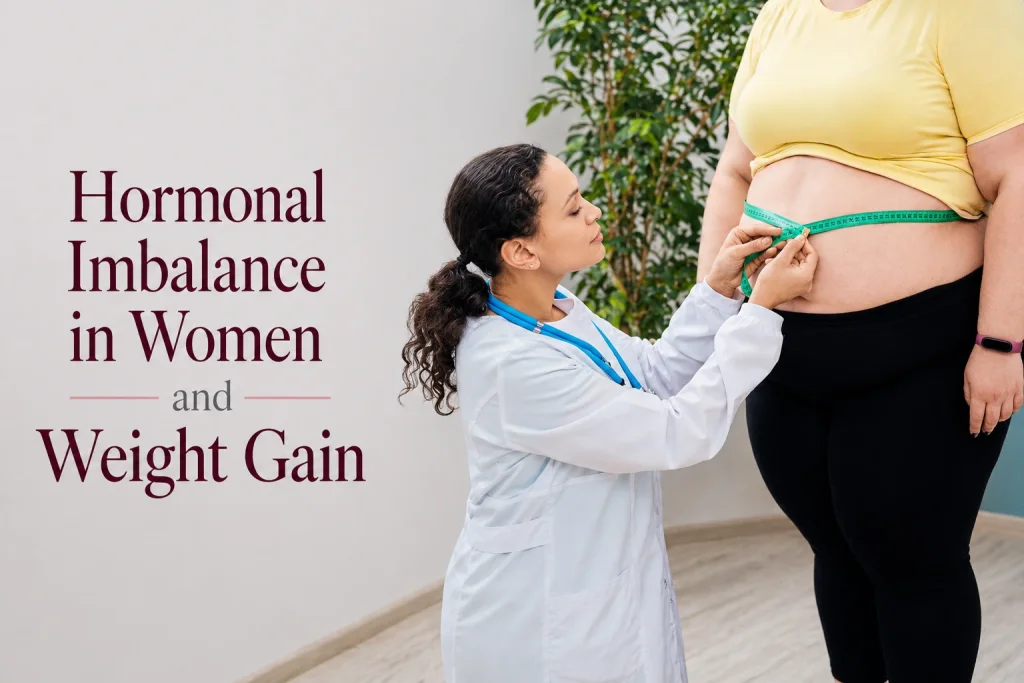
There is a particular kind of weight gain that doesn’t respond to effort.
You eat carefully. You move your body. You try to stay consistent. And yet, something feels… resistant. Almost as if your body is working against you.
This is often where hormonal imbalance quietly enters the conversation.
Not dramatically. Not obviously. But persistently.
For many women, especially in their late 30s, 40s, and beyond, weight gain is not simply about calories. It is about signals—chemical, biological, deeply internal signals that shape how the body stores, uses, and protects energy.
And when those signals shift, the body begins to behave differently.
This is not failure. It is physiology.
What Hormonal Imbalance Really Means in the Body
The term hormonal imbalance is often used casually, but in reality, it reflects a complex interplay between multiple systems:
Estrogen and progesterone
Insulin regulation
Cortisol and stress response
Thyroid function
Leptin and appetite signalling
Research published in UCLA Health highlights that even subtle hormonal fluctuations can significantly affect fat distribution, metabolic rate, and appetite control.
So when weight gain feels unexplained, it is rarely random.
It is patterned.
5 Powerful Signs Your Body Is Storing Fat for Hormonal Reasons
1. Weight Gain Is Concentrated Around the Abdomen
This is one of the most telling signs.
If fat accumulation has shifted toward the midsection, it is often linked to:
Lower estrogen levels
Increased insulin resistance
Elevated cortisol
Studies show that visceral fat, the kind stored around abdominal organs, is strongly associated with hormonal changes rather than lifestyle alone.
It is not just where fat appears.
It is why it appears there.
2. You Feel Hungrier, But Not Truly Satisfied
Hormonal imbalance can disrupt leptin and ghrelin, the hormones that regulate hunger and fullness.
You may notice:
Frequent cravings, especially for sugar or refined carbs
Eating enough, yet feeling unsatisfied
Energy crashes after meals
This is not a lack of willpower.
It is a shift in how your body interprets hunger signals.
3. Fatigue Feels Constant, Not Situational
When weight gain is hormonally driven, fatigue often accompanies it.
This may be linked to:
Thyroid hormone fluctuations
Blood sugar instability
Chronic cortisol elevation
Studies suggest that metabolic fatigue is closely tied to hormonal dysregulation, particularly in midlife women.
The body conserves energy when it feels uncertain.
And fat storage becomes part of that conservation.
4. Your Weight Does Not Respond to Dieting the Way It Used To
What worked in your 20s or early 30s may no longer work.
This is often where frustration peaks.
Hormonal imbalance can:
Slow down basal metabolic rate
Reduce muscle mass efficiency
Increase fat storage signals
The body becomes more protective, not more responsive.
It is not resisting you.
It is adapting to a different hormonal environment.
5. You Experience Other Subtle Hormonal Symptoms
Weight gain rarely exists in isolation.
It often appears alongside:
Irregular menstrual cycles
Mood fluctuations
Poor sleep quality
Skin changes or hair thinning
These are not separate issues. They are interconnected signals.
(MNT).
How Different Hormones Influence Fat Storage
To make this clearer, here is a simplified view:
| Hormone | What It Does | Impact on Weight |
|---|---|---|
| Estrogen | Regulates fat distribution | Lower levels increase abdominal fat |
| Insulin | Controls blood sugar | Resistance leads to fat storage |
| Cortisol | Manages stress response | High levels promote belly fat |
| Thyroid hormones | Control metabolism | Low function slows calorie burning |
| Leptin | Signals fullness | Resistance leads to overeating |
This is why hormonal imbalance cannot be addressed with a single solution.
It requires a more integrated approach.
A More Nuanced Way to Approach Weight Gain
If weight gain is hormonally influenced, the solution is not restriction.
It is alignment.
A few shifts that are consistently supported by research:
1. Prioritising Protein and Blood Sugar Stability:
Balanced meals help regulate insulin and reduce fat storage signals.
2. Strength Training Over Excessive Cardio:
Muscle mass supports metabolic health and improves hormonal sensitivity.
3. Sleep as a Metabolic Tool:
Poor sleep increases cortisol and disrupts appetite hormones.
4. Stress Regulation:
Chronic stress keeps the body in a fat-storing state.
5. Gentle Consistency Over Extremes:
The body responds better to stability than to sudden, aggressive changes.
(Brown Health University).
Why This Conversation Needs to Change
For too long, weight gain in women has been framed as a behavioural issue.
Eat less. Move more. But science tells a more sophisticated story.
Hormonal imbalance shapes how the body:
Stores fat
Uses energy
Signals hunger
Protects itself
And when we begin to understand this, something shifts.
The narrative softens.
The blame dissolves.
The approach becomes more intelligent.
A Miror Perspective
At Miror, we see this pattern often.
Women who are doing everything “right,” yet feeling disconnected from their own bodies.
What they need is not more discipline. They need clarity.
When you understand whether your weight gain is hormonally driven, your next steps become more precise, more effective, and far less overwhelming.
Final Thought
Hormonal imbalance does not announce itself loudly.
It shows up quietly.
In patterns.
In shifts that feel subtle, until they are not.
But once you learn to recognise these signs, you stop fighting your body. And start working with it.
FAQs
Yes, hormonal imbalance can lead to weight gain in women. Changes in hormones like estrogen, progesterone, insulin, and cortisol can affect metabolism, increase fat storage, and make weight loss more difficult, especially during perimenopause and menopause.
Common signs of hormonal weight gain include increased belly fat, unexplained weight gain despite no major lifestyle changes, fatigue, sugar cravings, irregular periods, and difficulty losing weight even with diet and exercise.
Hormonal imbalance affects how the body stores fat. Lower estrogen levels and higher cortisol or insulin levels can shift fat storage toward the abdomen, leading to increased belly fat in women, particularly during midlife.
Key hormones linked to weight gain include estrogen, progesterone, insulin, cortisol, and thyroid hormones. Imbalances in these can slow metabolism, increase appetite, and promote fat storage.
Managing hormonal imbalance and weight gain involves balanced nutrition, regular physical activity, stress management, quality sleep, and, in some cases, medical support such as hormone therapy or guided supplementation.