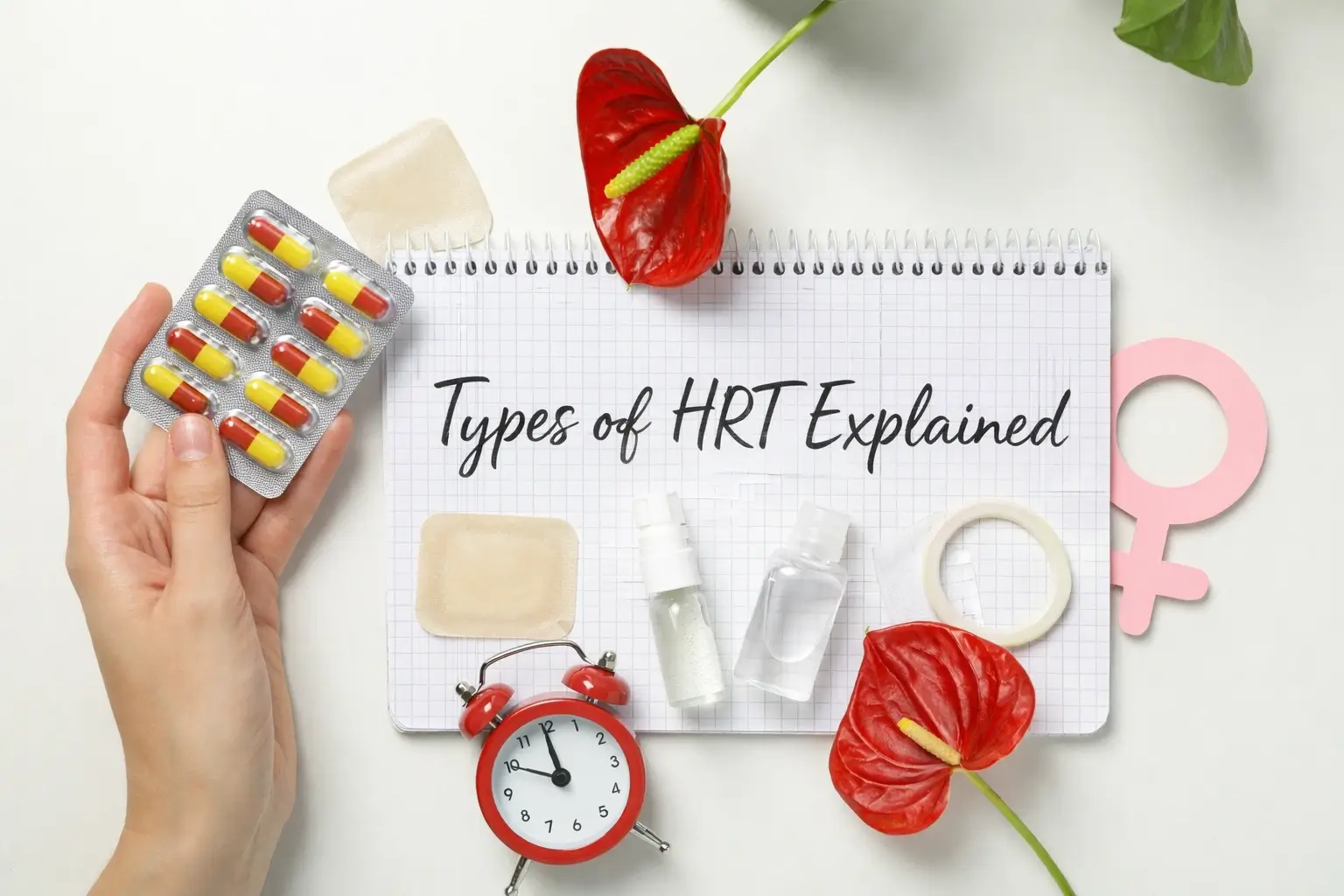


For decades, women entering midlife have searched for answers; often quietly, sometimes urgently, often alone. The hot flashes, sleep disruptions, mood shifts, unexpected anxiety, changing cycles, sudden skin sensitivity, the feeling that your body no longer behaves quite the way it used to. And somewhere in the swirl of confusion, one acronym appears again and again:
But on medical websites, in global menopause conferences, and in scientific literature, a more modern term is increasingly rising to the forefront:
Women who begin researching often ask the same question with a mix of curiosity and fatigue:
This is not just a semantic puzzle.
The shift in terminology reflects an important evolution in how we understand menopause, hormones, and women’s health. And like every meaningful shift, it deserves clarity.
This blog unravels the science, the language, the history, and the future of hormone therapy and helps you step into your next chapter informed, empowered, and beautifully aligned with your body.
For much of the 20th century and early 2000s, Hormone Replacement Therapy (HRT) was the universal term for any hormonal treatment designed to support women experiencing menopause symptoms.
HRT was built on a simple, almost intuitive idea: As hormones decline, symptoms appear. Replace the hormones, reduce the symptoms. And for millions of women, it often worked wonderfully.
But the language of replacement carried an unintentional and slightly misleading implication: that women moving into menopause were somehow “deficient,” and that the goal of therapy was to restore their hormones to youthful levels.
Advances in research revealed something more nuanced, more elegant, and far more aligned with the natural physiology of midlife.
As menopause science matured, expert bodies like the International Menopause Society (IMS), North American Menopause Society (NAMS), and European Menopause and Andropause Society (EMAS) began to refine how they described therapy.
They introduced a more precise, scientifically grounded term:
MHT: Menopausal Hormone Therapy
Unlike “HRT,” which implies we are replacing lost hormones, the term MHT recognises something essential:
A woman in menopause is not “missing” hormones.
She is transitioning into a new physiological state where her hormonal needs simply change.
MHT does not aim to recreate 25-year-old hormone levels.
It aims to support, supplement, smooth, and stabilise in harmony with the natural process of midlife change.
This is the heart of why the term has become the preferred choice in modern medical literature.
WA Menopause Clinic states: “MHT is used not to replace something missing, but to optimize health and well-being during and after menopause by treating symptoms and reducing long-term health risks like osteoporosis and heart disease.”
Here is the most important truth:
HRT and MHT often refer to the same therapies… but with very different philosophies.
Language in medicine is not just academic.
It shapes how women feel about their bodies, their choices, and their transitions.
The term HRT historically made women feel they were “losing” something or needed to be “fixed.” The term MHT reframes the conversation into one of empowerment: Menopause is not a failure. It is a natural, biologically intricate transition, one that can be supported with evidence-based hormonal care.
This shift in terminology helps remove stigma, fear, and misunderstanding. It brings compassion, precision, and dignity into the conversation.
Whether a woman calls it HRT or MHT, the therapy usually includes:
The primary support for hot flashes, sleep disturbances, vaginal dryness, mood changes, and bone protection.
Used for women who still have a uterus, to protect the endometrium.
Sometimes added in tiny physiological doses for libido, energy, and vitality but only when clinically indicated.
The core components are the same. What changes is how the therapy is conceptualised, communicated, and personalised. It is also important to note that local vaginal estrogen therapy, used for genitourinary syndrome of menopause (GSM), follows different safety considerations. Clinical evidence supports the use of low-dose vaginal estrogen even many years after menopause, including beyond ten years, when symptoms such as vaginal dryness, recurrent urinary infections, or discomfort persist.
Despite the accuracy of MHT, HRT continues to dominate everyday conversations for three reasons:
Women have heard “HRT” for decades; it feels known and accessible.
Most non-medical publications still use HRT.
Millions of women still Google “HRT,” making it a powerful SEO term.
This is why many menopause specialists use both terms interchangeably, even though MHT is the medically modern expression.
● Medical research journals
As science evolves, global use is gradually shifting toward MHT, but both terms remain correct.
The shift to MHT is not simply administrative or academic.
It reflects a deeper evolution in how medicine views women’s hormonal health.
Menopause was pathologised.
Symptoms were dismissed as inevitable or exaggerated.
Women were instructed to endure.
Menopause is recognized as a major physiological transition, one that influences:
● Emotional Wellbeing
And because this transition is so biologically complex, hormone therapy must be thoughtfully personalised. MHT captures this nuance. It signals a shift from “replacement” to support, from “fixing” to guiding, from dismissing to understanding.
Language shapes identity. When women hear “replacement,” some feel defective or lacking.
When they hear “menopausal hormone therapy,” the framing becomes softer, calmer, more respectful, and more aligned with the natural rhythm of midlife.
Women deserve terminology that supports dignity.
That acknowledges midlife as a stage of expansion, wisdom and renewal, not decline.
In practical terms:
The choice of term does not change what is prescribed.
But in conceptual terms:
The term MHT encourages a far more personalised, physiology-respecting approach to care.
Clinicians using the term MHT are often:
As research evolves, expect to see:
● Broader recognition of testosterone’s role for some women
The future of menopause care is personalised, data-driven, and deeply compassionate.
This shift toward personalised menopause care is also reflected in how clinical services are evolving. At Miror, this philosophy comes to life through our newly launched HRT Centre of Excellence — a dedicated initiative focused on evidence-based, individualised hormone therapy for women in India.
By combining specialist medical expertise, global menopause guidelines, and a deep understanding of Indian women’s midlife health needs, Miror’s HRT Centre of Excellence represents a move away from one-size-fits-all protocols toward truly personalised care.
When hormone therapy is discontinued, some women may experience a return of symptoms. Clinically, withdrawal symptoms tend to be more pronounced when both estrogen and progesterone are stopped together, compared to estrogen alone. This is why decisions around tapering, timing, and formulation should always be personalised and guided by a clinician experienced in menopause care.
Whether we call it HRT or MHT, hormone therapy is ultimately about something very human:
The language may evolve, the acronyms may shift, but the purpose remains the same: To support the woman you are, and the woman you are becoming.
They refer to the same family of hormonal therapies, but the philosophy behind the terminology differs. HRT emphasises “replacement,” while MHT reflects a more modern, menopause-specific, physiology-aligned approach. The treatments offered remain similar; the language simply brings more accuracy and nuance to how we understand midlife hormone support.
As research evolved, experts realised that menopause is not a disease or deficiency. Hormones are not being “replaced” but rather supplemented to ease the transition. The term MHT aligns more closely with modern science and honours menopause as a natural physiological stage, not a failure of the female body.
Because HRT has been part of public vocabulary for decades. Millions of women still search the term, and media outlets continue to use it for familiarity. In contrast, MHT is used more often in medical journals, guidelines, and expert conferences. Over time, public language may shift too.
Not at all. Clinicians understand that “HRT” is still the most widely recognised term among women. However, many specialists use MHT in consultations to help reframe menopause as a natural shift rather than a loss. You can use either term, your doctor will know exactly what you mean.
No. Duration is guided by your personal symptom pattern, health markers, comfort and preferences, not by whether the therapy is called HRT or MHT. Your clinician will reassess regularly, adjusting dosage or timing based on your evolving physiology and wellbeing.



 ×
×