

There is a phase in a woman’s life that often arrives quietly; without a diagnosis, without a ceremony, and without a clear explanation.
Your body feels different. Your sleep is lighter. Your emotions feel closer to the surface. Periods that once followed a rhythm begin to change. You may feel unlike yourself, yet unable to name why.
This phase is perimenopause. And for millions of women, it begins long before menopause is ever mentioned.
This guide is written by a woman, for women. It is science-backed, globally referenced, and grounded in compassion. Here, we will explore what perimenopause is, the age it typically begins, the symptoms that define it, and what you can realistically expect: physically, emotionally, and hormonally, so you can meet this transition informed rather than confused.
Perimenopause literally means “around menopause.” It is the transitional hormonal phase that precedes menopause, marked by fluctuating estrogen and progesterone levels.
During perimenopause, the ovaries do not stop functioning overnight. Instead, hormone production becomes erratic. Sometimes high, sometimes low, often unpredictable (Cleveland Clinic).
Menopause is diagnosed only after 12 consecutive months without a menstrual period. Perimenopause is everything that comes before that point and it can last several years.
This is not a disorder. It is a biological transition.
One of the most common misconceptions is that perimenopause begins in the late 40s. In reality, it often starts much earlier.
| Age Range | What May Happen |
|---|---|
| Late 30s | Subtle hormonal shifts, sleep or mood changes |
| Early–mid 40s | Cycle changes, PMS intensification |
| Late 40s | More noticeable symptoms, skipped periods |
| Early 50s | Transitioning toward menopause |
Globally, research suggests:
Average age of menopause: ~51 years
Average duration of perimenopause: 4–10 years
This means many women are in perimenopause while still menstruating regularly and often without realising it (John Hopkins Medicine).
Perimenopause symptoms vary widely, but they share one root cause: hormonal volatility.
Unlike menopause, which involves sustained low estrogen, perimenopause is defined by hormonal swings. This instability affects nearly every system in the body.
| Symptom | Why It Happens |
|---|---|
| Irregular periods | Inconsistent ovulation |
| Hot flashes & night sweats | Estrogen fluctuation affects temperature control |
| Sleep disturbances | Progesterone decline affects deep sleep |
| Mood changes & anxiety | Estrogen influences serotonin and dopamine |
| Brain fog | Hormonal effects on cognition |
| Fatigue | Metabolic and sleep disruption |
| Weight redistribution | Insulin sensitivity changes |
| Skin & hair changes | Reduced collagen and oil production |
| Vaginal dryness | Thinning of estrogen-dependent tissues |
Not every woman experiences all symptoms but no symptom is “random.”
(HealthDirect).
| Feature | Perimenopause | Menopause |
|---|---|---|
| Periods | Irregular, unpredictable | Fully stopped (12 months) |
| Hormones | Fluctuating | Consistently low |
| Pregnancy risk | Still possible | No longer possible |
| Duration | 4–10 years | Permanent stage |
Understanding this distinction matters—because care strategies differ at each stage (Piedmont Medical Center).
One of the least discussed, but most impactful effects of perimenopause is its influence on emotional well-being.
Estrogen interacts closely with neurotransmitters responsible for mood regulation. When estrogen rises and falls unpredictably, emotional resilience can feel compromised.
Women commonly report:
Increased irritability or emotional sensitivity
Heightened anxiety or low mood
Reduced stress tolerance
Feeling “not like myself”
These changes are physiological, not psychological weakness. Emotional health during perimenopause is hormonal health.
(ACOG).
Perimenopause is not limited to the reproductive system. Hormonal shifts affect:
Metabolism: Weight may redistribute, particularly around the abdomen
Muscles & joints: Increased stiffness or aches
Skin: Dryness, sensitivity, rashes, or new reactions
Hair: Increased shedding or texture changes
Energy levels: Slower recovery from stress or exertion
These changes often emerge gradually, and are frequently misattributed to aging alone
(Mayo Clinic).
Perimenopause is normal, but that does not mean women must suffer through it unsupported.
Support may include:
Lifestyle adjustments (sleep, nutrition, stress)
Targeted supplementation
Hormonal evaluation
Medical therapies, including HRT when appropriate
The goal is not to “fix” perimenopause—but to navigate it safely, comfortably, and informed. (Mayo Clinic).
Medical guidance is important if:
Symptoms interfere with daily life
Periods become extremely heavy or prolonged
Bleeding occurs between periods
Symptoms begin before age 40
Anxiety, low mood, or sleep disruption feels unmanageable
Early care can prevent long-term complications related to bone, heart, and metabolic health.
(Exon Publications).
At Miror, we believe perimenopause deserves the same clarity, respect, and intentional care as any other major health transition. This phase is not a breakdown, it is a recalibration. With the right education, support, and tools, perimenopause can become a period of self-awareness rather than self-doubt.
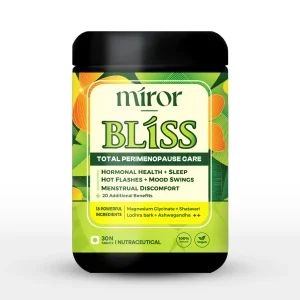
One of the ways we support women through this transition is with Miror Bliss, one of our most trusted and best-selling formulations—conceived and developed specifically for women navigating perimenopause. Miror Bliss is designed to support hormonal balance and nervous system calm, helping ease some of the most disruptive symptoms of this phase, including hot flashes, night sweats, sleep disturbances, mood swings, anxiety, and fatigue.
It also supports areas commonly affected during perimenopause such as bone and joint health, urinary health, cognition, metabolism, immunity, and overall vitality.
Miror Bliss is powered by 18+ carefully selected ingredients, bringing together evidence-backed botanicals and nutrients such as black cohosh, soy isoflavones, shatavari, ashwagandha, magnesium glycinate, calcium, vitamin D3, vitamin B12, CoQ10, pine bark extract, evening primrose oil, zinc, selenium, and iron.
These ingredients work synergistically to calm hot flashes, support restorative sleep, stabilise mood, reduce muscle tension, support libido and reproductive health, and promote long-term resilience from bones and joints to brain and immune health.
Alongside targeted formulations, Miror is also pioneering India’s first HRT Centre of Excellence: a landmark step toward structured, science-led hormone care. Hormone Replacement Therapy is not one-size-fits-all, and it should never be approached without expertise or individualisation.
At the Miror HRT Centre of Excellence, women have access to personalised hormonal assessments, specialist-led guidance, and evidence-based HRT pathways, bringing transparency, safety, and choice to a space that has long lacked accessible leadership in India.
At Miror, our approach to perimenopause is simple but uncompromising: women deserve options, context, and continuity of care. Whether through lifestyle support, targeted formulations like Miror Bliss, or carefully guided HRT, this transition should be navigated with confidence, not confusion.
Perimenopause is not an ending. It is a threshold.
You may feel unfamiliar to yourself at times. You may need new rhythms, new boundaries, and new forms of care. That is not failure—it is adaptation.
What you can expect is change.
What you deserve is understanding, support, and choice.
At Miror, we are committed to ensuring that when women enter perimenopause, they do so informed, empowered, and never alone.
Perimenopause is the hormonal transition phase before menopause, marked by fluctuating estrogen and progesterone levels. Menopause is diagnosed only after 12 consecutive months without a period, whereas perimenopause can last 4–10 years and often begins while periods are still occurring.
Perimenopause commonly begins in the late 30s to early 40s, though the exact age varies. Many women experience early symptoms years before menopause, which typically occurs around age 51 globally.
Early perimenopause symptoms may include irregular periods, sleep disturbances, mood changes, increased anxiety, fatigue, brain fog, and heightened PMS. These symptoms are caused by hormonal fluctuations rather than sustained hormone loss.
Perimenopause is a normal biological transition, not a medical condition. However, treatment or support may be recommended if symptoms affect quality of life. Options can include lifestyle changes, targeted supplementation, hormonal evaluation, or medical therapies such as HRT when appropriate.
You should seek medical guidance if perimenopause symptoms interfere with daily functioning, periods become extremely heavy or irregular, symptoms begin before age 40, or emotional and sleep disturbances feel unmanageable. Early care can help protect long-term bone, heart, and metabolic health.


 ×
×