
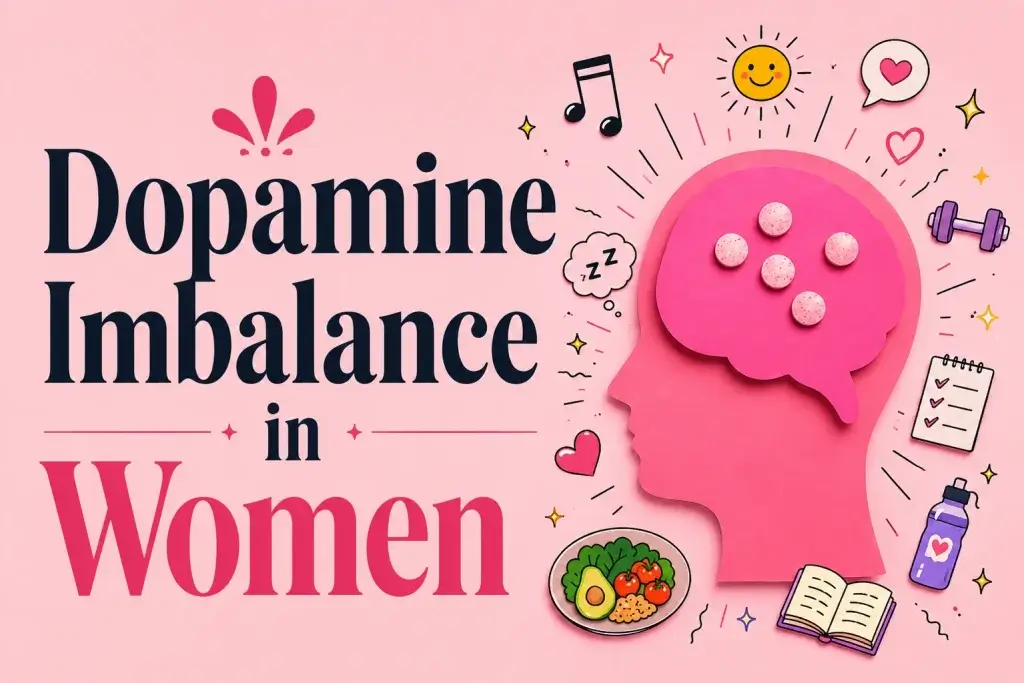
If your motivation has gone quiet, your joy feels borrowed, and the fog in your mind refuses to lift; this is not who you are. It may be what dopamine imbalance looks like in a woman’s body.
You passed every health check. Your thyroid is fine. Your iron is acceptable. Your doctor says you are doing well. And yet something in you knows that “doing well” is not the same as feeling alive.
One of the most significant neurochemical imbalances affecting women today rarely makes it onto a standard blood panel. Dopamine imbalance does not show up on a routine test. It shows up in your life; in the texture of your days, the quality of your focus, the flatness where enthusiasm used to live.
“Dopamine imbalance in women rarely announces itself dramatically. It arrives quietly — as a slow dimming, a thinning of enthusiasm, a heaviness around the simplest beginnings.”
This guide is here to name that dimming precisely and outline what science actually supports as a response.
What Is Dopamine Imbalance?
Dopamine imbalance refers to a disruption in how the brain produces, releases, uses, or recycles dopamine.
The neurotransmitter responsible for:
Motivation
Reward processing
Attention
Emotional resilience
Focus
Pleasure and desire
It is not a single event. It is a gradient.
Dopamine function can be subtly compromised long before dramatic symptoms emerge and in women, that compromise is deeply entangled with hormonal biology.
Estrogen actively modulates dopamine synthesis and receptor sensitivity. When estrogen fluctuates in perimenopause, postpartum, or under chronic stress; the entire dopaminergic system is affected.
This is the biological reality behind what millions of women describe as:
“I don’t feel like myself.”
“I’ve lost my spark.”
“I feel emotionally flat.”
“I can’t focus anymore.”
Dopamine Imbalance vs Burnout vs Depression:
| Symptom | Dopamine Imbalance | Burnout | Depression |
|---|---|---|---|
| Low motivation | Common | Common | Common |
| Emotional numbness | Common | Sometimes | Common |
| Cravings & compulsive scrolling | Very common | Moderate | Variable |
| Brain fog | Common | Common | Common |
| Pleasure feels muted | Strong sign | Sometimes | Common |
| Restlessness + exhaustion together | Common | Common | Sometimes |
| Linked to hormonal shifts | Very common | Less direct | Sometimes |
9 Signs of Dopamine Imbalance in Women
These signs are not diagnostic on their own but they are signals worth taking seriously, especially when they are new, worsening, or coinciding with hormonal transitions.
1. Motivation That Has Gone Completely Quiet
Not laziness. Not procrastination.
Something deeper; an inability to access the internal “start” signal that used to come naturally.
Tasks you once cared about feel impossible to begin.
This reflects reduced activity in the mesolimbic dopamine pathway, which generates drive and initiation.
2. Emotional Flatness That Does Not Feel Like Sadness
This is one of the most misunderstood signs.
It is not necessarily depression. There may be no crying or despair.
Instead, there is a muted quality to experience:
Good news lands softly
Excitement feels distant
Joy feels intellectually understood rather than emotionally felt
This is called anhedonia, and it is strongly linked to disrupted dopamine reward processing.
3. Concentration That Dissolves Mid-Thought
Dopamine is essential for:
Working memory
Sustained attention
Cognitive flexibility
Mental stamina
Too little dopamine, and focus becomes fragmented, distractible, and effortful.
This is why dopamine imbalance in women frequently resembles adult ADHD — especially during perimenopause.
4. Intense Cravings for Sugar, Stimulants, or Screens
When natural dopamine signaling weakens, the brain seeks fast substitutes.
This often shows up as:
Sugar cravings
Excess caffeine dependence
Doomscrolling
Alcohol cravings
Compulsive snacking
Constant stimulation-seeking
If your cravings feel compulsive rather than pleasurable, that matters.
The brain may no longer be seeking enjoyment, it may be seeking relief.
5. Low or Absent Libido Even When Hormones Seem “Normal”
Dopamine governs anticipatory desire:
the wanting before the having.
When dopamine signaling weakens:
Sexual interest can reduce
Desire may disappear
Emotional excitement may flatten
Even when hormone panels appear “normal.”
6. Sleep That Exhausts Rather Than Restores
Women with dopamine imbalance often report:
Lying awake despite exhaustion
Early waking
Non-restorative sleep
Sleeping long hours but still feeling depleted
Poor sleep further disrupts dopamine production, creating a neurological feedback loop that is difficult to break.
7. Restlessness, Irritability & a Short Emotional Fuse
Dopamine imbalance does not always look slow or low-energy.
Sometimes it looks like:
Irritability
Internal agitation
Emotional overstimulation
Inability to relax
Feeling “wired but tired”
The nervous system becomes simultaneously exhausted and unable to settle.
8. Movement Feels Sluggish or Physically Heavy
Subtle dopamine decline can manifest physically as:
Slower movement
Heaviness in the body
Reduced coordination
Stiffness
Slower reaction times
Dopamine is deeply involved in movement initiation and motor coordination which is why these symptoms deserve attention, not dismissal.
9. A Creeping Sense That Life Has Lost Its Colour
This last sign is perhaps the hardest to explain.
It is not exactly burnout.
Not exactly sadness.
Not exactly depression.
It is the feeling that:
Life used to feel more vivid
Excitement feels inaccessible
Curiosity has dimmed
Everything feels emotionally muted
Dopamine is often called “the molecule of possibility.” When it is depleted, possibility contracts.
Why Dopamine Imbalance Happens in Women
Dopamine imbalance is rarely caused by one thing alone.
In women, it is usually a convergence of hormonal, neurological, nutritional, and lifestyle stressors.
Common Causes of Dopamine Imbalance:
A. Hormonal Changes
Falling estrogen during: Perimenopause, Menopause and Postpartum recovery directly impacts dopamine synthesis and receptor sensitivity.
B. Chronic Stress
Sustained cortisol exposure down regulates dopamine receptor expression over time.
This is especially common in caregivers, high-pressure professionals and emotionally overloaded women.
C. Iron & B-Vitamin Deficiency
Iron, B6, folate, and B12 are essential for dopamine synthesis.
Indian women are disproportionately deficient in:
Iron
Vitamin B12
Magnesium
yet these deficiencies are rarely linked to neurological symptoms in routine care.
D. Poor Sleep
Deep sleep is where neurotransmitter restoration happens.
Sleep deprivation directly affects:
Dopamine production
Receptor sensitivity
Emotional resilience
E. Ultra-Processed Food & Sugar
Repeated dopamine spikes from ultra-processed food blunt reward sensitivity over time. The brain adapts and eventually requires more stimulation to feel less.
F. Social Isolation
Human connection is biologically rewarding.
Loneliness reduces dopaminergic stimulation and emotional resilience, especially during:
Empty nest transitions
Divorce
Caregiving years
Midlife isolation
G. Physical Inactivity
Exercise is one of the most powerful natural regulators of dopamine signaling.
Sedentary living quietly suppresses:
Motivation
Mood stability
Reward processing
What To Do About Dopamine Imbalance
There is no single supplement, productivity hack, or “dopamine detox” that repairs this overnight.
What helps is a layered biological approach.
1. Start With A Proper Medical Evaluation
Rule out overlapping conditions such as:
Hypothyroidism
Iron deficiency anemia
Depression
ADHD
Hormonal imbalance
Sleep disorders
A complete clinical picture matters.
2. Prioritise Protein At Every Meal
Dopamine is synthesised from the amino acid tyrosine.
Good sources include:
Eggs
Paneer
Curd
Rajma
Moong dal
Pumpkin seeds
Sesame
Soy
Lentils
3. Repair Sleep Aggressively
Sleep is neurological maintenance.
Protect:
Consistent sleep timing
Evening light exposure
Nervous system regulation
Deep sleep quality
4. Move Your Body Consistently
Both aerobic exercise and resistance training support:
Dopamine receptor density
Mood regulation
Cognitive function
Even 30 minutes of brisk walking, 5 days a week, can significantly support dopamine function.
5. Correct Nutritional Deficiencies
Pay attention to:
Iron
Magnesium
B6
Folate
Vitamin B12
These nutrients directly influence dopamine synthesis pathways.
6. Get Morning Sunlight
10–20 minutes of morning sunlight exposure helps regulate:
Circadian rhythm
Dopamine cycling
Sleep-wake signaling
Preferably before 9am.
7. Consider Expert-Guided Hormonal Support
If symptoms coincide with perimenopause or menopause, hormones matter.
Estrogen’s influence on dopamine pathways is well established.
For some women, appropriate hormonal support may help create a more stable neurochemical environment for dopamine recovery. This conversation should always happen with a qualified clinician.
Quick Daily Dopamine Support Checklist
| Habit | Why It Helps |
|---|---|
| Morning sunlight | Supports dopamine rhythm |
| Protein-rich breakfast | Provides dopamine building blocks |
| Daily movement | Improves receptor sensitivity |
| Quality sleep | Restores neurotransmitter balance |
| Reduce doomscrolling | Prevents dopamine overstimulation |
| Real social connection | Supports reward circuitry |
| Stress regulation | Protects dopamine receptors |
A Final Word
Women are rarely taught the neuroscience of their emotional experience.
They are taught to:
Push through
Minimise symptoms
Doubt themselves
Wonder whether what they feel is “serious enough”
But emotional flatness is not weakness. Reduced motivation is not laziness. Sometimes the brain is not failing. It is depleted. And depletion deserves support not judgment.
FAQs
Common signs of dopamine imbalance in women include low motivation, brain fog, emotional flatness, poor focus, sugar cravings, irritability, low libido, sleep issues, fatigue, and a feeling of losing interest in things that once felt enjoyable.
Yes. Estrogen plays an important role in dopamine production and receptor sensitivity. During perimenopause and menopause, falling estrogen levels can disrupt dopamine signaling, contributing to symptoms like brain fog, low motivation, emotional numbness, poor concentration, and reduced pleasure.
When dopamine signaling is low, the brain often seeks quick stimulation or reward. This can increase cravings for sugar, caffeine, ultra-processed foods, alcohol, social media, and other high-stimulation behaviors that temporarily boost dopamine levels.
Yes. Dopamine imbalance in women is often mistaken for burnout, chronic stress, anxiety, or adult ADHD because symptoms can overlap. Difficulty focusing, emotional overwhelm, low motivation, restlessness, and mental fatigue are all commonly associated with disrupted dopamine function.
Women can support dopamine naturally through consistent sleep, regular exercise, protein-rich meals, morning sunlight exposure, stress management, social connection, correcting nutrient deficiencies like iron and B12, and addressing hormonal imbalances during perimenopause or menopause.