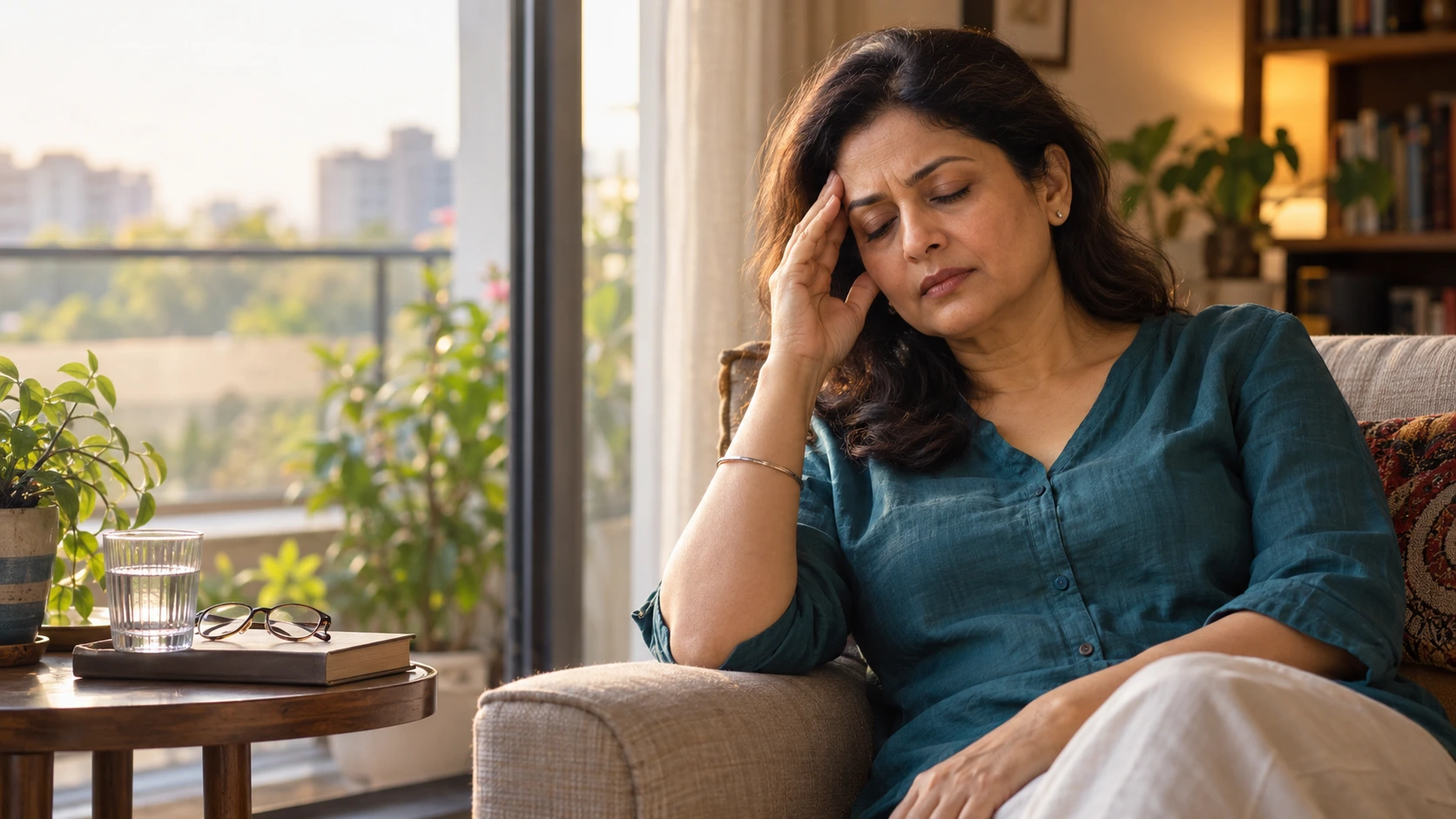


Perimenopause in Indian women is still spoken about too narrowly.
Most conversations begin and end with irregular periods, hot flashes, night sweats or the approaching end of fertility. These symptoms matter, of course. But they are not the whole story.
What is still rarely named, is what perimenopause can do to the mind:
Sudden anxiety with no clear trigger.
Irritability that feels unlike you.
Broken sleep that affects the entire next day.
Brain fog that makes even capable women doubt themselves.
Loneliness, rage, numbness and identity shifts that arrive quietly while she is still expected to keep everyone else’s life running.
For many Indian women, the mental health symptoms of perimenopause are not secondary. They are the reason they begin searching for answers.
This article is not meant to alarm women. It is meant to give language to an experience that has been minimised for too long.
What Is Perimenopause?
Perimenopause is the transition before menopause. It begins when menstrual cycles and hormones start changing, and it ends one year after the final period.
This phase can last for several years. It often begins in the late 30s or 40s, though the timing varies from woman to woman.
During perimenopause, estrogen and progesterone do not simply decline in a straight line. They fluctuate. Some months may feel normal. Some months may feel completely unfamiliar. This unpredictability is one reason the emotional symptoms can feel so confusing.
(Cleveland Clinic).
Why Perimenopause in Indian Women Affects Mental Health?
Perimenopause affects the mind because hormones and mental health are deeply connected.
Estrogen interacts with brain chemicals involved in mood, motivation, memory, sleep and emotional regulation. Progesterone is linked with calming pathways in the brain and can influence sleep and anxiety. When these hormones fluctuate, the nervous system may feel less steady.
But biology is only one part of the story.
For Indian women, perimenopause often arrives at a highly demanding life stage. Many women are managing careers, children, ageing parents, in-laws, marriage, household responsibility, financial pressure and decades of emotional labour. They may be the person everyone depends on, while having very little space to admit that they themselves are struggling.
This is why perimenopause mental health cannot be understood only through hormones. It must also be understood through culture, workload, silence, relationships, caregiving and the lack of language around women’s midlife transitions.
(Mirorpedia).
Perimenopause Mental Health: What Changes?
| What Changes | How It May Affect Mental Health |
|---|---|
| Estrogen fluctuation | Mood swings, anxiety, brain fog, emotional sensitivity |
| Progesterone changes | Poor sleep, restlessness, reduced calm |
| Sleep disruption | Irritability, low mood, fatigue, poor concentration |
| Hot flashes and night sweats | Panic like sensations, sleep disturbance, embarrassment |
| Midlife responsibilities | Burnout, resentment, loneliness, emotional overload |
| Changing roles | Identity loss, grief, invisibility |
| Cultural silence | Shame, delayed help seeking, self blame |
This table is not for self diagnosis. It is a way to understand why emotional symptoms during perimenopause can feel so layered.
(ACOG).
11 Hidden Mental Health Symptoms of Perimenopause in Indian Women
1. Anxiety That Appears Without Warning
One of the most unsettling symptoms of perimenopause is anxiety that seems to arrive from nowhere.
A woman may suddenly feel nervous before routine work calls. She may worry more about her health, her children, her parents, her future or her relationships. She may feel a racing heart, tight chest, shallow breathing or a sense of dread, even when nothing obviously threatening is happening.
This does not mean she is weak or overthinking. Hormonal fluctuations, poor sleep, hot flashes, blood sugar swings, stress and life pressure can all make the nervous system more reactive.
But anxiety should still be taken seriously. If it is persistent, intense or affecting daily life, professional support can help.
2. Irritability That Feels Out of Character
Many women say, “I do not recognise my reactions anymore.”
Small things feel louder. Noise feels harder to tolerate. Interruptions feel unbearable. A comment that would once have been brushed aside now hurts deeply or triggers anger.
Perimenopause irritability is often worsened by sleep disruption, emotional overload, chronic stress and hormone fluctuation. In Indian homes, where women are often expected to remain patient, available and composed, this irritability can create guilt.
But irritability is often a signal, not a character flaw.
It may be saying: “I am overstimulated.”
It may be saying: “I need rest.”
It may be saying: “I have been carrying too much for too long.”
3. Low Mood For No Specific Reason
Some women do not describe themselves as sad or low. They describe themselves as dull, flat or disconnected.
The things that once felt enjoyable may feel less rewarding. Social plans may feel tiring. Work may feel heavier. A woman may still function, but internally feel that life has lost some colour.
This can be part of perimenopause mental health change, but it can also overlap with clinical depression, thyroid imbalance, anaemia, vitamin deficiencies, grief, burnout or relationship distress.
If low mood lasts for more than two weeks, affects daily life, or comes with hopelessness or thoughts of self harm, it needs prompt professional care.
4. Brain Fog That Makes You Question Yourself
Brain fog can be one of the most frightening perimenopause symptoms.
You may forget names, lose words mid sentence, reread the same line, miss details or feel slower than usual. For women who are used to managing families, teams, deadlines and decisions, this can feel deeply threatening.
Brain fog during perimenopause is usually not a sign that you are losing your intelligence. It may be connected to hormone fluctuations, poor sleep, stress, anxiety, hot flashes, thyroid imbalance, low iron, vitamin B12 deficiency or chronic overload.
The fear around brain fog often makes the symptom worse. Reassurance, testing where needed and better sleep support can make a real difference.
5. Sleep Disruption That Changes Your Personality the Next Day
Sleep is one of the strongest bridges between hormones and mental health.
During perimenopause, women may struggle to fall asleep, wake at 2 AM or 3 AM, experience night sweats, feel hot suddenly, or wake unrefreshed despite being in bed for enough hours.
The next day, everything feels harder.
Patience is lower. Anxiety is higher. Focus is weaker. Cravings increase. Emotional regulation drops.
This is why sleep should not be treated as a minor symptom. For many women, improving sleep is the first step toward improving mood.
6. Panic Like Symptoms That Feel Physical
Perimenopause can sometimes feel like anxiety is happening in the body before the mind even understands it.
A sudden hot flash may bring sweating, palpitations, chest tightness or breathlessness. The body may interpret this as danger, which can create panic like symptoms.
It is important to be careful here. Not every racing heart is hormonal. Chest pain, fainting, severe breathlessness or new heart symptoms should always be medically evaluated.
But once medical concerns are ruled out, women should know this: panic like sensations during perimenopause are not imaginary. They are real body experiences that need grounding, support and care.
7. Emotional Numbness and Disconnection
Some women do not feel more emotional during perimenopause. They feel less.
They feel numb. Detached. Distant from their own life. They go through the motions, cook, work, answer calls, care for others and show up everywhere, but inside they feel strangely absent.
This can happen when the nervous system has been overwhelmed for too long. It can also overlap with depression, burnout, trauma responses, grief or chronic stress.
For a psychologist led blog, this matters deeply. Emotional numbness is not laziness or coldness. It is often a protective response when the mind has had too much to hold.
8. Loneliness Even When Life Looks Full
Many Indian women in perimenopause are surrounded by people and still feel lonely.
They may live with family, manage a full home, be active on WhatsApp groups and still feel unseen. People may ask them for meals, medicines, decisions and emotional support, but rarely ask, “How are you really?”
Perimenopause can coincide with social shifts. Children grow more independent. Friendships thin. Marriages may become more functional than intimate. Parents may need care. The woman who held everyone else may suddenly wonder who is holding her.
This loneliness is not always about being alone. It is often about not being emotionally met.
9. Identity Loss and the Grief of Changing Roles
Perimenopause is not only a physical transition. It can be an identity transition.
A woman may ask:
Who am I now that my children need me differently?
Who am I outside caregiving?
Who am I in a body that feels unfamiliar?
Who am I if I no longer want to be endlessly available?
For many Indian women, identity has been shaped around roles such as mother, wife, daughter, daughter in law, caregiver and household anchor. When these roles begin to shift, the emotional effect can be profound.
This grief deserves respect. It is not vanity. It is not self indulgence. It is the psychological work of becoming someone new.
10. Anger That Has Been Waiting for Years
Some women call it irritability. Some call it rage. Some simply say, “I cannot keep quiet anymore.”
Perimenopause may lower the emotional tolerance that helped a woman suppress years of unmet needs. She may suddenly feel angry about invisible labour, unequal responsibility, emotional neglect, lack of support or the expectation that she should keep adjusting.
This anger should not be dismissed as hormonal drama.
Sometimes anger is information. It points toward boundaries that were never allowed, needs that were never voiced and exhaustion that was never taken seriously.
The goal is not to shame the anger. The goal is to understand it safely and express it without harming oneself or others.
11. Depression That Needs Clinical Attention
Perimenopausal depression is real and deserves care.
It may show up as persistent sadness, loss of interest, hopelessness, guilt, low energy, poor sleep, appetite changes, withdrawal, difficulty functioning or feeling that life is not worth living.
This is not something to carry silently.
Women with a previous history of depression, postpartum depression, severe PMS or PMDD may be more vulnerable to mood symptoms during perimenopause. But even women with no previous mental health history can struggle during this transition.
Depression is treatable. Therapy, medical evaluation, psychiatric care when needed, lifestyle support and community can all help.
If there are thoughts of self harm or feeling unsafe, urgent help is needed immediately.
(NIH).
Perimenopause Symptoms Versus Mental Health Conditions
| Perimenopause Related Emotional Changes May Feel Like | A Mental Health Condition May Need Attention When |
|---|---|
| Mood changes that fluctuate with sleep, cycle or hot flashes | Symptoms are persistent, severe or disabling |
| Anxiety that worsens during hormone shifts | Panic, avoidance or fear affects daily life |
| Brain fog that comes and goes | Confusion, memory loss or cognitive decline is progressive |
| Irritability due to overload | Anger causes harm, fear or relationship breakdown |
| Low mood on and off | Hopelessness or loss of interest on most days |
| Loneliness | Life feels meaningless |
This table is not a diagnosis. It is a guide to help women know when to seek clinical support.
Why Indian Women Often Miss These Symptoms?
Perimenopause in Indian women is often missed because women are trained to normalise discomfort.
They may be told:
“It is just age.”
“Everyone goes through it.”
“Do not think too much.”
“You are lucky, your life is fine.”
“Be strong.”
But being common does not make a symptom unimportant.
Many women delay help because they do not know what is happening. They do not want to burden their family. They fear being labelled moody, difficult or unstable. They may also meet clinicians who focus only on bleeding patterns and hot flashes, while missing the mental health picture.
This silence has a cost.
Women cannot seek care for what they cannot name.
(THiP).
What Actually Helps?
1. Name the Symptoms Clearly
Do not only tell your doctor, “I am not feeling like myself.”
Say what is happening.
“I am waking at 3 AM with anxiety.”
“I am more irritable before my period.”
“I feel emotionally numb.”
“I am having panic like sensations.”
“I feel low and disconnected.”
“I am struggling to function.”
Specific language leads to better care.
2. Rule Out Medical Overlaps
Perimenopause symptoms can overlap with thyroid imbalance, anaemia, vitamin B12 deficiency, vitamin D deficiency, diabetes, medication effects, sleep disorders, depression, anxiety disorders and chronic stress.
A doctor may suggest evaluation based on your symptoms, age, cycle pattern and medical history.
3. Protect Sleep Like Mental Health Care
Sleep is not optional recovery. It is emotional regulation.
Reducing late caffeine, keeping a consistent sleep schedule, treating night sweats, managing anxiety and addressing hot flashes can all help the mind feel steadier.
4. Seek Therapy or Counselling
A psychologist can help a woman understand anxiety, irritability, grief, role shifts, boundary struggles, relationship stress and emotional numbness without shame.
Therapy is especially helpful when perimenopause brings up older patterns of self silencing, people pleasing, resentment or unresolved grief.
5. Build a Support System That Sustains You
Many women are surrounded by people who rely on them, yet have few relationships that truly support them emotionally.
Look for spaces where you can speak honestly without fear of being judged. This could be a therapist, a women’s group, a trusted friend, a community, a support circle or a doctor who listens well.
6. Discuss Menopause Care With a Clinician
Hormonal and non hormonal options may help some women, depending on symptoms, medical history and risk factors.
This should be discussed with a qualified doctor. Mental health symptoms should be part of that conversation, not treated as separate from the body.
(John Hopkins Medicine).
Where Miror Bliss Helps
Miror Bliss is designed for women navigating perimenopause, when sleep, mood, hot flashes, menstrual discomfort and hormonal rhythm may begin to change.
NOTE: Bliss is not a treatment for depression, anxiety, panic disorder or trauma. It does not replace therapy, psychiatric care, medical evaluation or prescribed treatment.
But for women whose emotional wellbeing is affected by perimenopause symptoms, Miror Bliss can be part of a broader care routine that includes sleep support, nutrition, movement, therapy, clinical guidance and community.
Its 18 ingredient formulation includes magnesium glycinate, shatavari, lodhra bark and ashwagandha, created to support sleep, mood, hot flashes, menstrual discomfort and hormonal wellness during the transition.
The Miror Approach
Perimenopause in Indian women needs a larger conversation.
Not only about periods, hot flashes or fertility changes. It must also include the mind: the anxiety, numbness, anger, loneliness, grief, brain fog, sleep loss and the quiet fear of not feeling like yourself anymore.
At Miror, we believe women deserve care that sees the whole picture. Hormones, mental health, relationships, culture, sleep, identity and community all matter.
Miror is India’s largest 360 degree women’s wellness ecosystem, supporting over 95,000 women through expert guidance, community, doctors, OBGYNs, psychiatrists, psychologists, nutritionists, dietitians and women’s health events.
You are not losing your mind. You are not too sensitive. You may be moving through a real biological and psychological transition that deserves language, care and support.
Join the Miror app and explore Miror Bliss for expert led perimenopause support, mental health awareness and a community that understands.
FAQs
The mental health symptoms of perimenopause in Indian women can include anxiety, irritability, mood swings, brain fog, sleep disruption, emotional numbness, loneliness, anger, low mood and identity changes. These symptoms are often missed because perimenopause is usually discussed only through periods, hot flashes and fertility changes.
Yes, perimenopause can contribute to anxiety and panic like symptoms in some women. Hormonal fluctuations, poor sleep, hot flashes, stress and life pressure can make the nervous system feel more reactive. A woman may experience sudden worry, racing heart, chest tightness, breathlessness or a sense of dread. New or severe physical symptoms should always be checked by a doctor.
Indian women may feel more irritable during perimenopause because hormonal changes, sleep loss, emotional overload and caregiving pressure often happen together. Many women in their 40s are managing family, work, ageing parents and household responsibility, while also experiencing internal hormonal shifts. This can make patience, emotional regulation and tolerance feel harder than before.
Yes, brain fog is a common perimenopause symptom. Women may notice forgetfulness, slower thinking, difficulty focusing, word finding trouble or reduced mental clarity. Brain fog can be linked to hormone changes, poor sleep, anxiety, stress, thyroid imbalance, low iron or vitamin deficiencies. If it is severe or worsening, medical evaluation is important.
Women can support their mental health during perimenopause by naming their symptoms clearly, improving sleep, checking for medical overlaps, seeking therapy or counselling, building emotional support and discussing menopause care with a qualified doctor. Miror Bliss can be part of a broader perimenopause wellness routine for sleep, mood and hormonal support, but it does not replace medical or mental health care.