
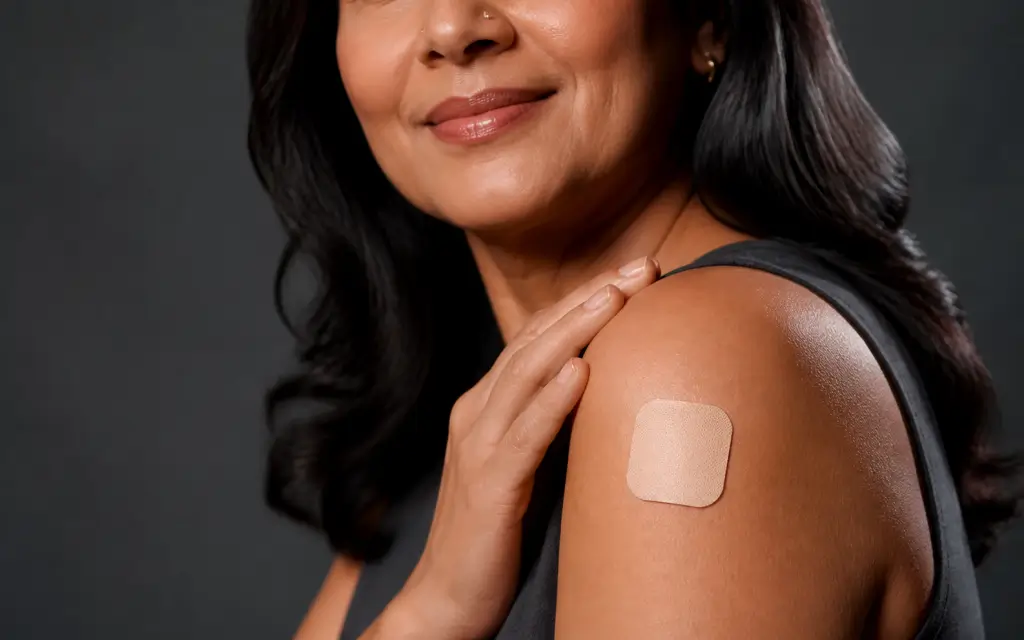
“Can I Just Use One Patch With Both Hormones?”
This is a very reasonable question.
A woman reads about an estrogen progesterone patch online and thinks: one patch, both hormones, fewer medicines to remember.
Sometimes that convenience is useful. But there is an important detail that gets lost online:
Combination HRT patches generally contain estrogen plus a progestogen, not micronised progesterone.
That distinction matters when we are choosing HRT, particularly for women in India who may have different products available to them.
So let me explain what these patches do, why the second hormone is needed, what your alternatives are, and where testosterone or DHEA actually fit.
Why Does Estrogen Need a Second Hormone?
The simplest explanation starts with the uterus.
Estrogen helps relieve many menopause symptoms, but it also stimulates the lining of the uterus.
If a woman has a uterus and uses systemic estrogen without adequate progestogen protection, the endometrium can become excessively stimulated. Over time, this increases the risk of endometrial hyperplasia and endometrial cancer.
The progestogen protects the uterine lining. This is called endometrial protection.
The basic rule:
| Your situation | What is generally needed |
|---|---|
| Uterus present | Estrogen + adequate progestogen |
| Total hysterectomy | Estrogen alone may be appropriate |
| Low-dose vaginal estrogen only | Additional progestogen is generally not required |
Your exact regimen can change depending on your medical history, the type and dose of estrogen, previous surgery and other clinical factors.
The progestogen is not an optional add-on if systemic estrogen is being used in a woman with a uterus.
(MedlinePlus)
Estrogen vs Progesterone: Why the Names Cause Confusion
The search term “estrogen progesterone patch” is widely used, but technically, progesterone and progestogen are not the same thing.
Progesterone is the hormone naturally produced by the body.
Progestogens are medicines that act on progesterone receptors and include different synthetic compounds as well as micronised progesterone.
For example, Climara Pro contains estradiol plus levonorgestrel, while CombiPatch contains estradiol plus norethindrone acetate. These are combination patches using synthetic progestins rather than micronised progesterone.
So when someone says, “I want a patch with natural progesterone,” it is important to clarify exactly what product and hormone they mean.
How Do Combination HRT Patches Work?
There are two broad ways combined HRT is used.
Sequential or cyclical HRT: Estrogen is used continuously and progestogen is added for part of the month. With micronised progesterone, a common regimen is 12 days per 28-day cycle, although the exact regimen depends on the product, estrogen dose and clinical situation. A predictable withdrawal bleed may occur.
Continuous combined HRT: Estrogen and progestogen are used continuously, usually once a woman is appropriately postmenopausal and the aim is to avoid regular withdrawal bleeding.
The key point is that the duration and dose of progestogen matter. If you have a uterus, do not simply stop the progestogen while continuing systemic estrogen because you dislike side effects. Talk to your clinician about changing the dose, formulation or route instead.
(NHS)
Combination Patch vs Estrogen Patch + Separate Progesterone
A combination patch has one obvious advantage:
Convenience.
But using separate estrogen and progestogen gives your doctor more flexibility.
With transdermal estradiol plus separate micronised progesterone, the estrogen dose can be adjusted independently, and the type and route of progestogen can also be individualised.
Transdermal estrogen may be preferred over oral estrogen for women with increased VTE risk. NICE specifically recommends considering transdermal rather than oral HRT for women at increased VTE risk, including women with a BMI over 30 kg/m².
That does not mean every woman should use a patch.
Your migraine history, blood pressure, cardiovascular risk, previous clotting events, liver health, breast history and other factors all matter.
There is another option worth discussing: the 52 mg levonorgestrel intrauterine system (LNG-IUS), commonly known as Mirena. It can provide endometrial protection and may also be useful for contraception and heavy menstrual bleeding in suitable perimenopausal women.
(Dr Louise Newson)
What Is Actually Available in India?
This is where online searches can become confusing.
International combination patches such as Climara Pro can be found through some India-based medicine suppliers, including import channels, but that does not mean they are routinely stocked in every Indian pharmacy or that supply will be consistent.
In India, the more practical options commonly encountered are separate estradiol patches or gels and micronised progesterone, depending on the patient’s needs and local availability.
Estradiol patches including products such as Estraderm MX and Systen are listed in India, while estradiol gels are also available. Micronised progesterone is available in oral formulations. Availability can vary by city, pharmacy and stock.
So the more useful clinical question is not: “Which combination patch can I buy?”
It is: “Which estrogen route, dose and form of endometrial protection are appropriate for me?”
Where Miror’s HRT Centre of Excellence Fits In
At Miror’s HRT Centre of Excellence, the focus is on helping women answer that second question properly.
Miror describes its centre as India’s first HRT Centre of Excellence, bringing specialist consultations, diagnostics, personalised treatment planning, Hormonal Index assessment and ongoing support into one menopause-focused care pathway.
For a woman considering an estrogen patch, the important questions go well beyond the product itself:
Do you need a progestogen?
Which estrogen route suits your risk profile?
Do you need treatment for heavy bleeding or contraception as well? What symptoms are you actually trying to treat?
The goal is not to prescribe a hormone because a particular product is trending online.
The goal is to understand the woman, then choose the treatment.
What About an Estrogen Testosterone Patch?
This is where I would urge particular caution with online marketing.
There is no licensed combined estrogen-testosterone patch for women as a standard menopause product.
More importantly, testosterone is not a general treatment for fatigue, brain fog, low mood or “vitality.”
The Global Consensus Position Statement says the evidence-based indication for testosterone therapy is hypoactive sexual desire disorder (HSDD) in postmenopausal women after a proper biopsychosocial assessment. A blood testosterone level should not be used by itself to diagnose HSDD.
(ResearchGate)
If testosterone is considered because of HSDD and an approved female formulation is unavailable, use is generally off-label and requires appropriate dosing and monitoring. Supraphysiologic preparations, including pellets, are not recommended.
So if you see an estrogen patch with testosterone advertised as a solution for energy, weight, memory or general menopause wellness, be cautious.
And What About DHEA?
DHEA has a much narrower evidence-based role.
Intravaginal DHEA, also called prasterone, is used locally for genitourinary symptoms such as painful intercourse associated with menopause. The Indian Menopause Society’s 2026 guideline includes vaginal DHEA among evidence-supported treatments for genitourinary syndrome of menopause.
That is very different from an oral DHEA supplement or a supposed DHEA and estrogen patch.
Prasterone may be obtainable in India through specialist or import supply, but routine local pharmacy availability should not be assumed.
Oral DHEA should not be treated as a routine menopause add-on simply because it is marketed as a “hormone booster.”
(Mayo Clinic)
What Should Your Doctor Assess Before Choosing HRT?
A good HRT consultation is much more than checking a hormone report.
Your doctor will consider:
Whether you have a uterus
When your periods stopped or how they are changing
Your main symptoms and how much they affect your life
Heavy or irregular bleeding
Blood pressure, BMI and cardiovascular risk
Migraine and clotting history
Breast and endometrial history
Liver health
Whether contraception is still needed
Whether low sexual desire is actually the main concern
The Hormonal Index can help organise symptoms, menopausal stage, relevant risk factors and investigations as part of a structured assessment.
But it should support clinical decision-making, not replace it.
(Menovivre)
The Indian Menopause Society‘s 2026 guideline states that biochemical markers such as FSH and estradiol are generally not recommended for diagnosing natural menopause in women aged 45 and above. Menopause care should be based on the clinical picture rather than chasing an “ideal” hormone number.
When Is HRT Not Something to Start Casually?
HRT is not appropriate for everyone.
A clinician needs to assess women with factors such as undiagnosed vaginal bleeding, active hormone-sensitive cancers, significant clotting or cardiovascular disease, severe active liver disease, pregnancy or other relevant contraindications before treatment.
And if you are already using HRT, new postmenopausal bleeding or persistent unscheduled bleeding needs assessment rather than being automatically blamed on the hormones. Current BMS guidance recommends investigation based on the timing, pattern, amount of bleeding and individual risk factors.
(NHS)
The Bottom Line
An estrogen progesterone patch may sound like the simplest HRT solution.
But HRT is not a one-size-fits-all decision.
A combination patch offers convenience. Separate transdermal estradiol and progestogen can offer greater flexibility. An LNG-IUS may be useful for some women. Testosterone has a specific evidence-based role. DHEA has a specific local vaginal role.
The best HRT is not the one with the most hormones. It is the one that matches your symptoms, uterus status, health risks, preferences and stage of menopause.
That conversation is worth having with a clinician who takes menopause seriously.
Medical Disclaimer: This article is for general educational purposes only and does not replace personalised medical advice, diagnosis or treatment. HRT may not be suitable for everyone. For personalised guidance on HRT, consult the experts at Miror’s HRT Centre of Excellence before starting, stopping or changing any hormone treatment.
FAQs
An estrogen progesterone patch is the common search term for a combination HRT patch delivering estrogen and a progestogen through the skin. International examples such as Climara Pro use estradiol plus levonorgestrel, rather than micronised progesterone.
If you have a uterus and use systemic estrogen, you generally need adequate progestogen for endometrial protection. After a total hysterectomy, estrogen alone may be appropriate. Low-dose vaginal estrogen generally does not require additional progestogen.
Some international products such as Climara Pro can be obtained through India-based import suppliers, but routine local pharmacy availability should not be assumed. Separate estradiol patches or gels and micronised progesterone are more practical components for an individually tailored regimen in India. For personalised guidance on HRT, consult the experts at Miror’s HRT Centre of Excellence before starting, stopping or changing any hormone treatment.
Intravaginal DHEA (prasterone) has an evidence-based role for certain genitourinary symptoms after menopause. It should not be confused with oral DHEA supplements or marketed “DHEA and estrogen patches.”
A structured Hormonal Index can organise your symptoms, menopause stage, medical history, risk factors and relevant investigations to support a personalised HRT discussion. It should complement, not replace, clinical assessment.