


What if progesterone is the part of HRT you are struggling with?
If your HRT includes estrogen and you still have your uterus, dydrogesterone may be one of the progestogen options your doctor discusses with you. It becomes particularly relevant when the question is not whether you need endometrial protection, but which progestogen is the better fit for you.
That distinction matters. Dydrogesterone and micronized progesterone can both be used as the progestogen component of menopausal hormone therapy, but they are not the same medicine, their doses are not interchangeable, and their effects on sleep and day-to-day tolerability may differ.
Dydrogesterone in menopause: what does it actually do?
If you still have your uterus and use systemic estrogen, a progestogen is usually added to protect the endometrium from ongoing estrogen stimulation.
Dydrogesterone is one oral progestogen that can be used for this purpose. It works alongside estrogen rather than replacing it.
The simplest way to understand its role is to look at what each part of HRT is doing:
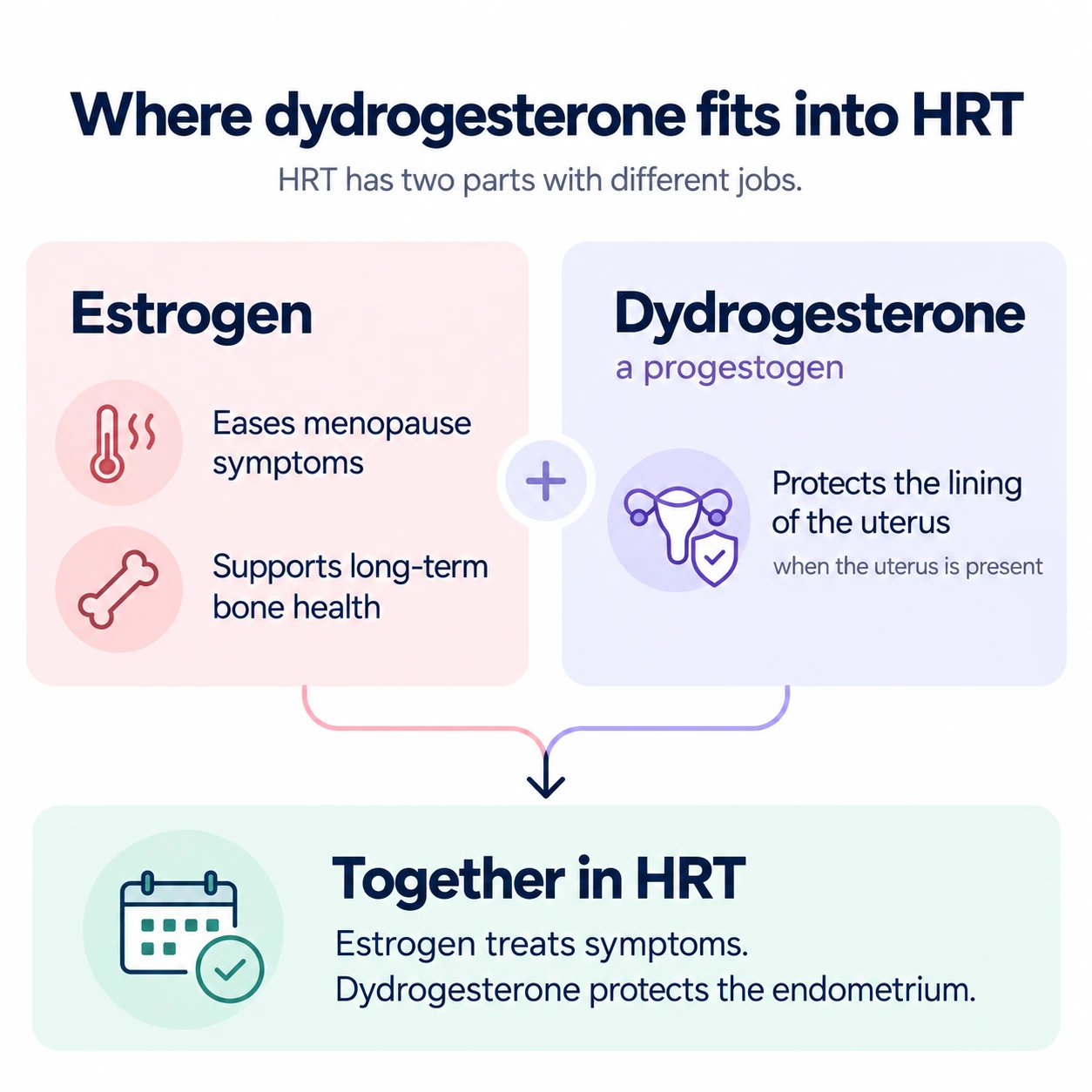
Dydrogesterone vs progesterone: what is the actual difference?
The terminology around these medicines can be confusing because both act through progesterone pathways.
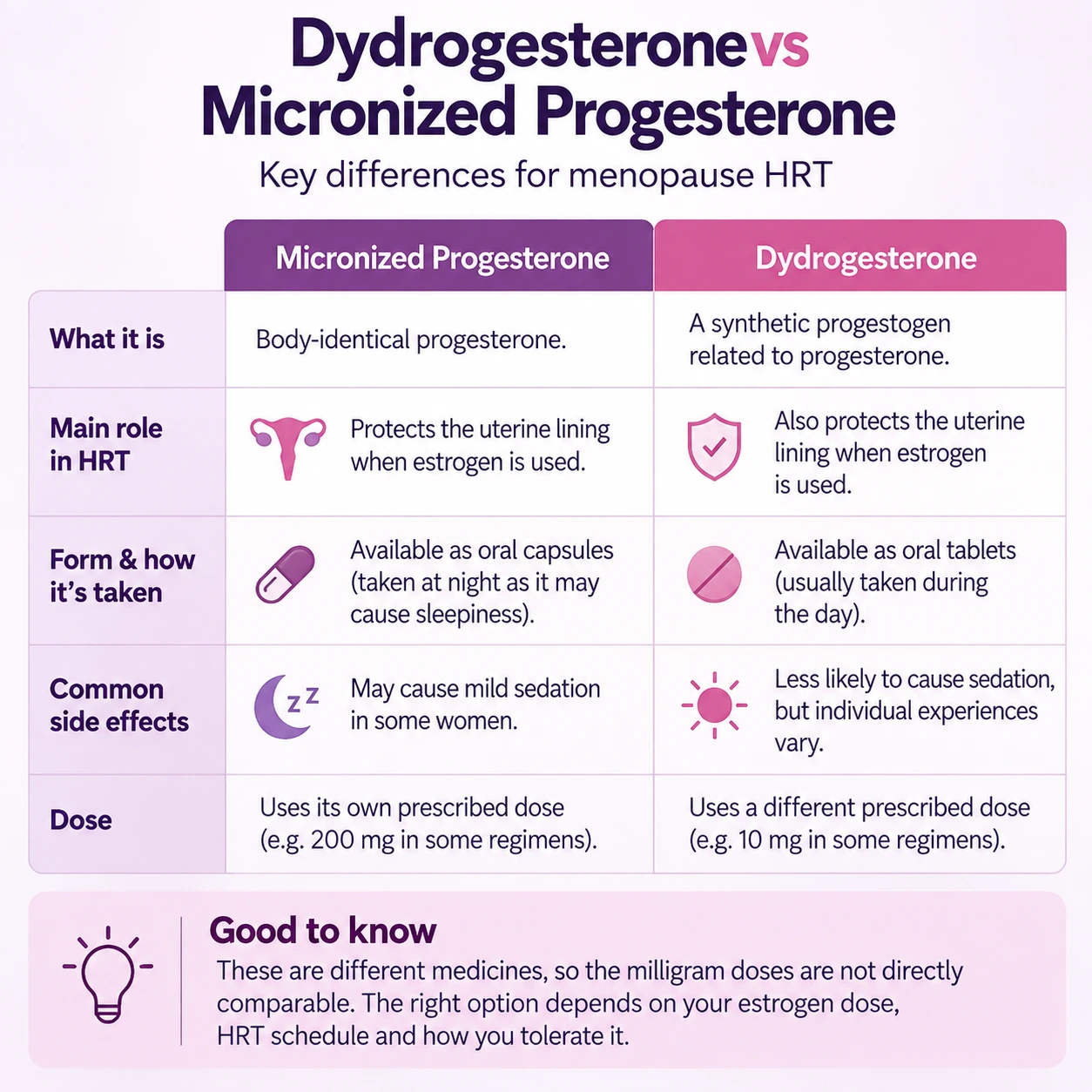
Micronized progesterone contains progesterone that is chemically identical to the progesterone naturally produced by the body. “Micronized” simply refers to processing the hormone into very small particles so that it can be absorbed effectively as a medicine.
Dydrogesterone, by contrast, is not body-identical progesterone. It is a laboratory-produced progestogen with a molecular structure closely related to progesterone and relatively selective progesterone-receptor activity.
That does not automatically make one option better than the other.
The more useful clinical question is whether the chosen medicine:
provides adequate protection for the endometrium
works with the estrogen dose being used
fits the required HRT schedule
produces acceptable side effects for that individual woman
Micronized progesterone and dydrogesterone also use different doses, so one should not be swapped for the other based on milligram strength alone.
Could dydrogesterone be an alternative if micronized progesterone makes you sleepy?
This is one of the most practical reasons the comparison comes up.
Oral micronized progesterone is broken down into compounds that can have a calming effect on the brain. This is one reason it may cause sleepiness or dizziness.
For some women, that can actually be helpful, especially if sleep is already a problem and the medicine is taken at night.
For others, the drowsiness becomes inconvenient.
Dydrogesterone does not appear to have the same sedating effect to the same extent. Current prescribing information lists dizziness as uncommon and sleepiness as rare.
That means a clinician may reasonably consider dydrogesterone when sedation from another progestogen is becoming difficult to manage.
If dydrogesterone is being considered, the next step is understanding how a progestogen fits into the HRT schedule, because the timing can differ depending on the type of regimen.
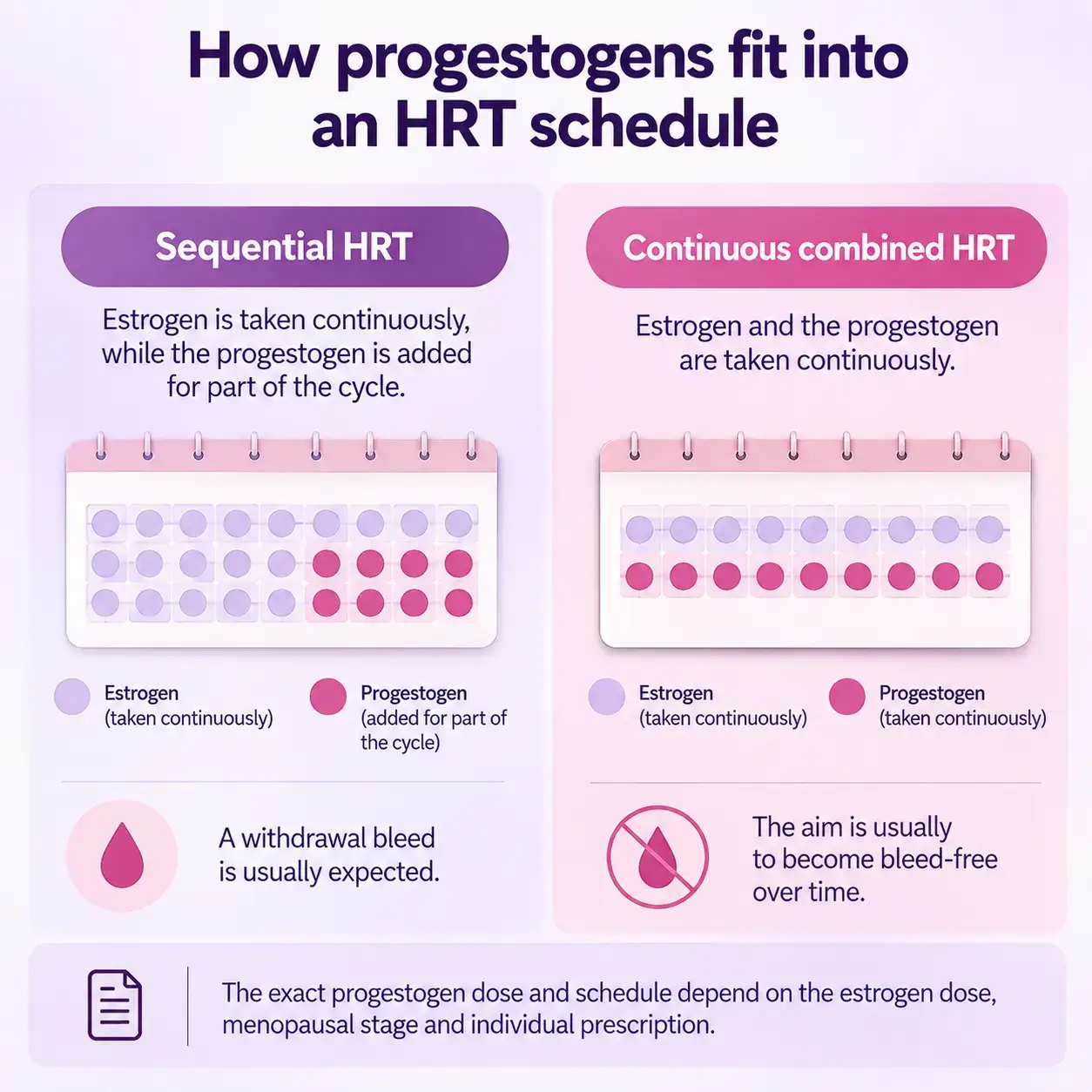
Why the progestogen schedule matters for uterine protection
The timing of a progestogen is not just about convenience. Its main purpose is to make sure the uterine lining is adequately protected while systemic estrogen is being used.
Both micronized progesterone and dydrogesterone can provide this protection when they are prescribed in the right dose and schedule for the estrogen regimen.
What matters is not simply which progestogen you take, but whether there is enough progestogen exposure to balance the effect of estrogen on the endometrium.
This becomes especially important when the estrogen dose changes, because the progestogen part of the HRT plan may also need to be reviewed.
Matching the progestogen to the estrogen dose
The amount of progestogen needed can also depend on the dose of estrogen being used.
Higher estrogen doses may stimulate the endometrium more, which means the progestogen part of the HRT plan may need to be adjusted to provide adequate protection.
This is why changing your estrogen dose can sometimes mean reviewing the rest of the prescription too.
The key point is that HRT should be treated as one complete regimen rather than adjusting estrogen and progestogen separately.
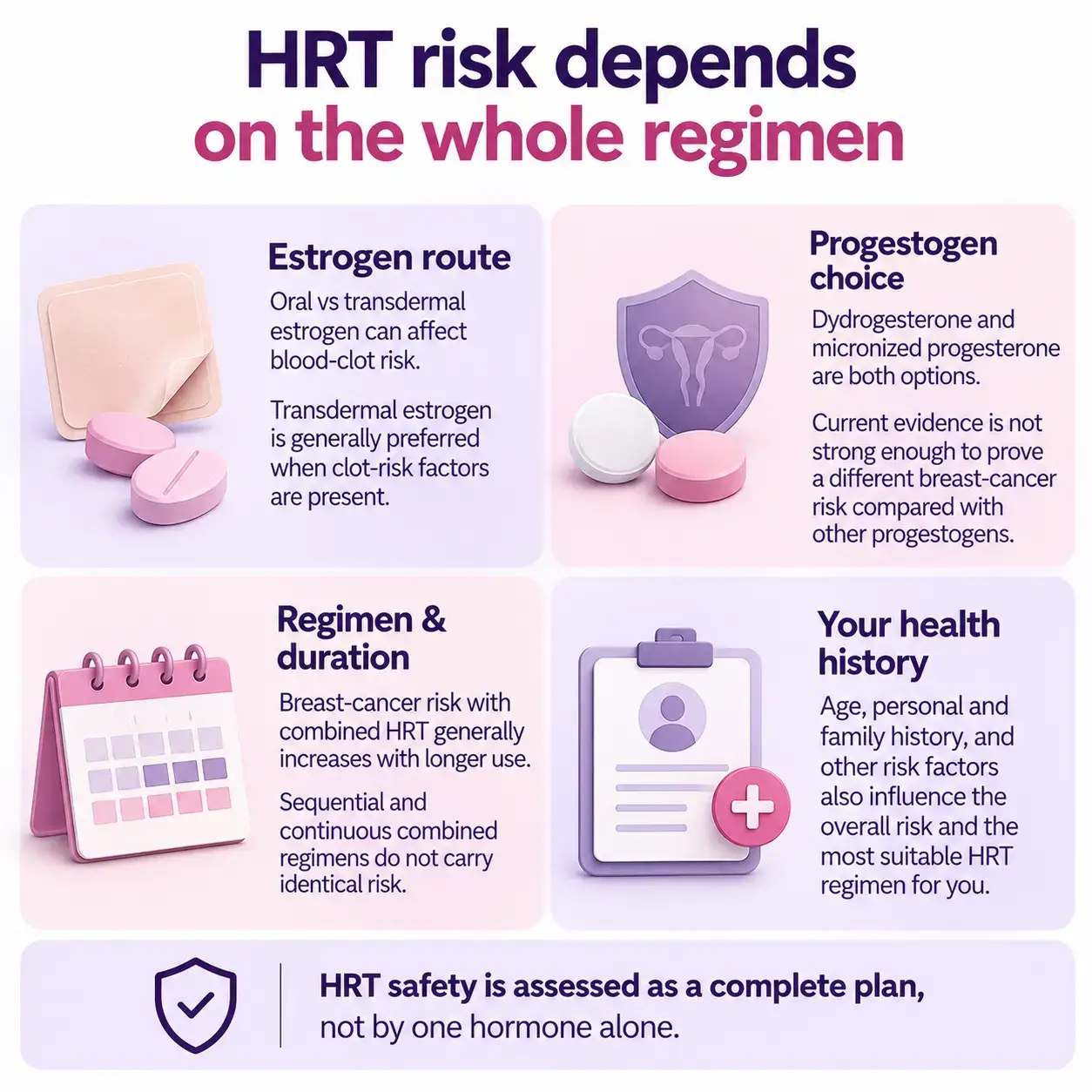
Dydrogesterone side effects to know about
Like any medicine, dydrogesterone can cause side effects. Reported effects include:
headache or migraine
nausea
breast tenderness
changes in bleeding patterns
dizziness
Less commonly, women may experience mood changes, skin reactions, vomiting or changes in liver function.
When dydrogesterone is taken as part of combined HRT, however, it is not always obvious which hormone is responsible for a new symptom. Estrogen, the progestogen, the dose and the timing of treatment can all play a part.
So a new side effect does not necessarily mean HRT needs to be stopped. Sometimes the dose, schedule or formulation simply needs to be reviewed.
What if your bleeding pattern changes?
Changes in bleeding can happen after starting HRT or changing the dose or type of treatment.
With sequential HRT, a withdrawal bleed is usually expected. With continuous combined HRT, the aim is generally to become bleed-free over time.
Unscheduled bleeding is more likely to need review if it is:
heavy or prolonged
happening most days
starting after you had previously become bleed-free
continuing beyond the expected adjustment period
Current British Menopause Society guidance recommends looking at the bleeding pattern, HRT regimen and individual risk factors together, rather than assuming the progestogen is automatically the cause.
If bleeding persists, the answer may be to adjust the HRT regimen, investigate further, or both, depending on the pattern and your individual risk factors.
When dydrogesterone may be worth discussing
Dydrogesterone may be considered when a woman needs a progestogen with systemic estrogen but her current option is not working well for her.
That conversation may come up if:
micronized progesterone causes troublesome drowsiness or dizziness
side effects are affecting daily life or making it difficult to stay on the prescribed regimen
bleeding patterns mean the overall HRT plan needs reviewing
a different progestogen may fit the estrogen dose or treatment schedule better
This does not mean dydrogesterone will automatically be the better choice. The decision depends on the whole HRT regimen, individual symptoms and medical history.
Why you should not switch progestogens on your own
Micronized progesterone and dydrogesterone are not directly interchangeable, even though both can be used as the progestogen part of HRT.
Their doses and schedules differ, and the right prescription depends on factors such as:
your estrogen dose
whether your HRT is sequential or continuous
your bleeding pattern
your menopausal stage
any side effects or medical risk factors
So switching should involve reviewing the whole HRT regimen, rather than simply replacing one tablet with another.
The practical takeaway
Dydrogesterone can be a useful alternative to micronized progesterone for some women, particularly when tolerability or the overall HRT regimen needs to be reconsidered.
But it is not a direct substitute, and current evidence does not support calling it universally safer or better tolerated.
The most useful decision is the one based on your estrogen dose, bleeding pattern, side effects, menopausal stage and medical history.
If your current progestogen is not working well for you, that is a reason to review the HRT plan rather than simply stop or switch treatment on your own.
Considering whether your HRT needs adjusting?
If side effects, bleeding changes or drowsiness are making you question your current HRT, the next step is to review the whole regimen, not just one medicine.
Through MIROR HRT, a menopause-focused clinician can look at your estrogen dose and route, progestogen choice, symptoms, bleeding pattern and medical history before deciding whether a change is appropriate.