

If estrogen gets all the attention, what is progesterone quietly doing?
If you have been reading about hormone replacement therapy, estrogen may have taken most of your attention. Then a second name appears on the prescription: progesterone, micronized progesterone, medroxyprogesterone, norethisterone, dydrogesterone or another progestogen.
It is easy to reduce that choice to “natural versus synthetic.” Clinically, however, the distinction is both more complicated and more useful than that.
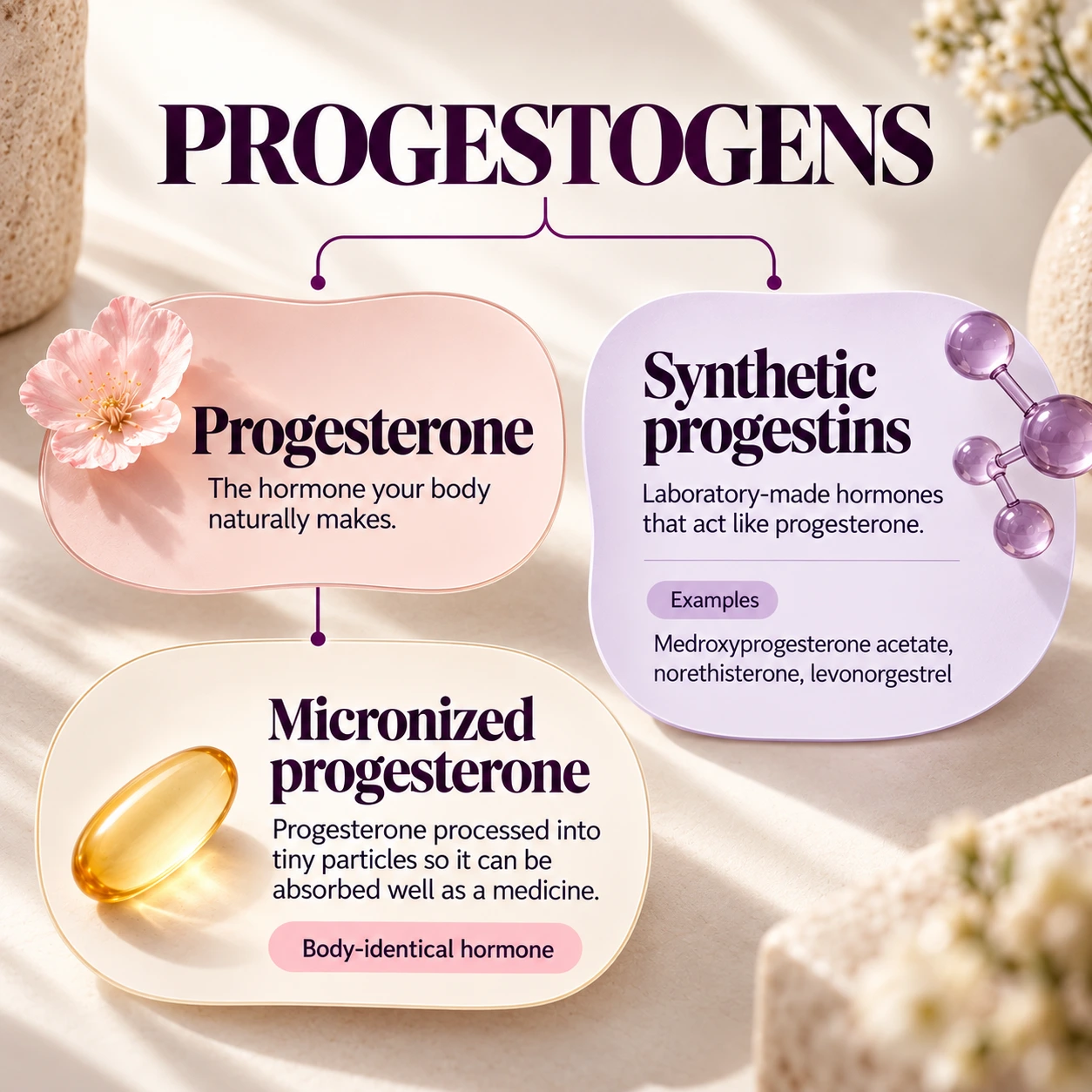
Micronized progesterone is progesterone that is chemically identical to the hormone produced by the ovaries, processed into very small particles so that it can be absorbed as a medicine. Synthetic progestins are laboratory-made compounds designed to produce progesterone-like effects. Both can protect the uterine lining when used correctly with estrogen, but they are not pharmacologically identical and may differ in tolerability and some risk profiles.
Understanding those differences starts with the language itself, because several terms that sound interchangeable actually describe different things.
(National Library of Medicine)
“Progesterone” and “Progestin” Are Not Quite the Same Thing
You may see several similar-sounding words on an HRT prescription: progesterone, progestin and progestogen. They are related, but they do not mean exactly the same thing.
This is also why regulated micronized progesterone should not be confused with every product marketed as “bioidentical.” Prescription micronized progesterone is a standardized, regulated medicine. Individually compounded hormone preparations may not have been tested for dose consistency, effectiveness and safety in the same way.
Progestogen is the broad term for hormones that act like progesterone in the body. It includes progesterone itself as well as synthetic progestins such as medroxyprogesterone acetate or norethisterone.
So the difference is not simply “natural versus synthetic.” Both micronized progesterone and synthetic progestins can have a role in HRT.
The more useful question is what they are being asked to do.
For a woman who still has her uterus and uses systemic estrogen, progesterone or a progestin is usually added for one particularly important reason: to protect the lining of the uterus from the effects of estrogen.
That is where the real comparison begins.
The Uterus Is the Reason This Choice Exists in HRT
Once the difference between progesterone and progestins is clear, the next question is practical: why is a progestogen added at all?
For most women who still have a uterus and use systemic estrogen, a progestogen is added to protect the endometrium, the lining of the uterus. Estrogen on its own can stimulate that lining, and over time, inadequate opposition can increase the risk of endometrial hyperplasia and endometrial cancer.
So the real question is not which hormone sounds better. It is whether the full HRT regimen provides enough endometrial protection.
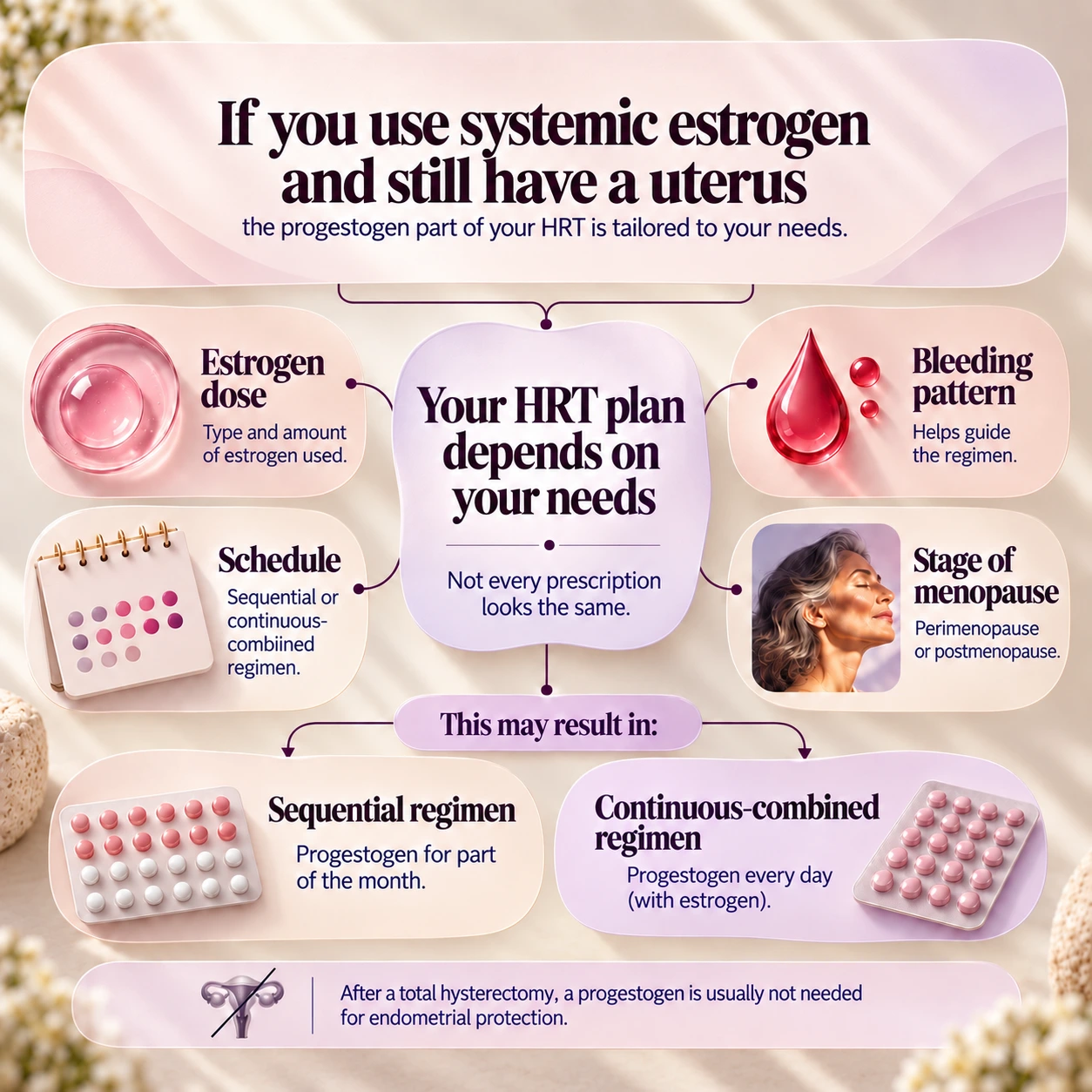
That protection depends on more than the name of the progestogen. The estrogen dose, the progestogen dose, and the number of days it is taken all matter. In practice, sequential regimens provide a progestogen for part of the month, while continuous-combined regimens provide it every day. The right schedule depends on the woman’s stage of menopause, bleeding pattern and overall treatment plan.
(National Library of Medicine)
This is why copying another woman’s HRT prescription can be misleading. Two women may both say they are “on HRT,” but that does not mean they are getting the same level of endometrial protection.
Women who have had a total hysterectomy usually do not need a progestogen for endometrial protection, although some situations still require individual clinical assessment.
For women who do need one, both micronized progesterone and synthetic progestins can be used. So the next step in the comparison is not whether they can do the job at all. It is how they may differ while doing it.
Micronized Progesterone and Synthetic Progestins Can Both Protect the Endometrium
This matters because there is sometimes an assumption that synthetic progestins are simply a lesser substitute for “real” progesterone. That is not an accurate way to understand HRT.
When prescribed in the right dose and regimen, both micronized progesterone and several synthetic progestins can protect the endometrium effectively. In other words, the key issue is not whether one category works and the other does not. The more important issue is whether the progestogen is being used in a way that gives the uterus enough protection.
That is also why inadequate exposure matters. Too little progestogen, too few days of use, or a mismatch between estrogen dose and progestogen cover can leave the endometrium under-protected.
So micronized progesterone has a valid and important place in HRT, but not because synthetic progestins “do not work.” They do. The more useful comparison begins when we look beyond the uterus and ask whether these options differ in tolerability, side effects and wider risk profile.
(National Library of Medicine)
The Differences Begin to Matter Beyond the Uterus
Once endometrial protection is taken care of, the choice of progestogen does not suddenly become irrelevant. This is where the differences between micronized progesterone and synthetic progestins become more personal.
Synthetic progestins are not all the same medicine. Medroxyprogesterone acetate, norethisterone, levonorgestrel and other progestogens have different chemical structures and biological effects. Micronized progesterone is different again.
That is why researchers have looked at whether the type of progestogen might influence things such as blood-clot risk, metabolic effects, breast-cancer risk and how well a woman tolerates her HRT.
For vascular risk, the evidence is encouraging but not absolute. A systematic review found that menopausal hormone therapy containing micronized progesterone did not appear to increase venous or arterial thromboembolic risk in the studies reviewed, although the authors also stressed that stronger randomised evidence is still needed.
Breast-cancer risk needs even more caution. Some observational research has suggested that micronized progesterone may have a more favourable profile than certain synthetic progestins. But NICE currently says there is not enough evidence to establish that breast-cancer risk is different with micronized progesterone compared with other progestogens.
That is an important distinction for the reader: a possible advantage is not the same as a proven safety advantage. (NICE)
The Differences Begin to Matter Beyond the Uterus
Once endometrial protection is covered, the choice of progestogen becomes more individual.
Micronized progesterone and synthetic progestins can differ in how they are tolerated and in what research suggests about some wider risks. But those differences are not equally certain, and they do not make one option universally better for every woman.
For vascular risk, some evidence suggests micronized progesterone may have a more favourable profile than certain synthetic progestins, although stronger randomized evidence is still needed.
Breast-cancer risk needs even more caution. Some observational studies suggest possible differences between progestogens, but current guidance does not consider the evidence strong enough to say that micronized progesterone definitively carries a lower breast-cancer risk than other progestogens.
So the useful question is not simply “Which one is safer?” It is which differences are established, which are still emerging, and which ones matter for you.
How You Feel on the Progestogen Matters Too
Population-level risk is only part of the decision. The other part is much more immediate: how the treatment actually feels in your body.
Some women tolerate one progestogen easily and struggle with another. Bloating, breast tenderness, headaches, changes in bleeding, mood symptoms or drowsiness can all influence whether an HRT regimen feels manageable enough to continue.
Micronized progesterone, for example, can cause drowsiness in some women because of the way progesterone metabolites act in the nervous system. Interestingly, that same effect may be helpful for sleep in some women, although it should not be treated as a general sleep medicine.
What this means in practice is simple: if estrogen is helping but the progestogen is making the overall regimen difficult to tolerate, the answer may be to review the type, dose, route or schedule rather than assume HRT itself is not suitable.
And that is also why labels such as “natural progesterone” can sometimes be misleading. How a hormone sounds is not the same as how appropriate it is for a particular woman.
“Natural Progesterone” Does Not Mean Risk-Free
The phrase “natural progesterone” can sound automatically reassuring, but it describes the hormone’s structure, not its entire safety profile.
Micronized progesterone is body-identical, but it is still a prescription hormone with specific dosing requirements, possible side effects and situations where clinical assessment matters.
That is why the most useful question is not whether a hormone is “natural” or “synthetic,” but whether the specific option fits your HRT regimen, health history and how you respond to treatment.
What Actually Guides the Choice
So if “natural” or “synthetic” is not enough to decide, the choice comes back to you rather than the label on the hormone.
A clinician will usually look at the bigger picture: your medical history, clotting and breast-risk factors, other medicines, bleeding pattern, side effects, and how you have responded to HRT so far. Practical things matter too. A regimen that is difficult to tolerate or remember may not be the right regimen for you, even if it looks appropriate on paper.
Your priorities are part of that decision as well. One woman may be most concerned about troublesome bleeding. Another may be struggling with drowsiness or mood changes. Someone else may have health factors that make the route or type of hormone particularly important.
That is why there is no single progestogen that can be called the “best” for every woman. The aim is to find the dose, type and regimen that provide the protection you need while fitting your individual risk profile and remaining tolerable enough to use consistently. Current Indian Menopause Society guidance similarly emphasizes individualized menopause care rather than a one-size-fits-all approach.
(National Library of Medicine)

The Better Question Is Not “Which One Is Better?”
Micronized progesterone and synthetic progestins can both have a place in HRT. What matters is whether the type, dose and schedule suit your health history, estrogen regimen and how you feel on treatment.
So instead of asking, “Which progesterone is best?”, ask:
“Why is this option the right fit for me?”
If your current HRT is helping but still does not feel quite right, MIROR’s HRT Centre of Excellence can help review the full regimen with a menopause-focused clinician.
The goal is not the most reassuring label. It is the HRT plan that makes sense for you.