

Can’t find your estrogen gel in India?
If you searched for “estrogen gel India” because the product your doctor prescribed is difficult to find, you are probably wondering whether another brand or formulation can be used instead.
The answer depends on more than what is currently in stock. Different estrogen products may vary in how they are delivered and dosed, and the reason your doctor chose a particular route may also matter.
Before switching anything, the first step is to understand exactly what part of your prescription you are unable to find.
First check exactly what is unavailable
When a pharmacy says your estrogen gel is “not available”, that can mean different things. It may be a local stock issue, a problem with one particular product, or simply that the pharmacy does not carry the preparation you were prescribed.
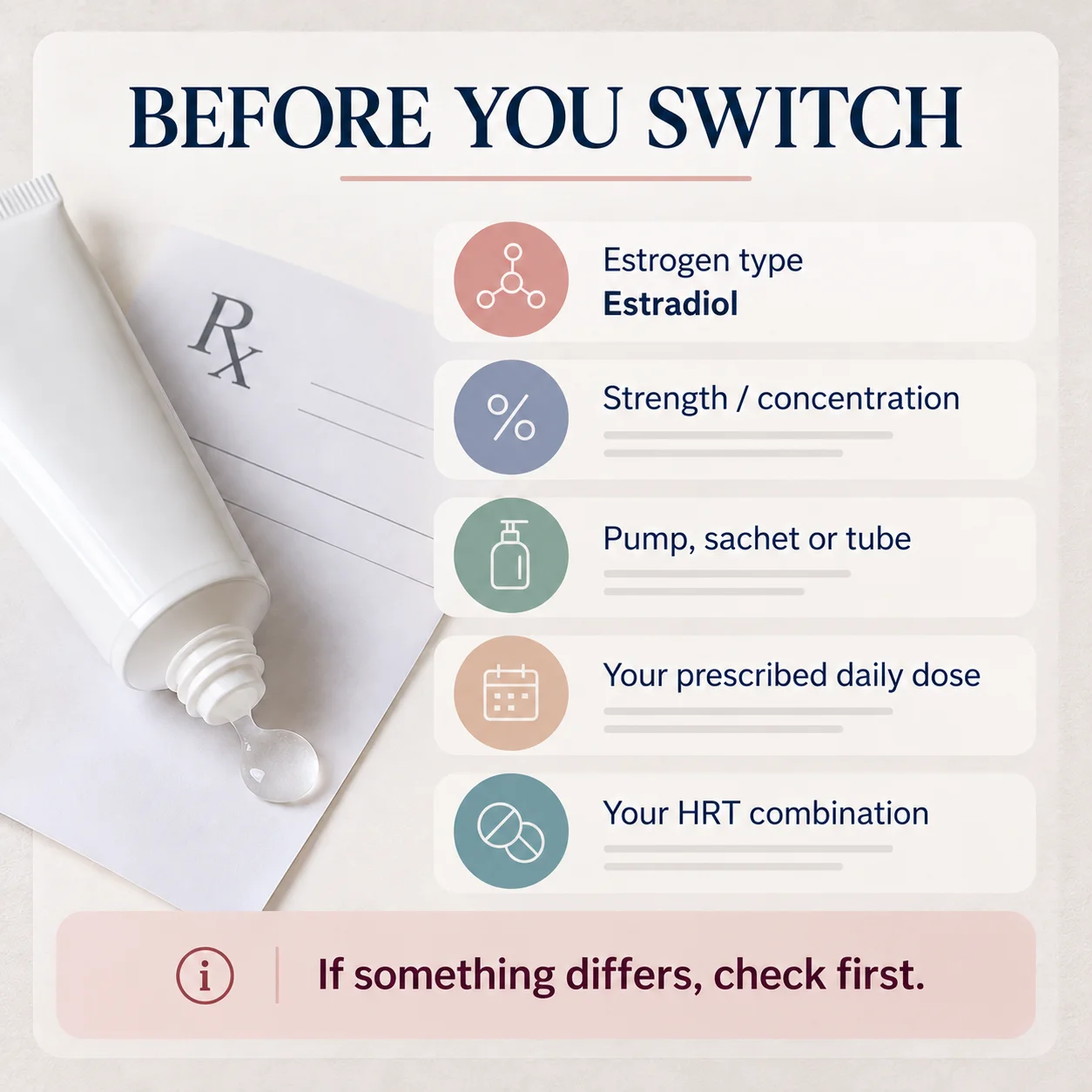
That distinction matters because the next product you are offered may look similar without being a straightforward substitute. Before you agree to a switch, there are a few details on your current prescription or pack worth checking.
Estrogen gel India: can another gel be used instead?
Possibly, but two estrogen gels should not be treated as automatically interchangeable just because they both contain estradiol.
Different preparations can deliver different amounts of estradiol with each pump, sachet or measured dose. Even when clinicians use dose-equivalence guidance, those comparisons are approximate because absorption and metabolism can vary between women.
So if your usual gel is unavailable, the useful question is not simply, “Does this product also contain estradiol?” It is whether the alternative gives you an appropriate dose for your existing HRT plan.
Can another estrogen gel be used instead?
Possibly, but two estrogen gels should not be treated as automatically interchangeable just because they both contain estradiol.
Different preparations can deliver different amounts of estradiol with each pump, sachet or measured dose. Even when clinicians use dose-equivalence guidance, those comparisons are approximate because absorption and metabolism can vary between women.
So if your usual gel is unavailable, the useful question is not simply, “Does this product also contain estradiol?” It is whether the alternative gives you an appropriate dose for your existing HRT plan.
That is something your doctor or prescribing clinician should confirm rather than relying on a like-for-like swap based only on the packaging.
What if another transdermal option is available?
If the exact gel you use cannot be sourced, your doctor may consider another way of delivering estrogen through the skin, such as a patch or spray.
These options belong to the same transdermal route, but they are different preparations and need to be prescribed at an appropriate dose. The choice may also depend on what is practical for you, what you tolerate well and what is reliably available.
For some women, staying with a transdermal form of estrogen is clinically important. Current guidance particularly favours this route when factors such as an increased risk of blood clots make oral estrogen less suitable.
If a suitable transdermal alternative is not available, the next decision is whether switching to an estrogen tablet would be appropriate for you. (NICE)
Why switching from gel to a tablet is a different decision
If a suitable transdermal option cannot be found, your doctor may discuss oral estrogen with you. But this is a bigger change than switching from one gel to another.
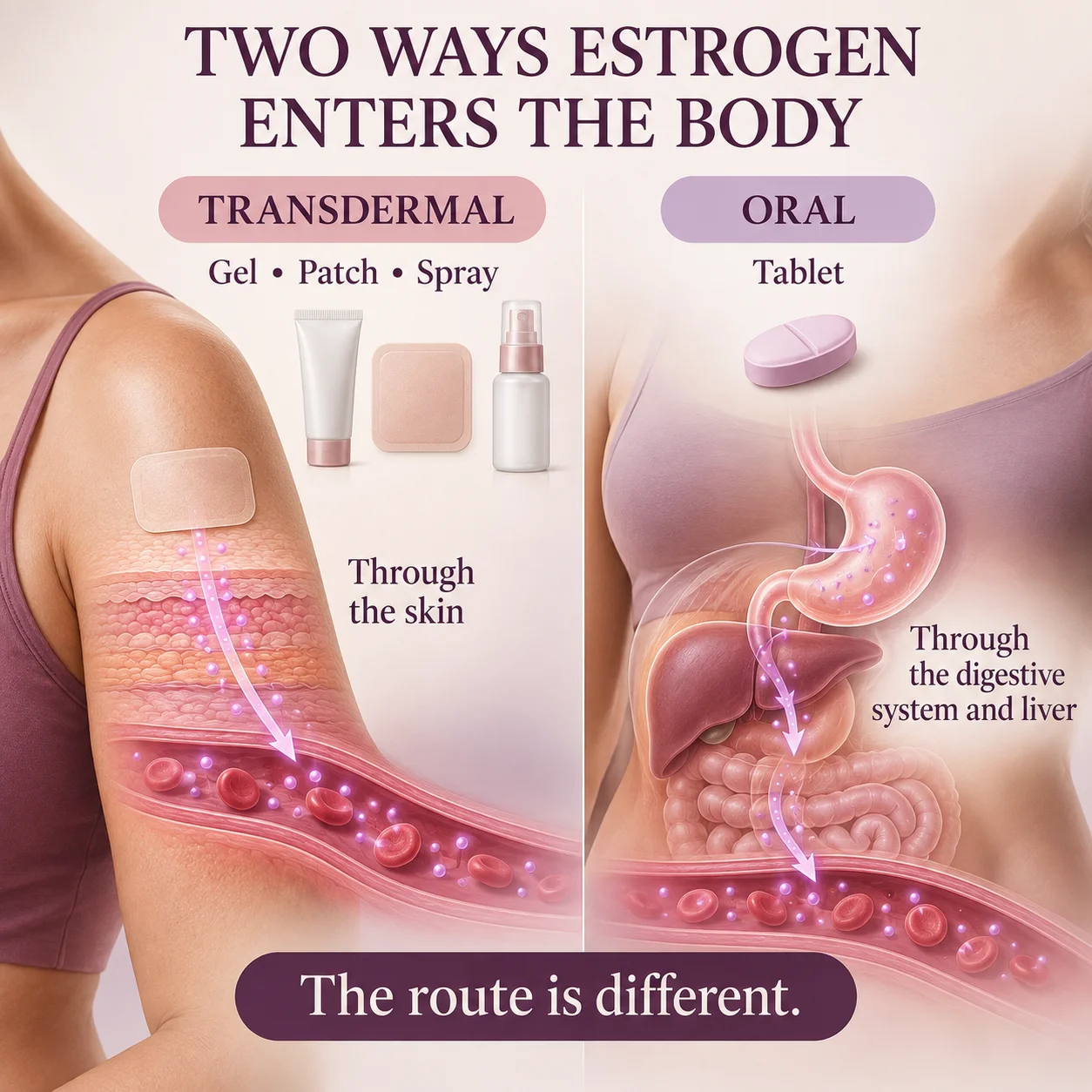
The route of estrogen can affect its risk profile. The 2026 Indian Menopause Society guidelines recommend considering a woman’s individual vascular and metabolic risks when choosing HRT, with transdermal estrogen preferred in some clinical situations. NICE similarly notes that blood-clot risk is higher with oral HRT than with transdermal HRT.
So if your doctor originally chose transdermal estrogen for a particular reason, it is worth checking whether that reason still makes staying with this route important for you. (PubMed)
Does changing estrogen affect the rest of your HRT plan?
Sometimes. If you have a uterus and use systemic estrogen, your HRT will usually also include a progestogen to protect the lining of the uterus. NICE recommends combined estrogen and progestogen HRT for women with a uterus rather than estrogen alone.
If your replacement estrogen changes the dose you are receiving, your doctor may also need to check whether the progestogen part of your prescription is still appropriate. Current British Menopause Society guidance recommends that progestogen dosing should be considered in relation to the estrogen dose.
This does not mean that every change in estrogen requires a change in progesterone or another progestogen. It simply means the prescription should be reviewed as one HRT regimen rather than changing one part in isolation.
What should you take to your HRT appointment?
You do not need to arrive knowing which replacement product you want. What is more useful is giving your doctor a clear picture of the HRT you are currently using and the supply problem you are facing.
A few simple details can make that conversation much easier.
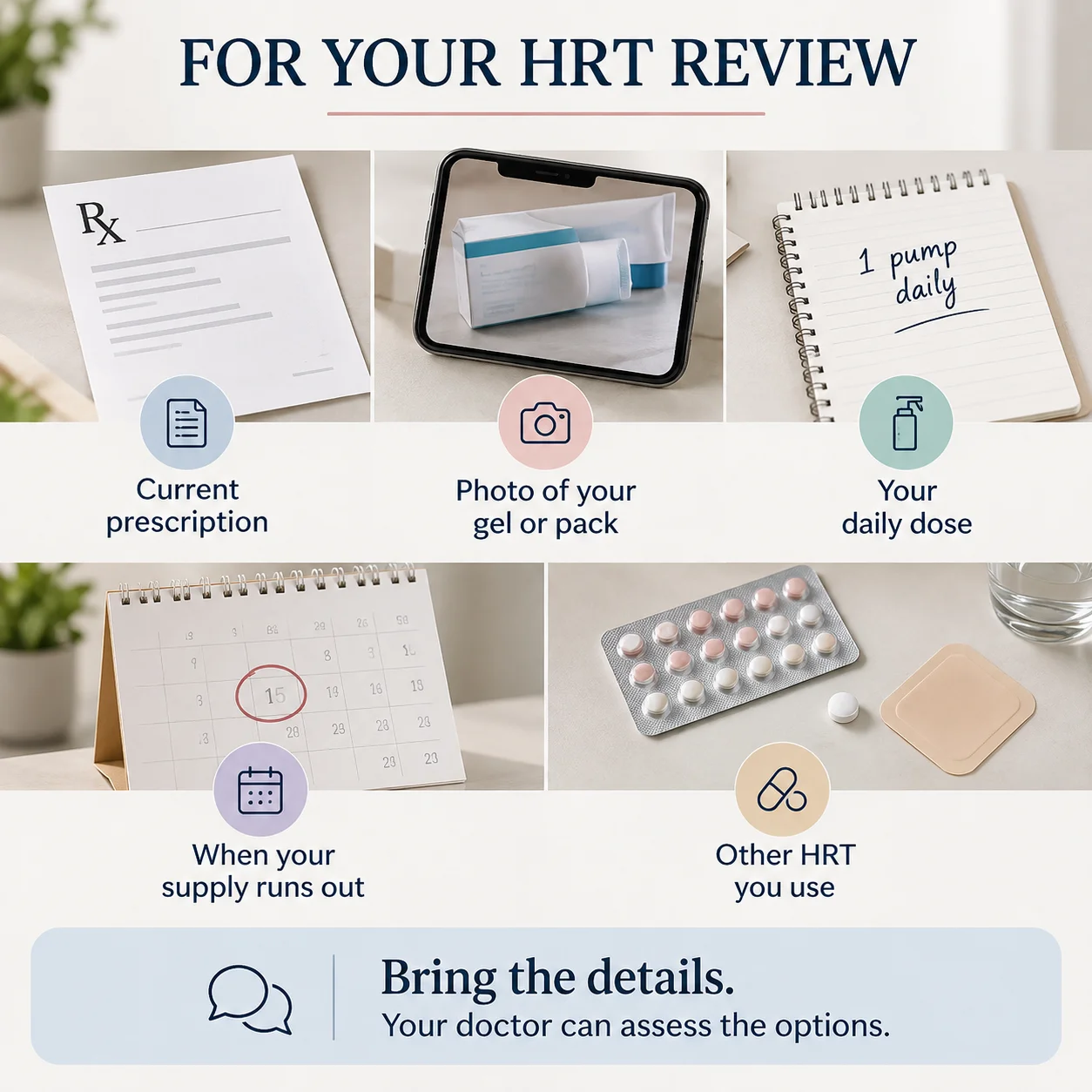
With that information, your doctor can assess whether another gel, a different transdermal option or an oral preparation would be appropriate for you without having to reconstruct your current treatment from memory. (PubMed)
Estrogen gel is not the same as vaginal estrogen
When searching for an alternative, you may also come across estrogen creams, vaginal gels, tablets or pessaries. These are not automatically substitutes for the systemic estrogen gel used as part of menopause HRT.
Systemic estrogen gel is absorbed through the skin and circulates throughout the body. Low-dose vaginal estrogen, by contrast, is primarily used to treat local symptoms such as vaginal dryness and urinary discomfort.
So if a pharmacy offers you a product simply because it also contains estrogen, check with your doctor or pharmacist before assuming it can replace your usual gel.(PubMed)
What if you run out before you can speak to your doctor?
If you miss a daily dose of estrogen gel because you have run out, do not try to make up for it by applying extra gel later. NHS guidance advises skipping a missed daily dose of estrogen gel and using the next dose at the usual time.
If the supply problem is likely to last longer than a missed dose or two, contact your prescribing doctor or pharmacist rather than improvising with another estrogen product or changing the dose yourself.
Your menopause symptoms may return if HRT is interrupted, but how quickly that happens varies from woman to woman. The priority is to work out an appropriate replacement plan rather than compensate for the interruption on your own. (NHS)
What matters when choosing a replacement?
If your usual estrogen gel is difficult to find, the goal is not simply to locate the closest-looking product. It is to find an alternative that still makes sense for the HRT plan your doctor chose for you.
That may mean another gel, a different transdermal preparation or, for some women, oral estrogen. The right option depends on your prescribed dose, medical history and the reason a particular route was recommended in the first place.
If sourcing your HRT has become difficult, MIROR HRT can help you review your current prescription with a women’s health specialist and discuss appropriate alternatives.