

Premenstrual anxiety may be something you’ve known for years.
A few difficult days before your period. More irritability. More overthinking. Perhaps a little crying, poor sleep or the feeling that absolutely everyone is getting on your nerves.
Then, somewhere in your 40s, the pattern changes.
The anxiety starts earlier.
It feels stronger.
It lasts longer.
And the calm days in between seem to be getting shorter.
You may even find yourself thinking: “This used to be PMS. Why does it feel completely different now?”
That question matters.
Perimenopause can bring more irregular cycles, fluctuating hormone levels, sleep disruption and changes in mood. These can overlap with premenstrual symptoms, making it genuinely difficult to work out what has changed.
(menopause.org)
The first step isn’t to blame your hormones or yourself.
It’s to look at the pattern.
1. Not Every Difficult Pre-Period Week Means the Same Thing
Three experiences can look remarkably similar:
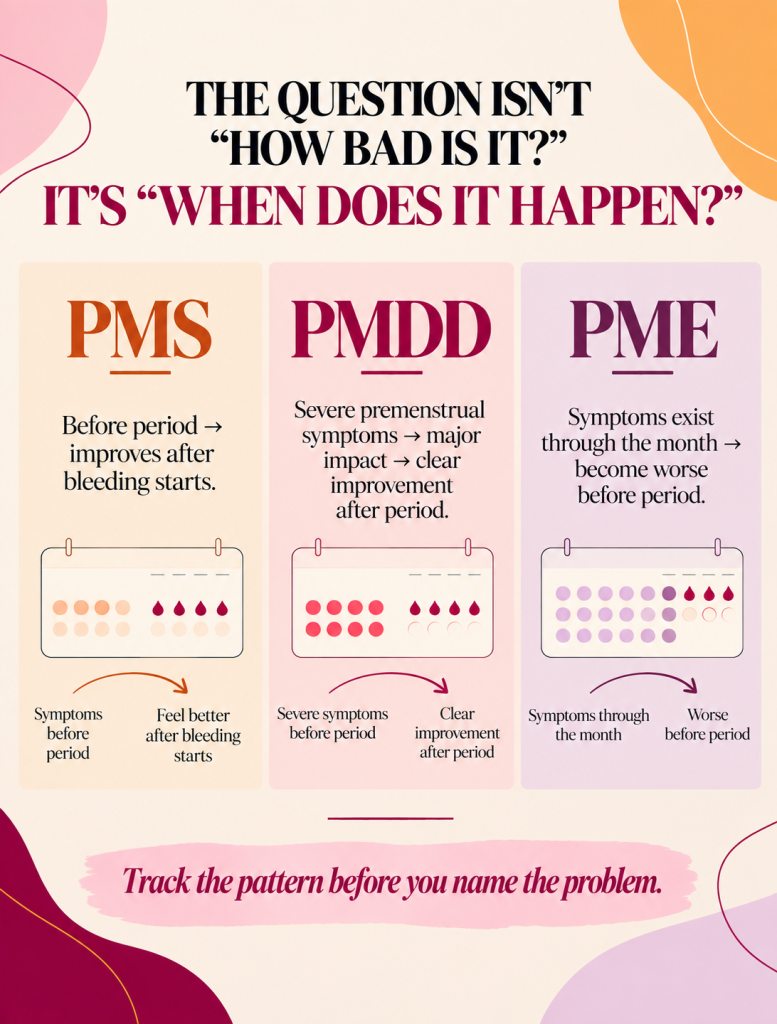
I. PMS
Symptoms appear before your period and improve once menstruation begins. They can include irritability, anxiety, low mood, fatigue and physical symptoms.
II. PMDD
Symptoms are much more severe and can seriously affect work, relationships and everyday functioning. The symptoms are strongly linked to the premenstrual phase and improve after the period begins.
III. Premenstrual Exacerbation — or PME
This is different. An underlying condition such as anxiety or depression is present throughout the month, but becomes noticeably worse before your period.
(PubMed)
That distinction matters because the support you need may be different. And importantly, these aren’t labels to diagnose yourself from one bad month.
2. Perimenopause Can Make an Old Pattern Feel New
Your 40s can bring a particularly confusing combination.
Your cycles may become shorter or more unpredictable. Hormonal fluctuations can become less predictable. Sleep may deteriorate. Hot flashes, fatigue, brain fog and irritability may enter the picture at the same time.
So something that once felt like:
“I get anxious for five days before my period.”
Can start to feel like:
“I’m anxious all the time and then somehow even worse before my period.”
That doesn’t necessarily mean your original PMS has disappeared.
It may mean several things are now overlapping.
3. The “Good Days” Matter Just as Much as the Bad Ones
When you’re suffering, the worst days are the easiest to remember.
But they’re not the only useful information.
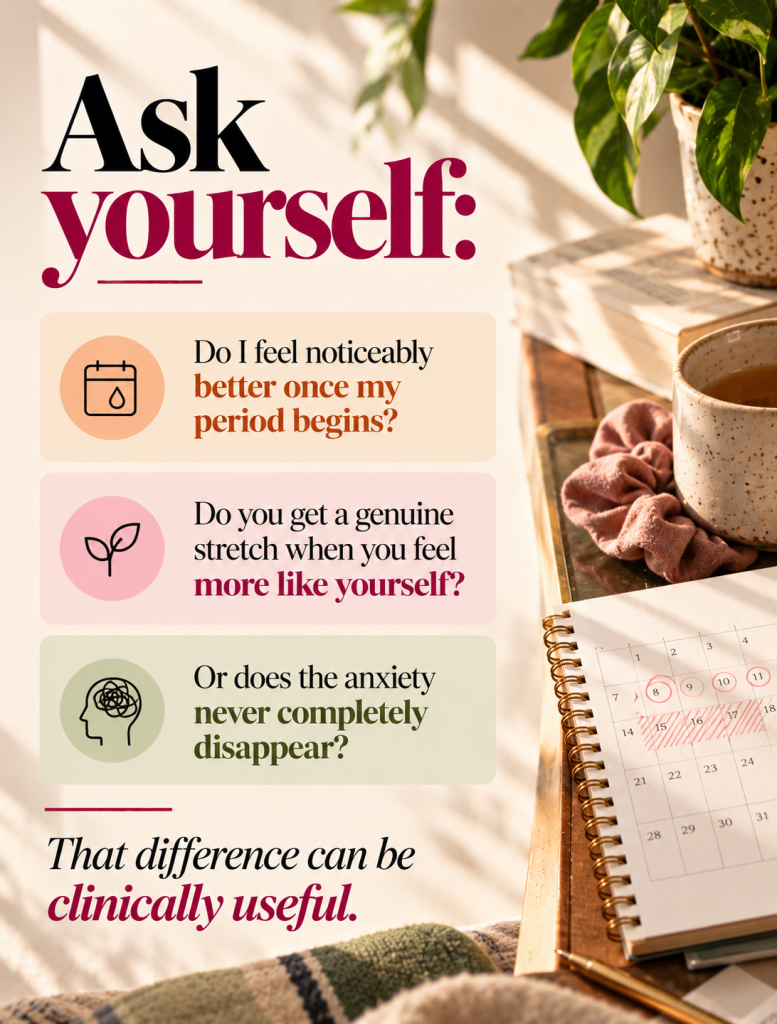
ACOG recommends keeping a daily record of symptoms across multiple cycles when assessing premenstrual disorders because the timing of symptoms helps distinguish cyclical problems from conditions that are present throughout the month.
You don’t have to remember perfectly.
You can simply track what actually happens.
4. Shorter or Unpredictable Cycles Can Make Everything Feel More Intense
Perimenopause can change the rhythm you’re used to.
Some cycles become shorter. Others become longer. Periods may become less predictable altogether. (menopause.org)
That can make emotional patterns difficult to recognise.
You may think: “I’m anxious again already.”
But you may not realise that your cycle itself has changed.
The old calendar you used in your 20s and 30s may simply no longer fit your body.
This is one reason cycle tracking becomes especially useful in your 40s.
5. Your Anxiety May Be Worse Before Your Period; But Not Only Because of Your Period
This is where life enters the picture.
Perhaps you’re sleeping badly.
You’re caring for ageing parents.
Your children need you in a completely different way.
Work feels relentless.
Your relationship is strained.
You are already physically exhausted.
Then your premenstrual days arrive.
What might once have been manageable suddenly feels enormous.
That’s not “making it up.”
And it isn’t necessarily one thing causing another.
Hormonal changes, sleep, stress, physical symptoms and emotional load can all interact.
For many women, the question isn’t:
“Is this hormones or stress?”
It’s:
“How much of each is happening at the same time?”
6. The Things You Say to Yourself During Those Days Matter Too
There is another layer that can make cyclical anxiety much harder.
You notice yourself becoming irritable.
You cancel plans.
You snap at someone you love.
Then comes the guilt: “What’s wrong with me?”
So the difficult few days become followed by another difficult emotion — shame.
Try not to turn a symptom into a character judgement.
Feeling more emotionally reactive during part of your cycle does not make you a bad partner, mother, daughter, colleague or friend.
It does mean something is worth paying attention to.
7. Tracking Can Turn “I Don’t Feel Like Myself” Into Something You Can Work With
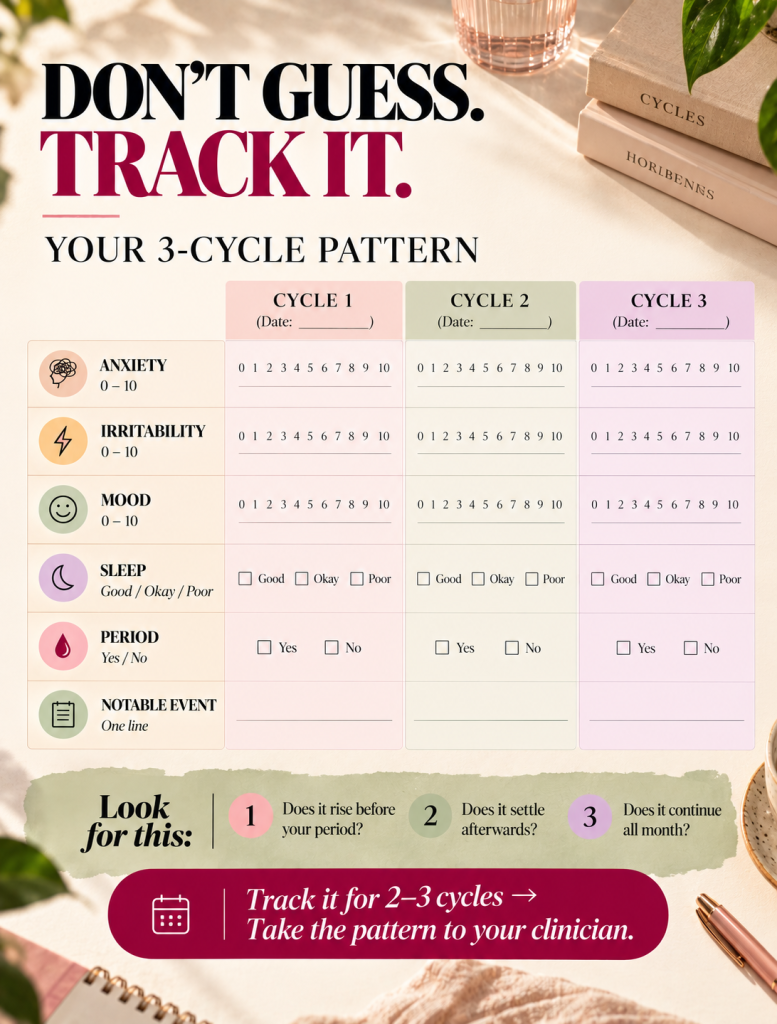
For two or three cycles, make a very simple daily note.
Record:
Anxiety: 0–10
Irritability: 0–10
Mood: 0–10
Sleep: good / okay / poor
Period: yes / no
Anything significant: one sentence
Most importantly, write on the good days too.
You’re looking for the pattern.
Does anxiety rise before every period and then settle?
Does it remain present throughout the month?
Has the “good” stretch become noticeably shorter?
That information can help a clinician understand what you’re experiencing far more clearly than: “It gets really bad sometimes.”
ACOG recommends daily symptom recording across cycles when evaluating premenstrual symptoms, and prospective tracking is an important part of confirming a cyclical pattern. (ACOG)
What Helps?
Once you understand the pattern, there is something important you can do:
Stop treating every difficult day as proof that something is wrong with you.
Psychological support may help you understand the emotional changes, reduce self-blame, manage anxiety, improve communication with the people around you and make room for the parts of your life that become harder during those days.
A gynaecologist can assess menstrual and perimenopausal changes and discuss medical options where appropriate. A psychologist can help you understand what happens emotionally around those changes.
You don’t have to choose one kind of care.
When You Shouldn’t Just “Wait for Your Period”
Please seek professional help if your symptoms are interfering with work, relationships or everyday life, if anxiety is present through most of the month, or if you increasingly avoid normal activities.
And there is one thing that should never be normalised because it happens before your period.
Thoughts of suicide or self-harm need to be taken seriously, even if they disappear when your period begins.
Please tell a doctor or mental-health professional. In India, Tele-MANAS is available 24×7 on 14416.
(DGHS)
What I’d Want You to Leave With
You are not imagining it because you’ve had PMS for twenty years and suddenly it feels different.
And you don’t have to decide today whether it’s PMS, PMDD, premenstrual exacerbation or perimenopause.
You can start by noticing the pattern.
Because sometimes the most reassuring thing isn’t another explanation.
It’s finally having enough information to say:
“This is what happens to me. Now I know where to begin.”
How Miror Can Help?
You Don’t Have to Figure It Out Alone!
Your period, hormones, mood, sleep and mental health don’t exist in separate boxes.
Miror is India’s largest and only 360-degree integrative women’s wellness ecosystem and community, bringing expert guidance, health information and support together across the different stages of a woman’s life.
With 95,000+ women, Miror has helped women access expert insights and support at the tip of a button.
Whether you’re trying to understand changing premenstrual anxiety, navigate perimenopause, make sense of mood changes, or simply talk to someone who understands, you can connect with Miror doctors, health experts and mental-health experts through the app.
You don’t have to keep guessing what your body and mind are trying to tell you.
Consult a Miror expert.
Talk to Miror doctors and mental-health experts today.