

This is one of the hardest questions women ask themselves in midlife.
You are tired. More emotional than usual. More anxious.
You are not enjoying things the way you used to.
And then you tell yourself:
Maybe it is just hormones.
Maybe I should wait.
Maybe everyone feels like this.
Other women have it worse.
Many women wait longer than they need to; not because they are not struggling, but because they are unsure whether what they are experiencing is serious enough to seek support.
Here is what I want you to know:
You do not have to reach a crisis point to deserve help.
Menopause can amplify what is already there. Hormonal changes can interact with sleep disruption, physical symptoms, stress, relationship difficulties and existing emotional vulnerabilities. The result can sometimes feel bigger than any one factor on its own.
So rather than asking, “Is this definitely menopause?”
A more useful question is: “Has something changed, and is that change beginning to affect my life?”
This is an important change to notice.
The things, people or places you once enjoyed—or looked forward to—may no longer bring the same interest or pleasure.
Maybe meeting friends feels like a chore.
Your favourite weekend activity feels meaningless.
You stop looking forward to things you once loved.
If this loss of interest persists, affects your daily life or keeps getting worse, it is time to seek professional support.
You do not need to work out whether it is depression, menopause or something else first.
A professional can help you understand what is happening.
Anxiety becomes important to address when it begins affecting how you live.
You may find that everyday routines start to cause stress and anxiety.
Getting ready for work feels overwhelming. Simple decisions take too much energy. You are constantly worrying about what might go wrong.
Or you find yourself avoiding things because they feel too difficult.
When anxiety starts disrupting your routine, sleep, relationships, health or work, it deserves professional attention.
Menopause anxiety treatment is not about telling you to “calm down.”
It is about understanding what you are experiencing and finding the right support.
You are going to work.
You are answering messages.
You are taking care of your family.
You are doing what needs to be done.
But everything feels harder than it used to.
The effort required to get through an ordinary day has increased.
You may feel like you are functioning on the outside while struggling on the inside.
Functioning is not the same as feeling well.
If everyday life is taking significantly more effort, or you feel that you are simply getting through the day rather than living it, that is worth discussing with a professional.
Sometimes other people notice the change before you do.
You may withdraw from friends. Snap at your partner. Avoid conversations. Feel emotionally distant from your children.
Or find yourself apologising repeatedly because you do not feel like yourself.
This is not necessarily about one relationship problem.
It can be a sign that something broader is affecting your emotional wellbeing.
Sometimes the clearest signal is also the simplest: “I don’t want to keep living like this.”
Maybe you are exhausted from pretending you are fine.
Maybe everything feels heavier than it should.
Maybe you feel hopeless.
Maybe you no longer recognise yourself.
That is enough reason to reach out.
And if you are experiencing thoughts of self-harm, feel unable to keep yourself safe, or are experiencing severe psychological distress, seek urgent professional help.
You do not need to wait until things become unbearable.
One of the biggest mistakes we can make is treating anxiety, sleep, mood and physical symptoms as separate problems.
They often affect one another.
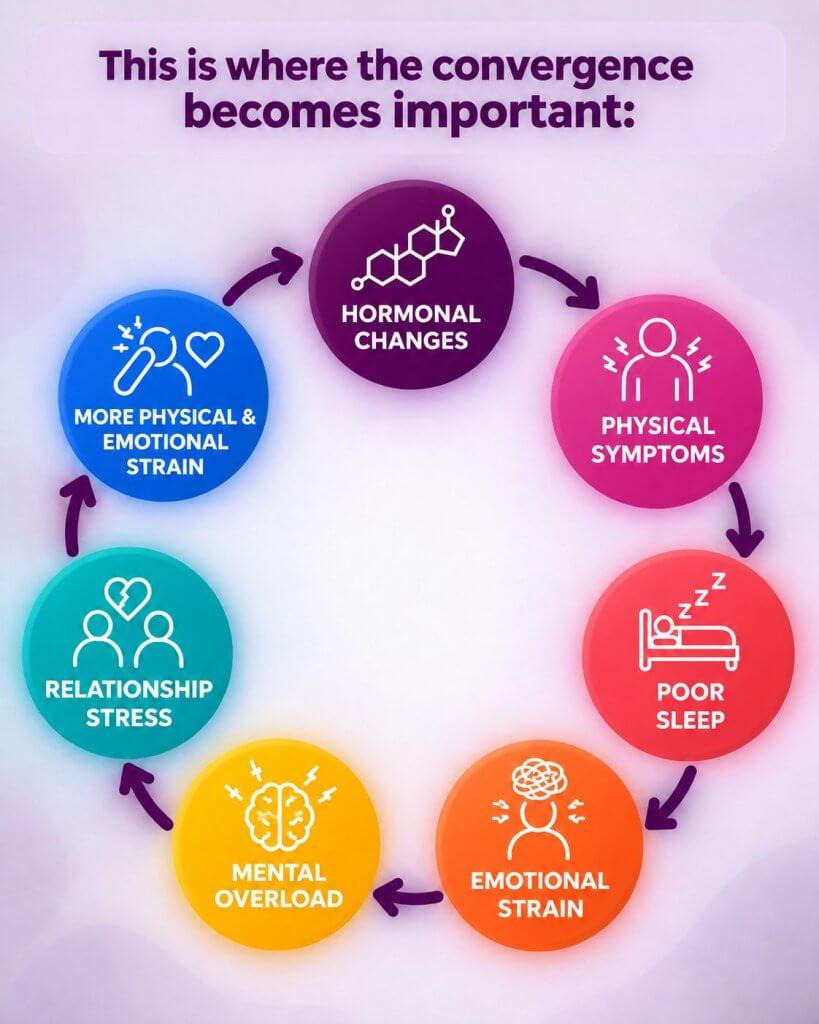
And the cycle can begin again.
Poor sleep can make emotional stress harder to manage. Emotional distress can affect relationships. Relationship stress can increase anxiety. Anxiety can make sleep more difficult.
Physical symptoms can make everything feel harder to carry.
This is why menopause mental health needs to be looked at as a whole; not as one isolated symptom.
And you do not need to work out where the cycle started.
You just need to notice when the cycle is beginning to affect your life.
Here is the simplest way I would put it:
If your symptoms are disrupting your routine, health, relationships or career or if they are persistent or getting worse; it is time to speak to a professional.
You don’t need to prove that you are “suffering enough.”
You don’t need to diagnose yourself.
And you don’t need to wait until someone else tells you that you look unwell.
Sometimes the most important sign is simply: “I know something has changed.”
That is enough to start a conversation.
There is no single treatment that works for every woman.
Depending on your symptoms and medical history, a healthcare professional may discuss:
For some women, menopause-related mood symptoms may be treated with hormone therapy where clinically appropriate. Whether HRT is suitable depends on your individual medical history, symptoms and risks.
A therapist experienced in menopause can help with anxiety, low mood, emotional overwhelm, identity changes, relationship strain and the psychological impact of physical symptoms.
Medication may be appropriate for some women depending on the severity and nature of their symptoms. This is a decision to make with a qualified prescriber.
Sometimes more than one form of support is appropriate.
The important thing is not to decide on treatment by yourself.
Get assessed first.
You do not necessarily have to choose between a doctor and a therapist.
A doctor or menopause specialist can assess the physical and hormonal picture and discuss appropriate medical options.
A psychologist or therapist can help you understand the emotional and psychological side of what you are experiencing.
A good therapist for menopause does not treat menopause as the entire explanation.
But they do not ignore it either.
Good care holds the body and the mind together.
At Miror, we believe women’s health works as an ecosystem—not as separate symptoms handled in separate rooms.
Hormonal health affects physical wellbeing.
Physical symptoms can affect sleep.
Sleep affects mood and mental health.
Mental health affects relationships, confidence and everyday functioning.
That is why Miror is built as a 360-degree integrative women’s health ecosystem, bringing together doctors, psychologists, health experts and a community of thousands of women navigating different stages of their health journey.
Sometimes you need a doctor.
Sometimes you need a psychologist.
And sometimes you need a community where you can simply say:
“I am not okay today.”
That is where the Miror Community matters.
But the real value is having a support system around you.
If anxiety, low mood or emotional changes are affecting your daily life, speak to a Miror expert and connect with a community that understands the whole picture.
You do not have to prove that you are struggling enough.
If something has changed, is persisting, is getting worse, or is making your life smaller, that is enough reason to talk to someone.
Getting help is not admitting that you cannot cope.
It is deciding that you do not have to cope alone.
This article is for educational purposes only and does not provide a diagnosis, treatment plan or replacement for psychological, psychiatric or medical care. Menopause-related mood symptoms can overlap with depression, anxiety disorders and other medical conditions. Please speak to a qualified healthcare or mental-health professional for personalised assessment and treatment.