


Panic attacks during perimenopause can make a first panic attack feel terrifying..
Especially when the sensations arrive suddenly and seem to come from nowhere.
You remember the first one.
Where you were. What time it was.
What your heart was doing.
For many women, a first panic attack is terrifying precisely because they have never experienced anything like it before.
The heart races. The chest feels tight. You feel dizzy, shaky or detached from yourself. And then comes the thought: “Something is seriously wrong.”
That experience can become especially confusing during perimenopause, when your body is already producing unfamiliar sensations. Anxiety symptoms are common around the menopausal transition, but that doesn’t mean every panic attack is “just hormones.”
The psychology becomes important in what happens after the first attack.
(Mirorpedia)
1. A Panic Attack Can Begin With a Body Sensation
Panic doesn’t always begin with:
“I’m worried about something.”
Sometimes it begins with:
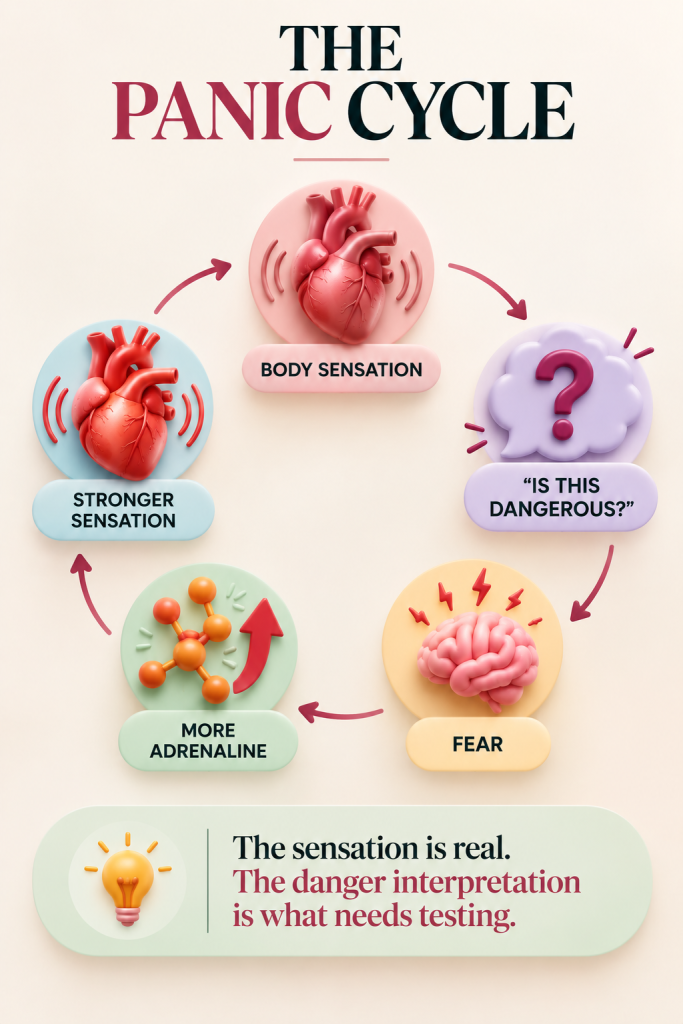
A racing heart → a sudden flush → dizziness → breathlessness → tingling
Then your brain tries to explain it.
“Why is this happening?”
That question can quickly become:
“What if something is seriously wrong?”
In panic, frightening interpretations of bodily sensations can amplify fear and physical arousal. This catastrophic-misinterpretation pattern is a well-studied psychological mechanism in panic disorder.
2. Perimenopause Can Give the Cycle More Fuel
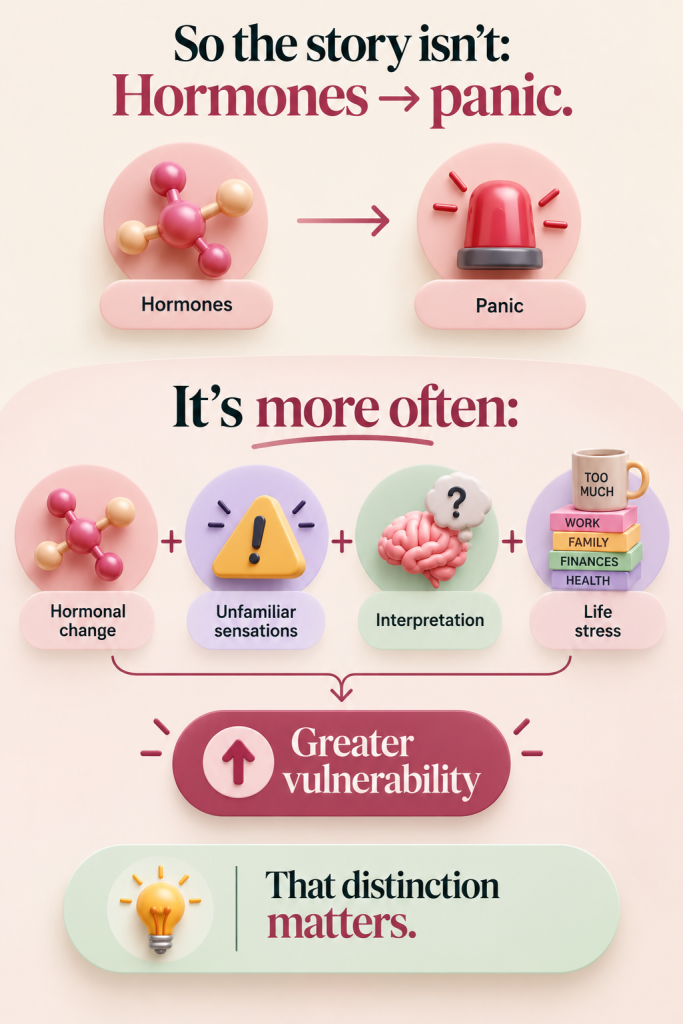
This is where perimenopause anxiety can feel different from anxiety you’ve experienced before.
Hormonal fluctuation can occur alongside:
palpitations
hot flushes
sleep disruption
headaches
dizziness
changes in mood
Those sensations can become raw material for an anxious brain to monitor. Research increasingly views perimenopause as a period of vulnerability for anxiety symptoms, while also recognising the role of stress, sleep and social factors.
(ScienceDirect)
3. The Second Attack Is Often Worse Than the First
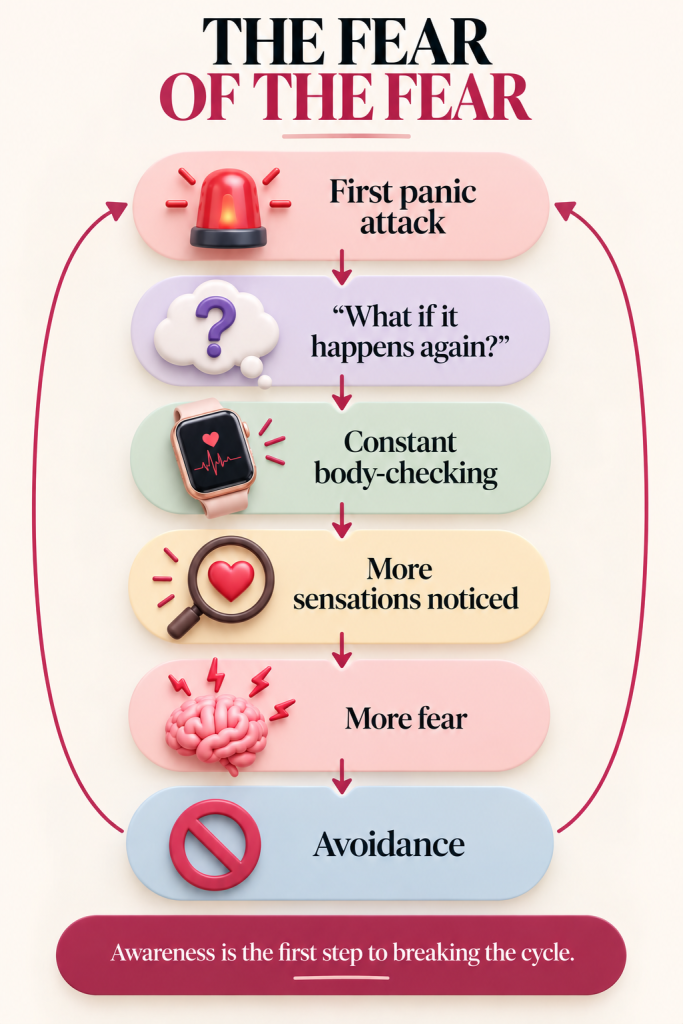
The first attack frightens you.
The fear of another attack can then become the bigger problem.
You start thinking:
“What if it happens at work?”
“What if I faint in public?”
“What if I can’t get home?”
You begin checking how your body feels before leaving the house. This is called anticipatory anxiety.
The attack hasn’t happened but your brain is already preparing for it.
4. Safety Behaviours Feel Helpful. They Can Keep Panic Going.
You carry water everywhere. You sit near the exit. You check your pulse. You keep your phone in your hand. You avoid driving alone. You ask someone to stay with you.
These behaviours make sense. They reduce fear in the moment.
But when they become necessary for you to feel safe, your brain can learn:
“I survived because I did that.”
So you never get the chance to discover:
“Maybe I could have handled the sensation without it.”
This is why reducing safety behaviours is an important part of CBT for panic.
5. Why 3AM Panic Feels Particularly Horrible
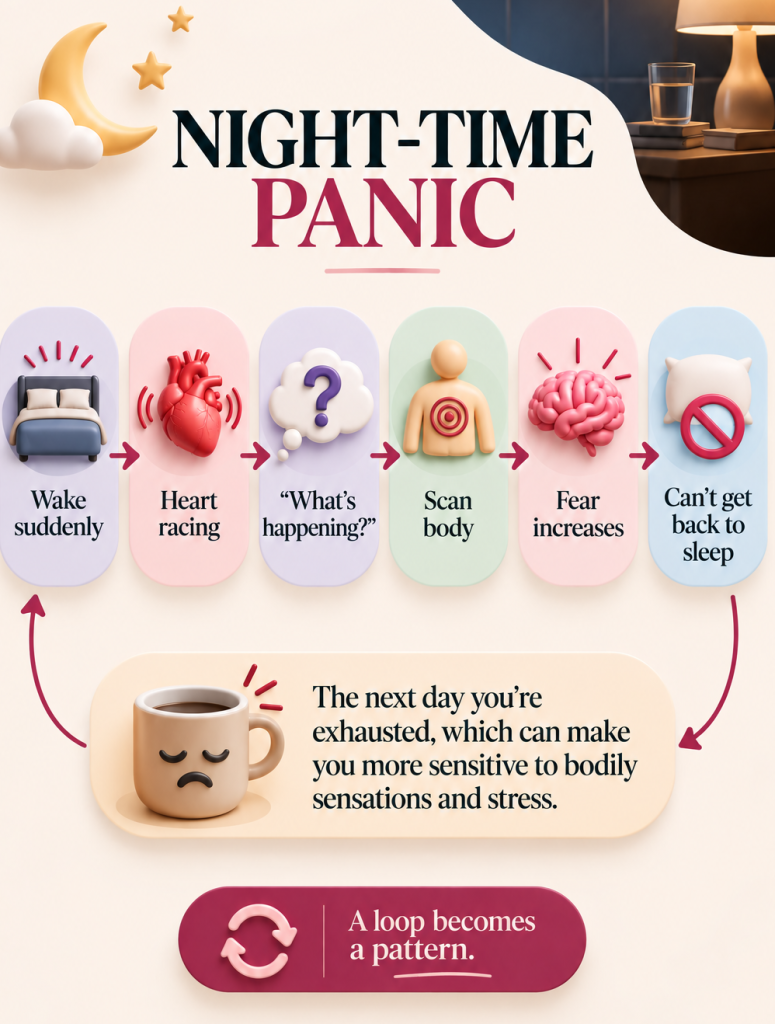
Night-time is almost designed to make bodily sensations feel enormous.
You’re half asleep. The room is silent.
There are no distractions.
You wake with your heart pounding; perhaps after a hot flush or night sweat and immediately notice everything your body is doing.
There is no context. So your brain fills in the gap.
6. What Actually Breaks the Panic Cycle?
This is where therapy becomes much more than “calm down”.
Therapy for panic disorder works on the specific processes maintaining the attacks. NICE recommends therapy as the psychological treatment for panic disorder.
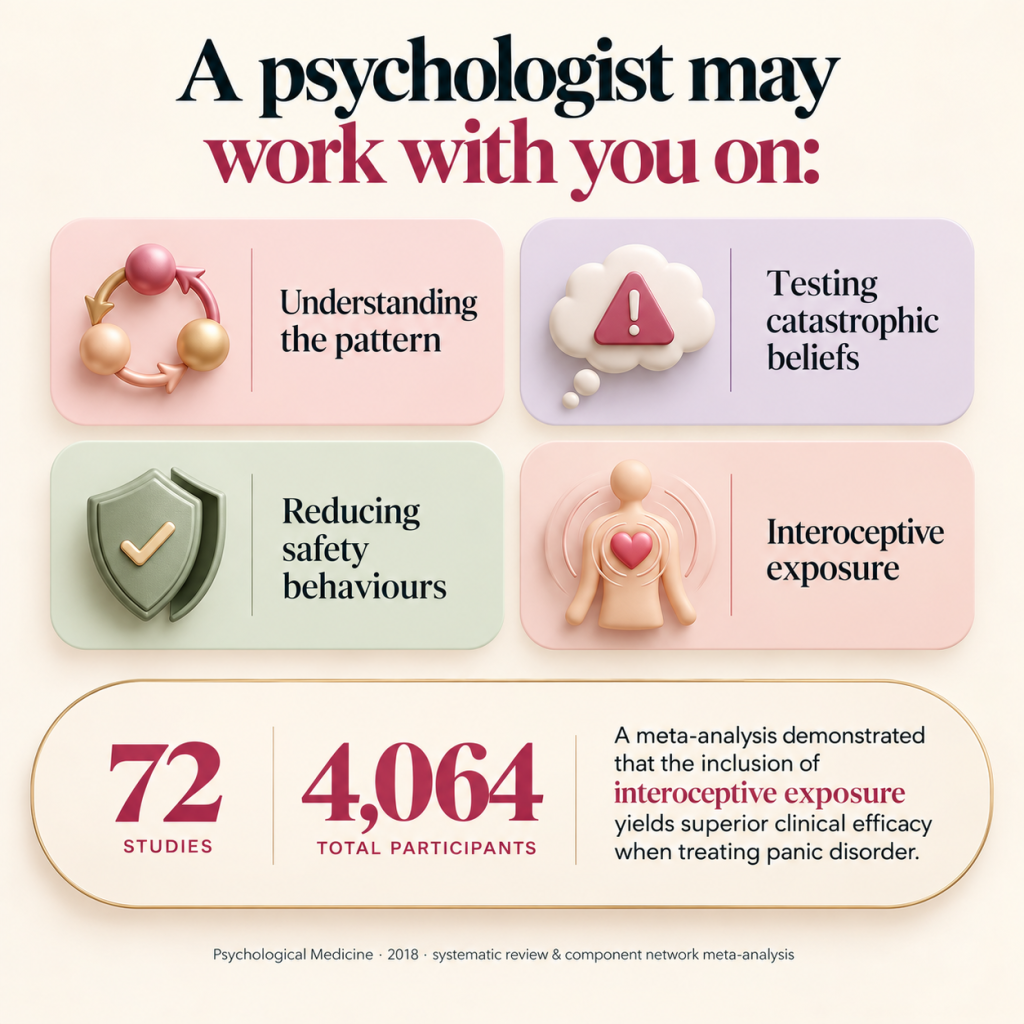
A psychologist may work with you on:
Understanding the pattern
What did you feel? What did you think it meant? What did you do?
Testing catastrophic beliefs
Is a racing heart evidence of danger or simply evidence that your alarm system is activated?
Reducing safety behaviours
Gradually discovering that you can tolerate sensations without checking or escaping.
Interoceptive exposure
Under professional guidance, deliberately experiencing feared bodily sensations so they stop automatically signalling catastrophe. A component network meta-analysis of 72 studies found interoceptive exposure was associated with better treatment efficacy and acceptability.
You Don’t Have to Choose Between Medical and Psychological Care
A psychologist shouldn’t tell you: “It’s all in your head.”
And a doctor shouldn’t have to solve the psychological cycle alone.
New or significant physical symptoms still deserve medical assessment because thyroid problems, anaemia, heart rhythm disorders, blood-sugar abnormalities and other conditions can mimic panic.
At the same time, once appropriate medical causes have been considered, repeatedly checking for reassurance can become part of the anxiety cycle.
This is where integrated care makes sense:
| Medical side | Psychological side |
|---|---|
| Assess physical symptoms | Understand the panic cycle |
| Review menopause symptoms | Challenge catastrophic interpretations |
| Discuss appropriate medical treatment | Reduce safety behaviours |
| Investigate persistent physical concerns | Work on avoidance and anticipatory anxiety |
What I’d Want You to Know
A first panic attack can make you question your body.
A second can make you question your confidence.
A third can make you start changing your life around the possibility of another one.
That’s the part worth interrupting.
You don’t need to prove that your sensations aren’t real. You need to learn that a sensation is not automatically a catastrophe.
And you need to discover, gradually and safely, that you can experience the sensation without letting it decide what you do next.
How Miror Can Truly Help You
Perimenopause anxiety can involve biology, sleep, physical sensations, life stress and learned patterns of fear.
Psychological therapy can help with the part that develops around those sensations: catastrophic interpretation, hypervigilance, avoidance and safety behaviours.
When physical symptoms are prominent, psychological support works best alongside appropriate medical assessment rather than instead of it.
Your first panic attack doesn’t have to become your new normal. Understanding the cycle is often the first step towards breaking it.
Talk to Miror’s expert panel of doctors and mental health professionals today.