
“Why Do I Suddenly Feel Like Something Terrible Is Happening?”
Your heart starts racing.
Your chest feels tight.
You feel hot, shaky or breathless.
Your thoughts speed up.
And then comes the scariest thought: “What is happening to me?”
If this has happened during perimenopause or menopause, you may wonder whether you are having a panic attack.
Panic attacks can occur during the menopause transition, but menopause is not necessarily the sole cause. Hormonal fluctuations can interact with sleep disruption, hot flashes, physical symptoms, existing anxiety and life stress, potentially amplifying anxiety that was already there.
So what might actually be happening?
(Mirorpedia)
7 Powerful Truths About Menopause Panic Attacks
1. Panic Can Feel Extremely Physical
One reason panic attacks during menopause can be so frightening is that they may begin with the body rather than an anxious thought.
Your heart races. You sweat. You feel dizzy, shaky, nauseous or short of breath. You may suddenly feel overwhelmed by fear.
These sensations are real.
The important question is not whether you are imagining them. It is important to understand what is causing them – is it panic response, a menopause symptom, or something else.
2. Menopause May Amplify Anxiety, Not Invent It
Menopause does not automatically create an anxiety disorder or panic disorder.
But hormonal fluctuations, poor sleep, hot flashes, physical discomfort and stressful life circumstances can affect emotional wellbeing.
Perhaps you have always been somewhat anxious. Perhaps you have never considered yourself an anxious person.
Then suddenly, your usual coping mechanisms don’t seem to work as well.
You may not have become a different person. Your capacity to absorb stress may simply have changed.
This is one reason peri/menopause panic attacks can seem to appear out of nowhere.
3. Your Body and Mind Can Trigger Each Other
Imagine you experience a sudden hot flash. Your heart starts beating faster.
You notice it and think: “Why is my heart racing?”
That thought creates fear. Fear increases physical arousal. You notice the sensations even more.
Now you are frightened by your own body.
This is a genuine body-mind feedback loop, and poor sleep or emotional exhaustion can make it harder to interrupt.
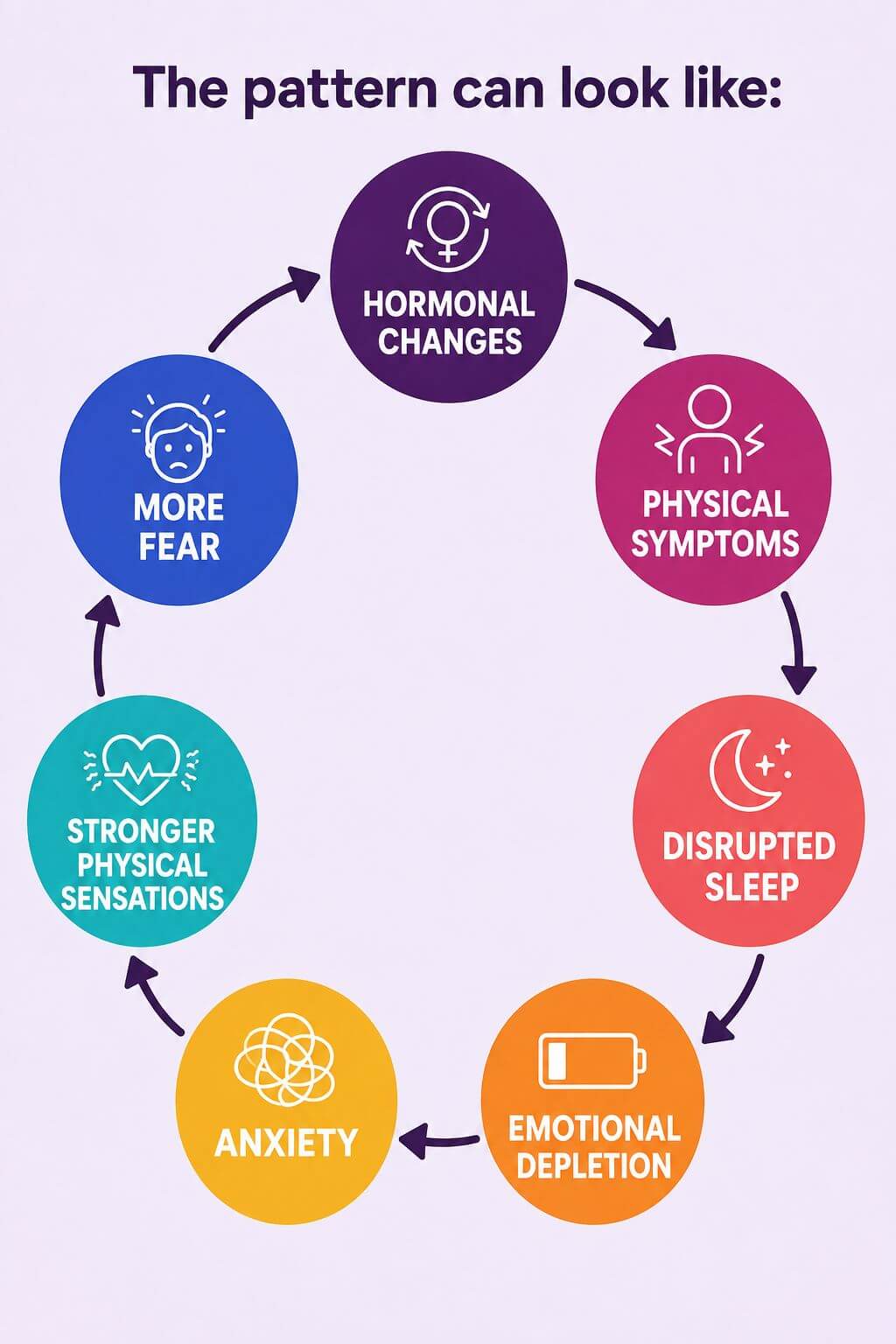
That is why menopause anxiety symptoms need to be understood in context, rather than treated as an isolated problem.
(Cleveland Clinic)
4. Fear of the Next Attack Can Keep the Cycle Going
After one frightening episode, you may start worrying about another.
What if it happens at work?
What if I’m alone?
What if I can’t control myself?
You begin checking your heartbeat, breathing or body for warning signs.
The more closely you monitor yourself for danger, the more noticeable ordinary sensations can become. You may eventually start avoiding places or activities because you fear another attack.
The goal is not to become hyper-aware of your body. It is to learn to notice sensations without automatically interpreting them as danger.
5. Know What to Do When Panic Hits
When panic arrives, your instinct may be to make it stop immediately.
Instead, try telling yourself: “This feels frightening, but I can slow this moment down.”
Panic attacks can feel much longer than they actually are; many often peak within minutes and may last around 5–20 minutes, although it’s different for everyone. The aim is not to tell yourself “nothing is happening.” Something is happening, but a frightening sensation is not automatically a dangerous one.
If you feel like ‘something uneasy is happening’ make sure you are somewhere safe:
- Sit down and reduce stimulation if possible.
- Breathe slowly and comfortably rather than forcing deep breaths.
- Focus your attention on something outside your body.
- Avoid repeatedly checking your pulse or searching symptoms online.
- Once it passes, think about what may have contributed rather than immediately fearing the next episode.
6. Don’t Blame Every Physical Symptom on Menopause
This is crucial.
Menopause can involve hot flashes, sweating, palpitations, sleep problems and anxiety. But that does not mean every new physical symptom is “just menopause.”
New, severe or persistent symptoms, especially chest pain, significant breathing difficulty or fainting—need medical assessment.
Taking your symptoms seriously is not being dramatic. It is being responsible.
7. You Don’t Have to Manage Panic Alone
If panic attacks are recurring, affecting your daily life or making you afraid of your own body, seek support immediately.
A psychologist can help you understand:
- What may be triggering the panic
- How thoughts and physical sensations interact
- Whether avoidance is maintaining the fear
- How to respond differently when symptoms appear
Sometimes the answer isn’t either psychological support or medical care. It is both.
(News-Medical)
A Few Things to Do and Not Do!
You don’t need another giant checklist.
Do:
- Notice patterns: Look at sleep, stress, hot flashes, caffeine and other factors around an episode.
- Talk about it: Tell a doctor or psychologist what you are experiencing.
- Look at the whole picture: Hormonal, physical, emotional and psychological factors can interact.
- Work through your fears: Gradually addressing them can help prevent fear from taking control of your life.
Don’t:
- Assume every racing heartbeat is a panic attack.
- Blame every panic symptom on hormones.
- Repeatedly search symptoms online during an anxious episode.
- Shame yourself for being frightened.
- Wait until panic is controlling your life before seeking help.
When Should You Seek Professional Help?
Speak to a healthcare or mental health professional if panic symptoms are recurring, worsening or affecting your sleep, work, relationships or daily life.
Seek support particularly if you are avoiding places because of panic, constantly monitoring your body, experiencing anxiety between attacks or losing confidence in your ability to cope.
You do not have to wait until anxiety becomes unbearable.
Where Miror Fits In Perfectly For You
At Miror, we believe women’s health cannot be divided into separate boxes.
A racing heart may feel physical.
The fear around it may feel psychological.
Poor sleep may make both worse.
Hormonal changes may be part of the picture.
And anxiety can affect relationships, work, confidence and everyday life.
That is why Miror is built as a 360-degree integrative women’s health ecosystem, bringing together doctors, psychologists, health experts and a community of thousands of women navigating different stages of their health journey.
Sometimes you need a doctor.
Sometimes you need a psychologist.
And sometimes you need a community where you can simply say: “This is happening to me too.”
For women navigating perimenopause, Miror Bliss can be explored as part of a broader wellness routine; and Miror Thrive is designed to support postmenopausal wellness.
But the bigger support is the ecosystem around you.
If panic, anxiety or other menopause-related changes are affecting your daily life, speak to a Miror expert and connect with a community that understands what you’re going through.
A Final Word
A panic attack can make you feel as though you have lost control of your body.
You haven’t.
Your body may be responding to a complicated combination of hormonal changes, physical sensations, stress, sleep disruption and emotional load.
The answer is not to fear your body more. It is to understand it better and get support when you need it.
Medical Disclaimer
This article is for educational purposes only. It does not provide a diagnosis, treatment plan or replacement for medical, psychological or psychiatric care. Panic-like symptoms can have causes other than anxiety or menopause. New, severe or concerning physical symptoms should be medically assessed. Seek urgent medical attention for symptoms such as sudden or persistent chest pain, severe breathing difficulty, fainting or other symptoms that may indicate a medical emergency.