

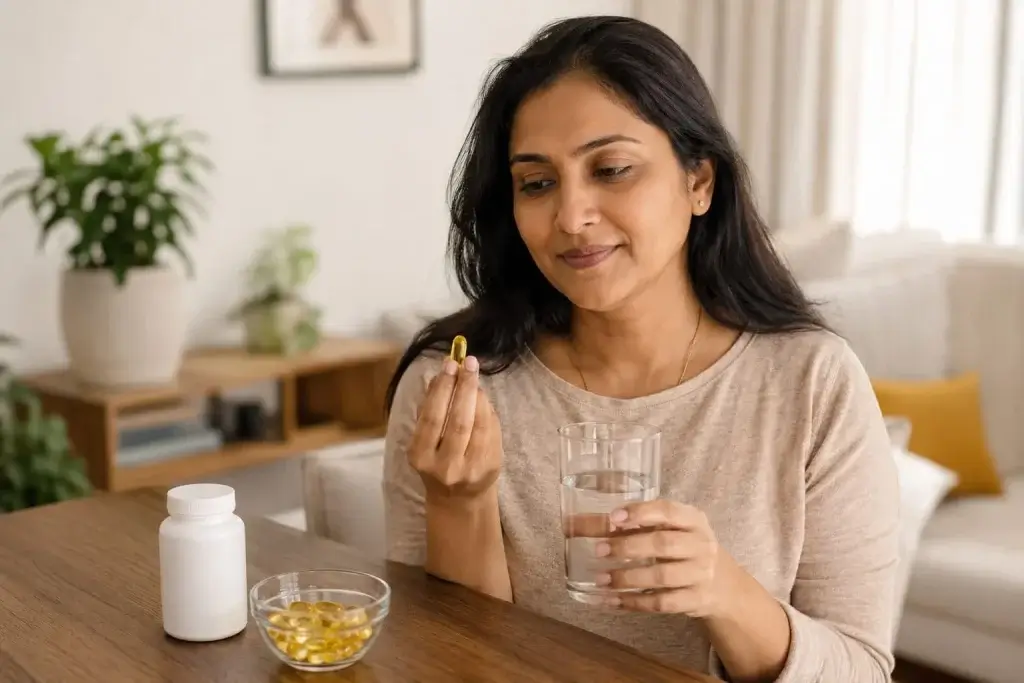
If you are searching for the best evening primrose oil for menopause, you are probably asking whether it can genuinely help with hot flashes, night sweats or other menopause symptoms.
At present, research does not identify one product, strength or formulation as the “best” for symptom relief. Evening primrose oil contains gamma linolenic acid, or GLA, but studies have produced mixed and limited results.
Before comparing bottles, it is more useful to understand what evening primrose oil is, what the research has tested, and what a supplement label can actually tell you.
What Is Evening Primrose Oil?
Evening primrose oil, or EPO, is extracted from the seeds of Oenothera biennis. It contains omega-6 fatty acids, including gamma linolenic acid, commonly called GLA.
GLA is a fatty acid involved in normal biological processes in the body. Its presence has made EPO interesting to nutrition researchers, but it does not mean the oil acts like estrogen, increases estrogen levels or automatically improves symptoms linked with hormonal change.
Why Is Evening Primrose Oil Popular During Menopause?
Evening primrose oil is widely promoted among supplements for menopause, with claims around hot flashes, night sweats, breast tenderness, mood changes and “hormonal wellbeing.”
Its plant origin may also appeal to women looking for natural supplements for menopause. But “natural” describes the source of an ingredient, not whether it is effective.
Some proposed evening primrose oil menopause benefits are linked to its GLA content. These claims still need to be separated from findings in controlled clinical research.
Best Evening Primrose Oil for Menopause: What Does the Research Show?
The best way to judge EPO is to look at the overall body of evidence rather than rely on a single positive study. So far, research on evening primrose oil for menopausal hot flashes has produced mixed results. Some studies have reported small improvements in certain aspects of hot flashes or night sweats, while others have found little or no meaningful difference compared with placebo.
When researchers have reviewed the available trials together, the results have not shown a consistent improvement in how often hot flashes occur or how intense they feel. There may be some benefit for the duration of hot flashes in certain studies, but the evidence is not strong enough to draw firm conclusions.
The research also has important limitations. Many studies are relatively small, use different formulations or amounts of evening primrose oil, and follow women for different lengths of time. This makes it difficult to determine whether any benefit is reliable or whether one GLA content or formulation is more effective than another.
Overall, current evidence does not establish evening primrose oil as a consistently effective option for managing vasomotor symptoms such as hot flashes and night sweats.
What “best evening primrose oil for menopause” should mean in practice
There is no evidence based reason to assume that the highest dose, highest GLA content or most strongly marketed product will work best.
Ask two separate questions: is the supplement clearly labelled and produced to an appropriate quality standard, and is there convincing evidence that the ingredient helps the symptom you want to manage?
A product can be well made and accurately labelled while the evidence for its menopause benefits remains uncertain. Quality and effectiveness are not the same thing.
Can Evening Primrose Oil Help With Hot Flashes?
Research on evening primrose oil for hot flashes has not shown a reliable benefit across how often hot flashes occur, how severe they feel and how long they last.
A statistically significant result in a study also does not automatically mean the change will be meaningful in everyday life. A measurable difference may still be too small to noticeably improve sleep, comfort or quality of life.
This is why one positive finding should not be treated as proof that EPO is an effective treatment. Frequent or disruptive hot flashes deserve a broader assessment rather than reliance on a supplement alone.
How to Choose an Evening Primrose Oil Supplement
If you are considering an evening primrose oil supplement, read beyond the large number on the front of the pack.
Check the label for:
- The amount of evening primrose oil per serving
- The GLA content, if stated
- A complete ingredient list
- Clear serving information
- Manufacturer, batch and expiry details
- Quality or independent testing information where available
- Clearly stated quantities rather than a proprietary blend
One useful distinction is that the total amount of EPO and the amount of GLA are not necessarily the same number. If a product advertises a large EPO amount, check whether it also states how much GLA it provides.
More is not automatically better. Research has not established that higher EPO or GLA amounts provide greater menopause symptom relief.
Is Evening Primrose Oil Safe?
Evening primrose oil appears to be generally well tolerated by many adults when taken orally. Reported evening primrose oil side effects include gastrointestinal symptoms such as abdominal discomfort, nausea or diarrhoea. Headache has also been reported in some studies.
“Natural” does not mean risk free, and supplements can interact with medicines.
If you take regular medication, have a medical condition, are preparing for surgery, are pregnant or breastfeeding, or use several supplements, discuss EPO with an appropriate healthcare professional before adding it to your routine.
What Evening Primrose Oil Cannot Do
Evening primrose oil should not be described as an estrogen booster, hormone balancing supplement or natural hormone replacement.
There is no reliable evidence that it restores declining ovarian estrogen levels. It does not replace estrogen and is not a proven treatment for menopause simply because it is plant derived.
When Should You Speak to a Healthcare Professional?
Persistent or severe menopause symptoms deserve appropriate assessment.
Speak to a healthcare professional if you experience frequent hot flashes, major sleep disruption, persistent vaginal or urinary symptoms, unexplained bleeding, or symptoms that significantly affect daily life.
A dietician can support nutrition and supplement decisions. Medical symptoms, medication interactions and treatment choices should be assessed by an appropriately qualified healthcare professional.
Start With the Evidence, Not the Marketing
When searching for the best evening primrose oil for menopause, the most useful question is not which product has the highest dose, most GLA or strongest claims. It is whether evening primrose oil itself has good evidence for the symptom you want to manage. At present, that evidence remains limited and inconsistent, particularly for hot flashes. If you are considering EPO, focus on transparent labelling, realistic expectations and guidance that takes your health, medicines and other supplements into account.
You can also use the MIROR app to track your menopause symptoms, better understand changes through your journey and access personalized guidance. Download the MIROR app from the Apple App Store or Google Play Store.
FAQs
Studies have assessed EPO over several weeks, but research has not established a reliable "time to work" for menopause symptoms. Be cautious of products promising guaranteed results within a fixed number of days.
GLA stands for gamma linolenic acid, an omega-6 fatty acid found in evening primrose oil. A label may state both the total EPO amount and the amount of GLA it provides.
Some studies have used EPO daily, but that does not establish one regimen that is appropriate for everyone or confirm long term benefit. Regular use is worth discussing with a qualified professional if you take medicines or have a medical condition.
Herbal and nutritional supplements can interact with medicines, depending on the products and your health circumstances. If you use prescription or regular over the counter medicines, ask a doctor or pharmacist to review the combination.
There is no established evidence that a higher GLA content produces better menopause symptom relief. Clear labelling tells you what you are taking, but a larger number does not prove greater effectiveness.