
There is a particular moment many women describe to me.
Not the hairbrush.
Not even the shower drain.
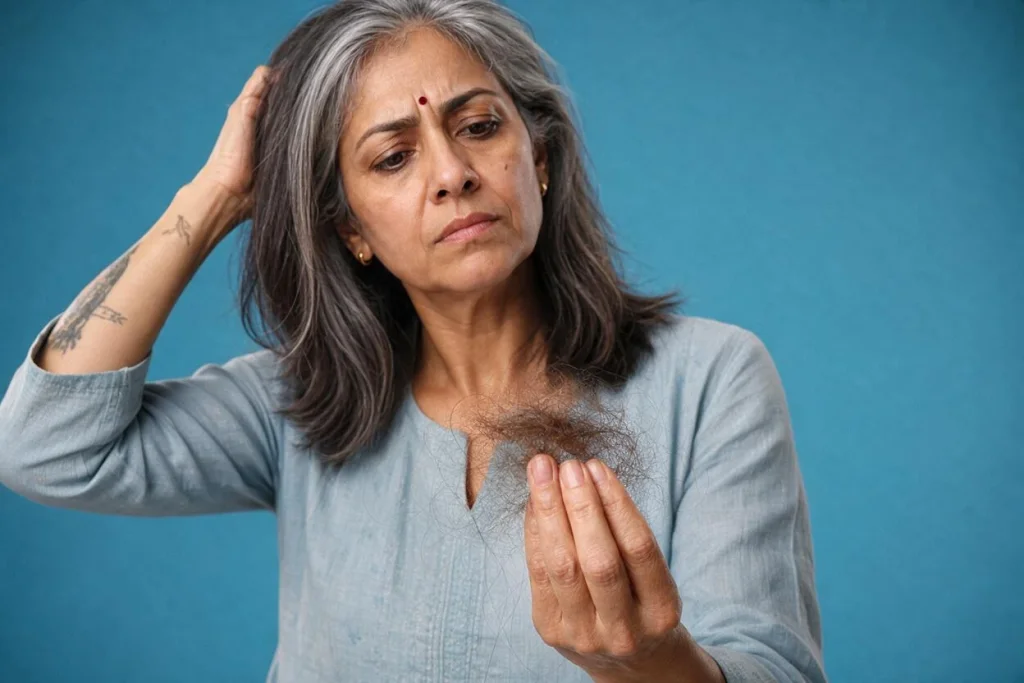
It is noticing the parting.
Perhaps it looks wider in a photograph. Or you catch your reflection under harsh lighting and suddenly notice more scalp than you remember seeing before.
And the next question is often:
“Is this because of menopause and will an estrogen patch fix it?”
It is a fair question.
Estrogen does interact with the hair follicle, and menopause can be accompanied by changes in hair density, texture and growth. But hair thinning in midlife is more complicated than one hormone going down.
So let’s look at what the evidence actually tells us.
Why Does Hair Thin Around Menopause?
Hair grows in cycles. Each follicle moves through a growth phase, a resting phase and eventually shedding before beginning the cycle again.
Hormonal changes during perimenopause and menopause can influence this cycle. At the same time, other forms of hair loss—including female pattern hair loss and telogen effluvium—can become more noticeable during midlife. Recent reviews describe menopause-associated changes in hair density and calibre, while also emphasising that several distinct hair disorders can occur during this period. (PubMed)
This is why two women of exactly the same age can experience completely different hair changes.
One may notice gradual thinning around the parting.
Another may suddenly shed large amounts of hair after an illness or prolonged stress.
Another may have a scalp condition that has nothing to do with estrogen at all.
“Menopause hair loss” is not one diagnosis.
5 Important Facts About Estrogen Patches and Hair Loss
1. An Estrogen Patch Is Not a Hair-Loss Treatment
Let’s start with the answer most women actually want.
There is not enough evidence to prescribe an estrogen patch specifically to treat hair loss.
The biological theory is reasonable: estrogen interacts with hair follicles and may influence the hair-growth cycle. But having a plausible mechanism is not the same thing as proving that a treatment works.
A 2026 systematic review of estrogen therapy and menopausal hair loss concluded that estrogen therapy is not currently indicated for hair loss alone.
(PubMed)
There is some preliminary research. A small pilot study involving 11 postmenopausal women with female pattern hair loss found changes in some hair-growth measures after estradiol therapy. But it had no control group and was far too small to establish that estrogen therapy treats female pattern hair loss.
(PubMed)
So if you are already taking HRT for appropriate menopause symptoms and notice your hair feels different, that is something to discuss.
But I would not start HRT for hair alone.
2. Hair Loss Can Have Several Causes at the Same Time
This is where a proper diagnosis matters.
Female pattern hair loss
This usually develops gradually, often with widening of the central parting and thinning across the top of the scalp.
Telogen effluvium
This causes more noticeable shedding, often after a physical or emotional stressor such as illness, surgery, high fever, major weight loss or significant stress. Importantly, the shedding can appear weeks to months after the trigger, so the connection is easy to miss.
(Cleveland Clinic)
Traction and hair-shaft damage
Tight hairstyles, repeated pulling, frequent heat styling and chemical treatments can contribute to breakage and traction-related hair loss.
Scalp disorders and inflammatory conditions
Persistent itching, scaling, redness, pain or scarring are not things to simply label as menopause.
There can also be more than one cause at the same time.
That is why the first question should be “What type of hair loss is this?” rather than “Which hormone should I take?”
3. Look Beyond Estrogen
When a woman comes to me with significant hair thinning, I don’t want to blame every change on menopause.
Depending on her history and symptoms, we may also need to consider:
-
Iron deficiency or blood loss
-
Thyroid problems
-
Recent illness or major physical stress
-
Rapid weight loss or restrictive dieting
-
Inadequate protein intake
-
Certain medicines
-
Other hormonal or inflammatory conditions
This is particularly relevant during perimenopause because periods can become heavier or more irregular, while other health changes may be happening at the same time.
A clinician may recommend blood tests such as a blood count, ferritin or thyroid testing when they are clinically appropriate.
The important thing is not to collect every possible test.
It is to investigate the causes that fit your story.
4. Changing HRT Can Sometimes Coincide With Hair Shedding
This is a useful point if you are already on HRT.
Starting, stopping or changing a hormone treatment can coincide with changes in the hair cycle. That does not automatically mean the HRT is damaging your hair, and it does not prove that menopause is responsible either.
If you notice significant shedding after starting or changing HRT, tell your prescribing doctor.
They can consider:
Was the timing related?
Has the HRT formulation changed?
Is there another trigger for shedding?
Does the hair pattern suggest a separate dermatological condition?
The answer should come from looking at the whole picture, not from stopping treatment on your own.
5. Hair Takes Time, So Don’t Judge Changes Too Quickly
This is one of the hardest things about hair.
You can change your routine today and still see shedding tomorrow.
Hair follicles operate on a much slower biological clock than most of us would like.
A temporary shedding episode can take several months to become visible, and meaningful changes in density also take time to assess.
That is why I often recommend photographs rather than relying on memory.
Take one photograph of your parting or hairline in the same place, same lighting and same angle once a month.
Not every day.
Daily checking only makes gradual changes harder to interpret.
(Science-Direct)
What Can You Do Now?
You do not need a complicated hair-care routine.
Do:
Eat adequately.
Avoid prolonged under-eating, and make sure your diet provides sufficient protein and other nutrients.
Treat deficiencies when they are actually found.
Supplement according to your doctor’s advice rather than taking multiple products “just in case.”
Reduce mechanical stress.
Give your scalp a break from very tight hairstyles and repeated pulling.
Be gentle with heat and chemical treatments.
Frequent straightening, bleaching or aggressive styling can weaken the hair shaft.
Pay attention to your scalp.
Persistent itching, scaling, soreness or redness deserves assessment.
(Mirorpedia)
Don’t:
Don’t assume every hair fall is menopause.
Don’t start HRT just to improve hair.
Don’t stop prescribed HRT because of shedding without discussing it with your doctor.
Don’t keep switching hair products every few weeks and expect to know which one helped.
(Healthline)
When Should You See a Hair Specialist?
I’d recommend getting assessed rather than simply watching and waiting if you notice:
-
Rapid or excessive shedding
-
A steadily widening parting
-
Noticeable thinning across the crown
-
Round or sharply defined bald patches
-
A receding frontal hairline
-
Loss of the outer eyebrows
-
Scalp redness, scaling, pain, itching or visible scarring
-
Hair loss accompanied by new facial hair growth, acne or other hormonal changes
These patterns can point toward different conditions and may need a dermatologist or hair specialist to examine the scalp directly.
Some scarring forms of hair loss, including frontal fibrosing alopecia, can permanently damage hair follicles, making early assessment particularly important. Menopause and postmenopause are recognised settings in which this condition is seen more frequently.
(PubMed)
HRT and Hair: What Should You Actually Remember?
If you are considering an estrogen patch because your hair has started thinning, I would separate two questions.
Question one: Do I need HRT for my menopause symptoms?
Question two: What is causing my hair loss?
They may be related.
But they are not necessarily the same problem.
Current evidence does not support using systemic estrogen as a standalone treatment for menopausal hair loss.
(MNT)
So if you are experiencing hot flushes, night sweats, sleep problems or other symptoms for which HRT may be appropriate, discuss HRT on those grounds.
And if your main concern is your hair, get the hair loss assessed properly rather than expecting an estrogen patch to solve it.
Where Miror’s HRT Centre of Excellence Fits In
Midlife hair changes can sit at the intersection of hormonal health, nutrition, menstrual changes, general health and dermatology.
At Miror’s HRT Centre of Excellence, the focus is on understanding the wider picture when women are considering HRT, rather than assuming every midlife symptom needs more estrogen.
Your clinician can discuss your menopause symptoms, medical history and relevant investigations, review HRT where appropriate, and help identify when a separate dermatology or hair-specialist assessment is needed.
We don’t treat hair loss with HRT. We help make sure the right questions are being asked.
If you’re experiencing menopause symptoms alongside hair changes, speak to a Miror HRT expert for personalised guidance.
A Final Word
Seeing more scalp can be surprisingly emotional.
But hair thinning is not a verdict on your health, your femininity or your age.
Don’t chase the hormone label first. Find the cause first.
Medical Disclaimer
This article is for general educational purposes only and does not replace personalised medical advice, diagnosis or treatment. Hair loss can have many causes and should be assessed by a qualified healthcare professional. HRT should not be started, stopped or changed specifically to treat hair loss without medical guidance.
FAQs
There is currently insufficient evidence to use estrogen patches as a standalone treatment for hair loss. A 2026 systematic review concluded that estrogen therapy is not currently indicated for menopausal hair loss alone.
Hair shedding can coincide with hormonal changes, including starting or changing HRT, but that does not prove that HRT is the cause. If significant shedding begins after an HRT change, discuss the timing and pattern with your prescribing doctor.
Perimenopause can coincide with changes in the hair-growth cycle, but hair thinning can also result from female pattern hair loss, telogen effluvium, nutritional issues, thyroid problems, hair practices or scalp disorders. A proper assessment can help distinguish between them.
Depending on your symptoms and medical history, a clinician may consider tests such as a blood count, ferritin or thyroid function. Testing should be guided by your individual history rather than done as a standard panel for every woman.
No. HRT should be considered based on appropriate menopause indications and your individual medical history, not hair loss alone. Discuss both your menopause symptoms and your hair changes with the appropriate clinicians.