
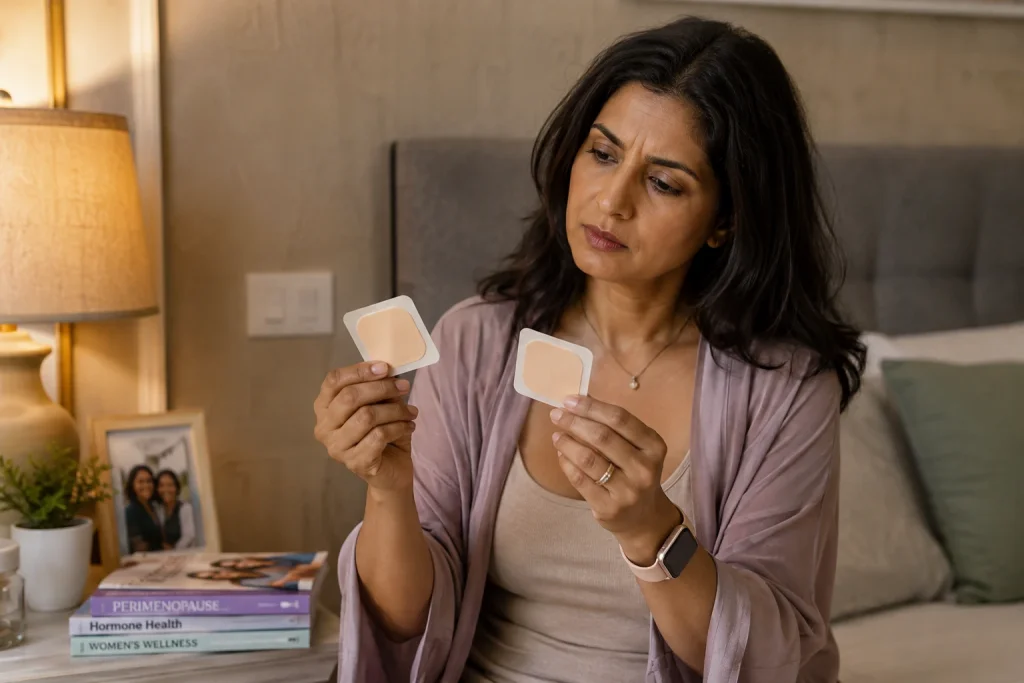
You Put on a Patch. So How Does Estrogen Get Inside Your Body?
It looks almost too simple.
Peel off the backing. Stick a small patch onto your skin.
And somehow, that patch is delivering a hormone into your bloodstream.
So naturally, one of the first questions women ask me is: how does it actually work?
An estrogen patch is a form of transdermal hormone replacement therapy. Instead of swallowing estrogen and sending it through your digestive system, the patch delivers estradiol across the skin and into the bloodstream.
And the clever part isn’t the hormone. It’s how the patch releases it.
1. What’s Actually in the Patch?
A modern estradiol patch has three layers, and it’s worth picturing them.
On the outside, a thin waterproof backing film. In the middle, an adhesive matrix with the estradiol dissolved directly into it. Underneath, a protective liner you peel off and throw away.
That middle layer is what makes it a matrix patch. Older designs held the hormone as liquid in a small reservoir; in a matrix patch, the drug is mixed into the adhesive itself, so it sits in direct contact with your skin across the whole patch. It’s thinner, more flexible, and less likely to leak if damaged.
Estraderm MX, one of the estradiol patches available in India, is described in its product information as an adhesive matrix that releases estradiol into the circulation through intact skin at a low rate for up to four days.
Think of it less as one big dose released at once, and more as a small amount made available continuously.
(Dr Louise Newson)
2. How Does Estradiol Cross the Skin?
Your skin is built to keep things out. The outermost layer, the stratum corneum, is a dense barrier of dead cells and lipids.
Estradiol gets through because of two properties: it’s a small molecule, and it’s fat-soluble. That combination lets it dissolve into the lipid layers of the stratum corneum and diffuse across.
From there it passes into the tissue below, picks up the small blood vessels in the dermis, and enters the general circulation. Once in the bloodstream it travels everywhere, binding to estrogen receptors in bone, brain, blood vessels, breast and vaginal tissue.
This is why a patch on your buttock relieves hot flushes. The skin is only the doorway.
(PubMed NIH)
3. Why Does It Release So Slowly?
Because that’s the point.
The formulation controls how fast estradiol becomes available at the skin surface, which in turn controls how much reaches your blood each day. Patches are labelled by that daily rate — a “50” patch delivers around 50 micrograms of estradiol per day, whatever the brand.
The pharmacology behind this is well characterised. With Estraderm MX 50, steady-state estradiol levels in the blood are reached within about eight hours of applying the patch and stay stable across four days. When the patch comes off, levels return to baseline within roughly 24 hours.
Different products have different wear periods. Some are changed twice weekly, others once a week.
Don’t stretch the interval yourself because the patch still looks fine. The adhesive routinely outlasts the medicine. A patch that’s still stuck on is not necessarily still delivering.
(Gaya Wellness)
4. Why Do People Say Patches Give “Steadier” Levels?
The eight-hour, four-day figures above are the answer.
A tablet produces a peak after you swallow it and a trough before the next dose. A patch holds you at a fairly flat level for its whole wear period.
There’s a second difference that matters more clinically. Estrogen taken by mouth is absorbed through the gut and passes through the liver before reaching the rest of the body — the first-pass effect. Transdermal estradiol skips that step entirely and enters the circulation directly.
That doesn’t make patches automatically right for everyone. But it’s the reason route matters when your clinician is weighing your clotting and cardiovascular risk. NICE recommends considering transdermal rather than oral HRT for women at increased risk of venous thromboembolism, including those with a BMI over 30 kg/m².
(GoodRx)
5. How Quickly Does an Estrogen Patch Work?
This is probably the question I hear most: I put the patch on yesterday, why don’t I feel different?
Because HRT isn’t a switch.
Some women notice a change within the first two to three weeks, usually in hot flushes and sleep first. Mood, energy and concentration often lag behind. NHS guidance advises that estrogen HRT can take a few weeks to begin helping and up to around three months for the full benefit.
Three months is also the standard review point. If symptoms haven’t improved adequately by then, the dose can be adjusted.
So don’t conclude after three days that it isn’t working — and do keep some record of your symptoms, because that’s what your clinician needs in order to judge whether the dose is right.
(MNT)
What Affects How Well a Patch Absorbs?
A patch only works if it stays on and the skin underneath can absorb properly.
Where you put it. Estradiol patches go on clean, dry, intact skin on the trunk below the waistline — the buttock is the usual site, and the lower abdomen is an alternative. Choose somewhere the skin doesn’t crease much when you move.
Avoid:
- Anywhere on or near the breasts
- Broken, irritated or inflamed skin
- The waistline itself, where clothing rubs
- Skin you’ve just moisturised
- The same spot twice in a row — rotate each time
Heat, sweat and sun. Sweating loosens adhesive, which matters in an Indian summer. Give a new patch an hour to bond before a workout. Keep it under clothing rather than exposed: ultraviolet light degrades estradiol, so a patch worn in direct sun may deliver less than it should.
If it comes off. Apply a fresh patch and carry on with your original change day. Don’t shift the whole schedule. If you forget a patch entirely, apply one as soon as you remember and go back to your usual timetable.
Patches are designed to survive bathing and showering.
Estrogen Patches in India
Transdermal estradiol is available in India, though which brand your pharmacy stocks varies by city.
Estradiol patches listed here include Estraderm MX and Systen. Estradiol gel — Oestrogel and similar — is often easier to source than patches, and is applied daily to the arms or thighs rather than the trunk.
One caution: dosing information on Indian e-pharmacy listings is not always accurate. Follow the leaflet inside your box and your doctor’s instructions, not a product page.
(Mirorpedia)
Two Things a Patch Doesn’t Change
You may still need a progestogen. If you have a uterus and use systemic estrogen, you need adequate progestogen to protect the uterine lining — in a sequential regimen, for at least 12 days of each cycle. Using a patch instead of a tablet doesn’t remove that requirement. After a total hysterectomy, estrogen alone may be appropriate. Low-dose vaginal estrogen for dryness is a different treatment and usually doesn’t need added progestogen.
HRT isn’t suitable for everyone. Estrogen patches are not used where there is undiagnosed vaginal bleeding, current or past breast cancer, a previous clot or known clotting disorder, or active liver disease.
Contact a doctor promptly if you develop painful swelling in a leg, chest pain or sudden breathlessness, any bleeding after menopause, or a new breast lump.
The Simple Version
An estrogen patch is a controlled delivery system. It holds estradiol against your skin, the hormone dissolves through the outer barrier, enters the bloodstream, and circulates to receptors throughout the body — steadily, for as long as that patch is designed to last.
You don’t need the chemistry to use HRT safely. But understanding it makes the treatment feel a great deal less mysterious.
Where Miror’s HRT Centre of Excellence Fits In
Choosing HRT isn’t only about patch, gel or tablet.
At Miror’s HRT Centre of Excellence, you can discuss your symptoms, history and risk factors with experienced clinicians, and get a treatment plan built around your circumstances — including which route and dose make sense for you, and how you’ll be reviewed.
The goal isn’t to put every woman on a patch. It’s to work out what actually suits her.
Medical Disclaimer: This article is for general educational purposes only and does not replace personalised medical advice, diagnosis or treatment. HRT may not be suitable for everyone. For personalised guidance on estrogen patches and HRT, consult a qualified clinician at Miror’s HRT Centre of Excellence before starting, stopping or changing treatment.
FAQs
Estrogen patches are a form of transdermal HRT. They gradually release estradiol through the skin so it can enter the bloodstream and act throughout the body. (nhs.uk)
A matrix estrogen patch contains estradiol within an adhesive or polymer matrix. The hormone is gradually released from the matrix and absorbed through intact skin. Estraderm MX is one example of a matrix patch.
Transdermal patches are designed to release estradiol continuously over their specified wear period rather than as a single daily oral dose. The Indian Menopause Society notes that transdermal preparations can maintain relatively stable serum estrogen levels.
Most estrogen patches are designed to stay on during bathing and normal activity. However, heavy sweating can affect adhesion, and product instructions differ. Follow your specific patch's instructions and replace a patch that comes off as directed.
A structured Hormonal Index can organise your symptoms, menopause stage, medical history, risk factors and relevant investigations to support a personalised HRT discussion. It should complement, not replace, clinical assessment.