
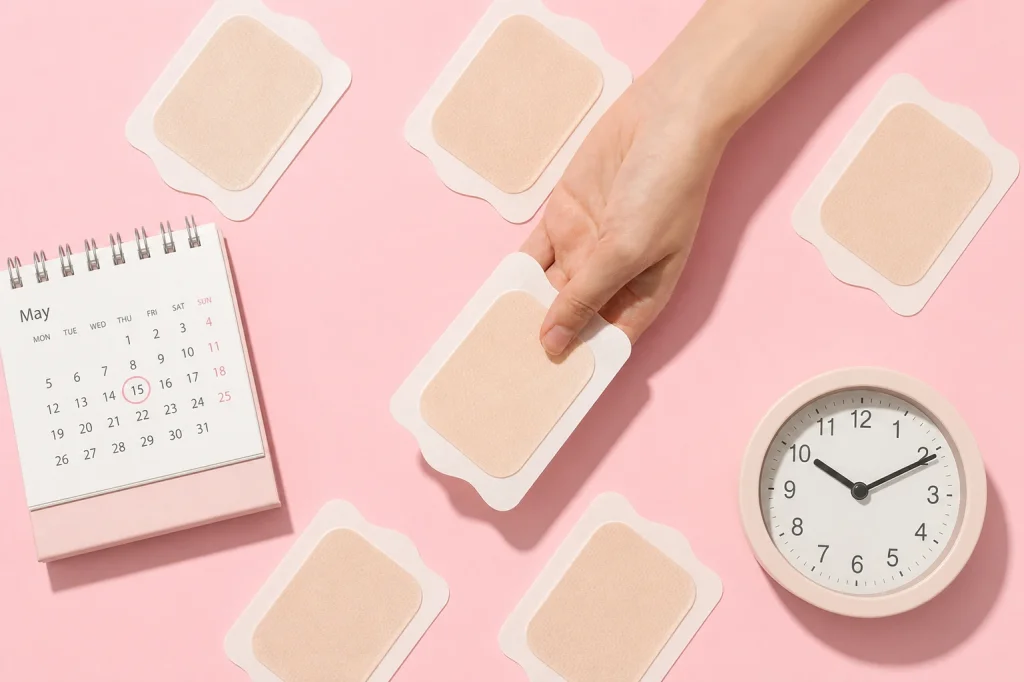
The patch goes on. And then you wait.
A few days later, you may still be waking at 3 a.m., flushing during a meeting and wondering:
“Is this actually working?”
That is a very reasonable question.
The important thing to know is that how long for an estrogen patch to work does not have one universal answer. The hormone begins entering your bloodstream quickly, but symptom relief takes longer—and different symptoms can improve at different speeds.
Think of the timeline below as a practical guide, not a promise.
1. The First 24 Hours: The Patch Starts Delivering Estrogen
Once an estradiol patch is applied, the hormone begins crossing the skin and entering the bloodstream.
For some specific products, blood levels reach a relatively steady state within hours. For example, product information for Estraderm MX 50 reports steady-state estradiol concentrations within about eight hours and relatively stable levels during its four-day wear period. That timing should not be assumed for every estrogen patch, because products differ.
(Medicines.org.uk)
But here is the important distinction: Estrogen being absorbed is not the same as your symptoms disappearing.
Your body needs time to respond.
So if you feel no dramatic difference after the first few days, that does not mean the patch has failed.
2. Weeks 1–4: Hot Flushes and Night Sweats May Start to Shift
For many women, hot flushes and night sweats are among the first menopause symptoms to improve.
But even here, the pattern varies.
Some women notice that flushes become less intense before they become less frequent.
You may still experience them, but perhaps they no longer stop you in the middle of a meeting or wake you completely at night.
A realistic guide is:
| Time | What you may notice |
|---|---|
| Week 1–2 | Often little noticeable change; some women notice early improvement |
| Week 2–4 | Flushes or night sweats may begin becoming less intense or less frequent |
| Around 4 weeks | Some women notice a clearer difference, while others need longer |
NHS guidance says estrogen HRT can take a few weeks before symptoms begin to improve.
(nhs.uk)
So don’t judge your entire HRT experience by the first week.
3. Weeks 4–12: Sleep, Mood and Energy May Follow
This is often the part where women become impatient.
The hot flushes may be settling, but they are still exhausted.
Sleep may improve as night sweats and other menopause symptoms become easier to manage. But if you have been sleeping badly for a long time, improving sleep may take longer and may need separate attention.
Mood and anxiety can also take time. They are influenced by much more than estrogen alone, including sleep, stress, physical symptoms and what is happening in your life.
Energy and concentration may improve gradually, particularly when sleep improves.
So don’t expect every symptom to move together.
You might notice:
Fewer night sweats → slightly better sleep → more energy → clearer thinking.
Or you may experience improvement in one area while another symptom continues.
That is normal.
NHS guidance notes that HRT can take up to around three months to work fully, and the type or dose may need adjustment depending on response and side effects.
4. Months 3–6: Some Symptoms Need a More Targeted Approach
Some menopause symptoms are slower to respond, and some may need a treatment specifically designed for them.
Vaginal and urinary symptoms
If vaginal dryness, painful sex or urinary symptoms are your main concern, tell your doctor.
A systemic estrogen patch may help some symptoms, but local vaginal estrogen is often the more targeted treatment for genitourinary symptoms. NICE recommends discussing vaginal estrogen for these symptoms separately from systemic HRT.
Joint and muscle symptoms
Some women notice improvement in joint or muscle symptoms with HRT, but the evidence is less consistent than it is for vasomotor symptoms such as hot flushes and night sweats.
Skin and hair
This is where I would urge you to ignore a lot of online marketing.
Estrogen does influence skin biology, and some studies have reported improvements in measures such as skin collagen and thickness. But the evidence is inconsistent, and HRT is not prescribed simply to improve skin or hair.
If you notice a cosmetic improvement, think of it as a bonus—not proof that your estrogen dose is “perfect.”
Bone health
Bone benefits are a much longer-term story. You won’t know that HRT is supporting bone health by looking at how you feel after three weeks.
5. Around Three Months: Time for a Proper HRT Review
Three months is an important milestone.
Not because HRT suddenly stops working after 90 days.
Because by then, your doctor has a much better picture of:
Which symptoms have improved
Which symptoms have not
Whether you are experiencing side effects
Whether the dose or formulation needs changing
Whether something else may be contributing to your symptoms
It is recommended to review three months after starting treatment and then at least annually. An earlier review may be appropriate if you are having troublesome side effects or treatment is clearly not working.
So if you are wondering “When should I review my estrogen patch?”, the practical answer is:
Around three months, unless there is a reason to speak to your doctor sooner.
(Winona)
Before Assuming Your Dose Is Wrong, Check the Basics
Sometimes the issue is not the estrogen dose.
Is the patch staying attached?
A patch that keeps lifting or coming off may not be delivering its medicine as intended. Follow the instructions for your specific product if it becomes loose or falls off.
Are you applying it correctly?
Patch application varies by product, so always follow the leaflet or your clinician’s instructions. Many estradiol patches are applied to clean, dry skin on the lower trunk or buttock rather than the breast. (nhs.uk)
Are you changing it on schedule?
Different patches have different wear schedules. Some are changed once a week, others twice weekly. Follow your prescription rather than judging by how well the adhesive is still sticking. (nhs.uk)
Could something else be affecting your symptoms?
Persistent fatigue, low mood or brain fog can have causes other than menopause. Depending on your symptoms and medical history, your clinician may consider other possible contributors such as thyroid problems, anaemia or nutritional deficiencies.
The answer is not always “more estrogen.”
(Kiran Patel M.D)
How Do You Know Whether the Patch Is Actually Helping?
Gradual improvement is surprisingly difficult to remember.
You may think: “Nothing has changed.”
But then you realise you are no longer changing the bedsheets because of night sweats.
That counts.
Instead of relying on memory, track a few things from the day you start:
| Track once a week | Rate or record |
|---|---|
| Hot flushes | Number per day |
| Night waking | Number of times |
| Sleep | 1–10 |
| Mood | 1–10 |
| Energy | 1–10 |
| Most troublesome symptom | Simple note |
Once a week is enough.
The purpose is not to obsess over every symptom.
It is to give you and your doctor something concrete to discuss at your review.
(FMA)
Do You Need a Blood Test to See If the Patch Is Working?
Usually, no.
For women over 45 with typical menopause symptoms, HRT is generally adjusted according to symptoms, response and tolerability, rather than trying to reach a particular estradiol number.
Menopause Care does not recommend routine hormone testing to diagnose menopause in this group, and clinical review is based primarily on how treatment is working.
Blood tests may still be appropriate when there is a specific clinical reason—for example, uncertainty about the diagnosis or concern about another medical condition.
There is no single “perfect” estradiol number that tells you your HRT is working.
So, How Quickly Does an Estrogen Patch Work?
Here is the simple version:
First hours: the patch begins delivering estradiol.
Weeks 1–4: hot flushes and night sweats may begin improving.
Weeks 4–12: sleep, mood and energy may gradually follow.
Months 3–6: slower symptoms may need more time or targeted treatment.
Around 3 months: review whether the treatment, dose and formulation are right for you.
And remember: These are ranges, not promises.
If your friend felt better in ten days and you don’t, that does not mean your HRT will not work.
Likewise, if three months have passed and you are still struggling, don’t simply keep waiting.
That is what the review is for.
(Midi)
Where Miror’s HRT Centre of Excellence Fits In
Finding the right HRT is not just about choosing a patch and waiting.
At Miror’s HRT Centre of Excellence, women can discuss their symptoms, medical history, treatment response and side effects with clinicians experienced in menopause care.
A structured follow-up can help you look at what has changed, what has not, and whether the treatment needs to be continued, adjusted or reconsidered.
If you are wondering whether your estrogen patch is working or whether your HRT needs reviewing speak to a Miror HRT Expert for personalised guidance.
Medical Disclaimer: This article is for general educational purposes only and does not replace personalised medical advice, diagnosis or treatment. Individual response to HRT varies, and the timelines described are typical ranges rather than guarantees. Consult a qualified clinician at Miror’s HRT Centre of Excellence before starting, stopping or changing treatment.
FAQs
An estrogen patch begins delivering estradiol soon after application, but symptom relief takes longer. Many women begin noticing changes within a few weeks, while HRT can take up to around three months to show its full effect. (nhs.uk)
Hot flushes and night sweats may begin improving within the first few weeks. Some women notice reduced intensity before reduced frequency. Response varies from person to person.
One month can still be early. Make sure the patch is being applied and changed correctly and remains attached. If symptoms are still significantly affecting you by around three months, speak to your doctor about whether the dose or treatment needs reviewing.
Some women may notice changes in their skin, but evidence is inconsistent and HRT is not prescribed specifically for cosmetic skin or hair concerns. It should be used to treat appropriate menopause-related symptoms and health needs.
Not routinely. For most women over 45, HRT is adjusted according to symptoms and response rather than aiming for a specific estradiol blood level. Blood tests may be appropriate in specific clinical situations.