
Do you need a DEXA scan as soon as menopause begins?
Not necessarily. A DEXA scan (also written DXA) is a bone density test that helps measure bone mineral density and assess osteoporosis and fracture risk.
Menopause matters because falling estrogen levels can accelerate bone loss, particularly during the years around and immediately after menopause. But menopause alone does not tell you exactly when you need a scan. Your age, how long it has been since menopause, fracture history, medicines and other health conditions all matter.
For women in India, there is another important point: India-specific guidance recommends a somewhat earlier, more menopause-focused approach to DEXA than several international screening guidelines. (Indian Menopause Society)
Menopause can accelerate bone loss before symptoms appear
Bones are constantly being broken down and rebuilt. As estrogen levels fall around menopause, that balance can shift towards faster bone loss.
The Indian Menopause Society (IMS) guideline notes that bone loss may accelerate during the first five years after menopause. The challenge is that osteoporosis is usually silent. You may not know bone density has fallen until a fracture occurs.
That makes bone health worth discussing during menopause care. It does not, however, mean every woman needs a DEXA scan on the day her periods stop. (Indian Menopause Society – Clinical Practice Guidelines on Postmenopausal Osteoporosis)
When should women in India consider a DEXA scan?
For Indian women, the answer is not simply “wait until 65.”
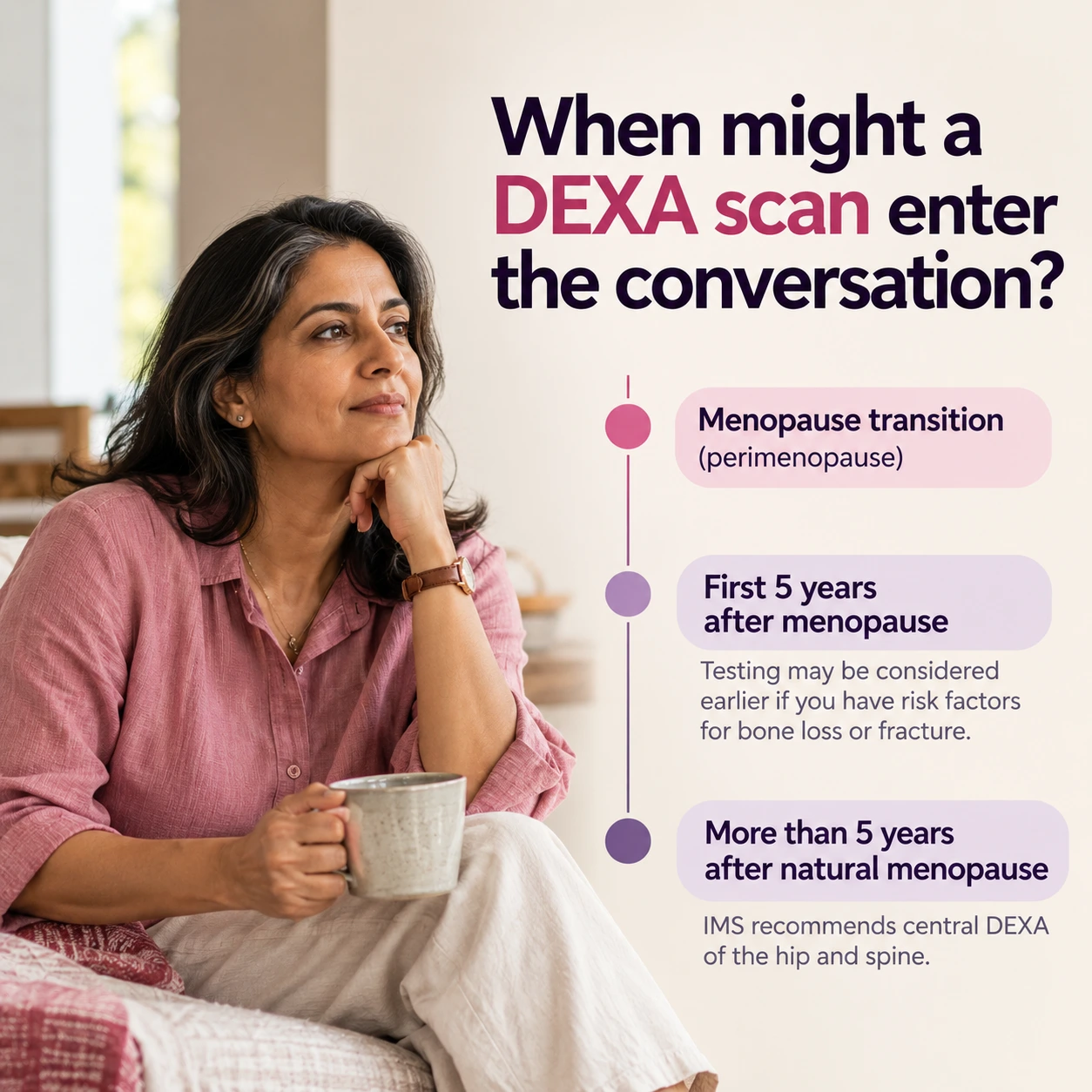
The Indian Menopause Society recommends a DEXA scan of the hip and spine for women who are more than five years past natural menopause. But age or time since menopause is only part of the decision.
Guidelines in some other countries use age 65 as the routine starting point for bone-density screening, while recommending earlier testing for women with additional risk factors. This is why advice about when to have your first DEXA scan can look different depending on which guideline you read.
For Indian women, the timing of a DEXA scan is best understood in the context of both menopause stage and individual fracture risk. The timeline below shows how those two factors come together when deciding whether testing may be useful.
Certain risk factors can bring the DEXA conversation forward
You may need bone-density assessment earlier if your fracture risk is higher than expected for your age.
Factors worth discussing with your doctor include:
- a previous fracture after relatively minor trauma
- low body weight
- a parent who had a hip fracture
- prolonged or repeated systemic steroid use
- premature or early loss of ovarian function
- rheumatoid arthritis or another inflammatory condition
- conditions that affect nutrient absorption
- certain thyroid, kidney or endocrine disorders
- aromatase-inhibitor treatment for breast cancer
- smoking, higher alcohol intake or significant fall risk
NICE specifically advises against routinely assessing fracture risk in people under 50 unless major risk factors are present, giving examples such as untreated premature menopause, systemic glucocorticoid use and previous fragility fracture.
The practical message is simple: your menopause stage gives context, but your risk profile often decides how urgently bone density needs to be measured. (NICE)
What does your DEXA scan result actually mean?
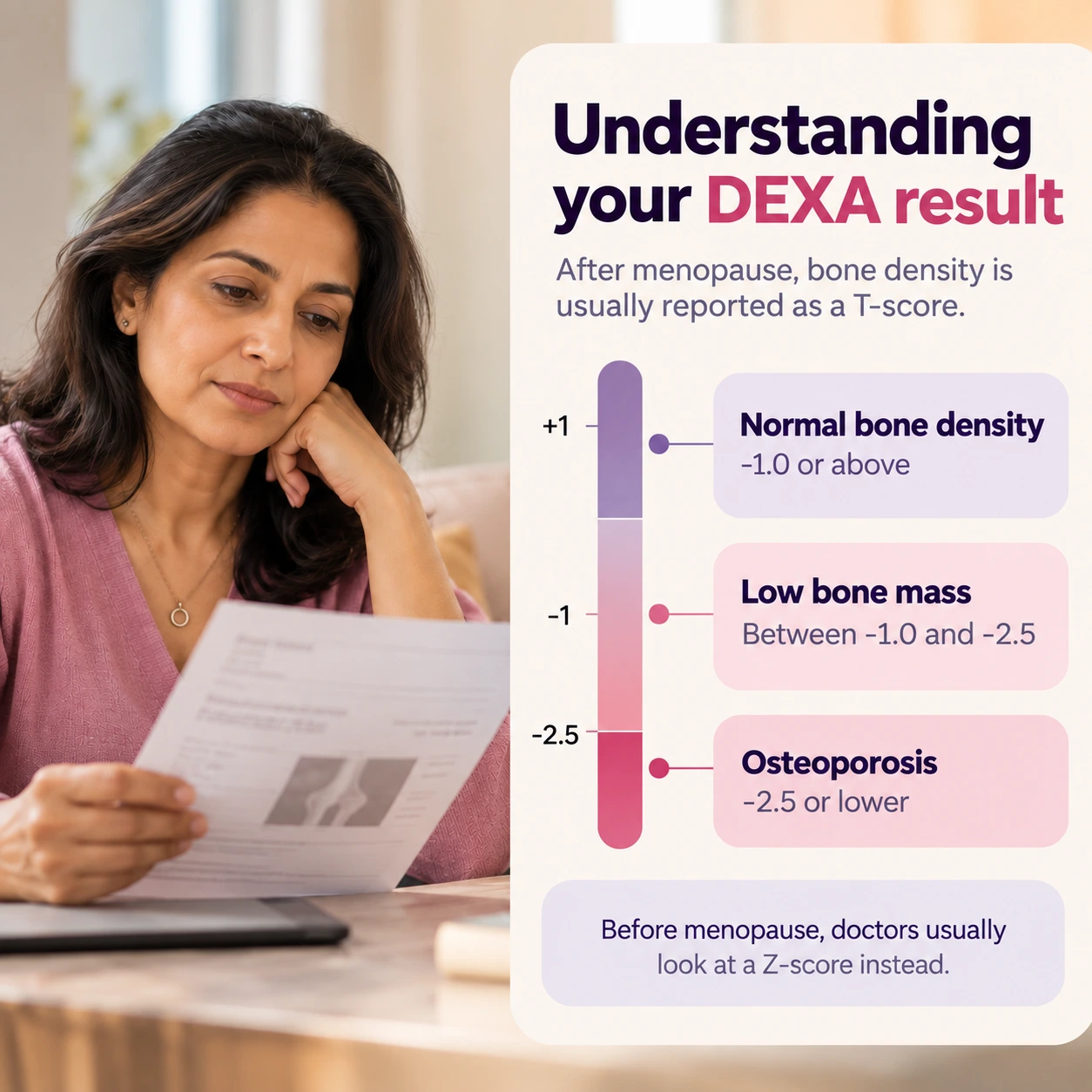
For postmenopausal women, DEXA results are commonly interpreted using a **T-score**, which compares your bone density with that of a healthy young-adult reference population.
Rather than thinking of the result as simply “good” or “bad”, it is more useful to understand where your T-score falls within the standard bone-density ranges. The visual below shows how those ranges are generally interpreted.
Fracture risk goes beyond the T-score
A DEXA result is only one part of the picture. Factors such as age, previous fractures or falls, medicines, family history and certain health conditions can also influence fracture risk.
Clinicians may combine bone mineral density with a fracture-risk assessment such as FRAX. An India-specific FRAX model is available, although Indian guidance notes that limitations in local fracture and mortality data may affect how precisely it estimates risk.
Repeat DEXA scans should have a reason
A DEXA scan does not automatically need to be repeated every year.
The Indian Menopause Society suggests that the timing of repeat scans should depend on individual risk and may commonly range from one to five years. Women at higher fracture risk or those being treated for osteoporosis may need closer monitoring.
The key question is whether repeating the scan now would change your treatment, monitoring plan or how your fracture risk is being managed. If it would not, another scan may not yet add useful information.
HRT protects bone, but it does not replace a DEXA decision
HRT can help reduce bone loss and lower fracture risk while it is being taken, which is one reason bone health forms part of menopause care.
But starting HRT does not automatically mean you need a DEXA scan first. Whether testing is useful still depends on factors such as your age, how long it has been since menopause, previous fractures and other risks for bone loss.
Bone health deserves closer attention in women with premature ovarian insufficiency, early menopause or surgical menopause, because they may spend more years with lower estrogen levels.
If you are unsure whether your menopause history or current treatment changes your bone-health needs, a menopause-focused clinician can help assess whether a DEXA scan would add useful information. MIROR’s HRT and specialist services can support that discussion. (NICE)
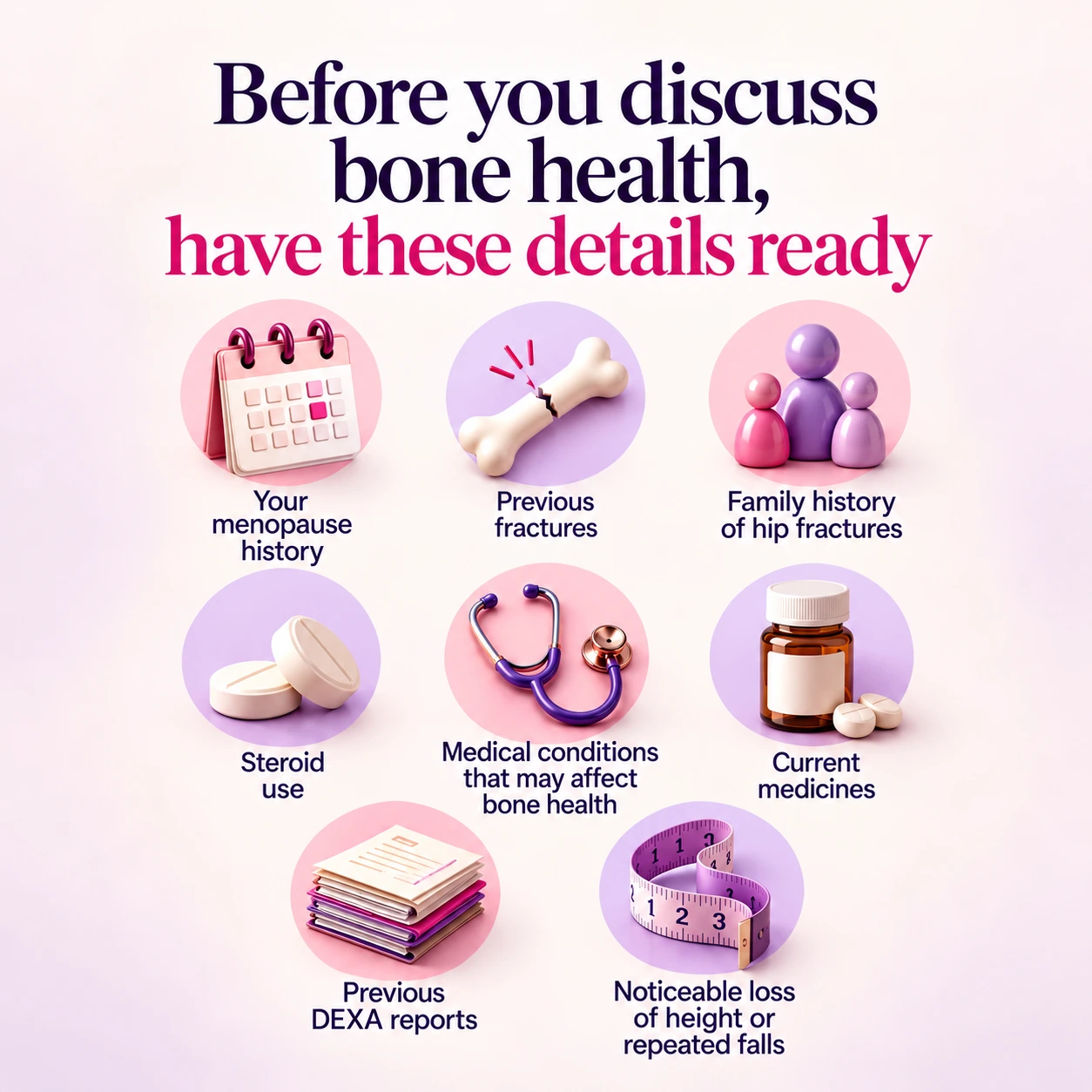
What to have ready when you discuss bone health with your doctor
You do not need to ask for a DEXA scan straight away. What helps more is having the right background information ready, so your doctor can decide whether bone-density testing would actually be useful.
So when should you get a DEXA scan?
There is no single age that answers this for every woman. The right timing depends on where you are in menopause, your bone-health history and whether anything is increasing your fracture risk.
If you are unsure whether a DEXA scan makes sense for you now, the next step is a conversation with a menopause-focused clinician rather than booking a scan on your own.
Through the MIROR app, you can book a consultation with menopause specialists who can review your history, current treatment and bone-health risk, and help decide whether a DEXA scan should be part of your assessment.
Medical Disclaimer: This article is for educational purposes only and is not a substitute for personalized medical advice, diagnosis or treatment. Whether you need a DEXA scan depends on your age, menopause history, fracture risk, medicines and overall health. Speak with a qualified healthcare professional about the screening approach that is appropriate for you.