

How much estrogen from estriol cream reaches your bloodstream?
If you have been prescribed estriol cream for vaginal dryness or repeated urinary infections, one question can make the treatment feel much less “local” than it sounds: does some of that estrogen still enter the bloodstream?
The short answer is yes, but usually only a small amount compared with systemic hormone therapy. “Local” does not mean zero absorption. More importantly, the amount absorbed is not fixed: it varies with the dose and formulation, how thin the vaginal tissue is when treatment begins, and how long it has been used. NICE describes systemic absorption from vaginal estrogen as minimal compared with systemic HRT and unlikely to have a significant effect throughout the body. (NICE)
That distinction matters, particularly when estriol is being considered for both vaginal dryness and recurrent UTIs.
Estriol cream is local treatment, not zero-absorption treatment
Estriol cream acts mainly on estrogen-responsive tissues in and around the vagina and lower urinary tract, rather than being designed to circulate throughout the body like systemic HRT.
Some estriol can still enter the bloodstream, but the amount is generally much lower than with oral estrogen therapy.
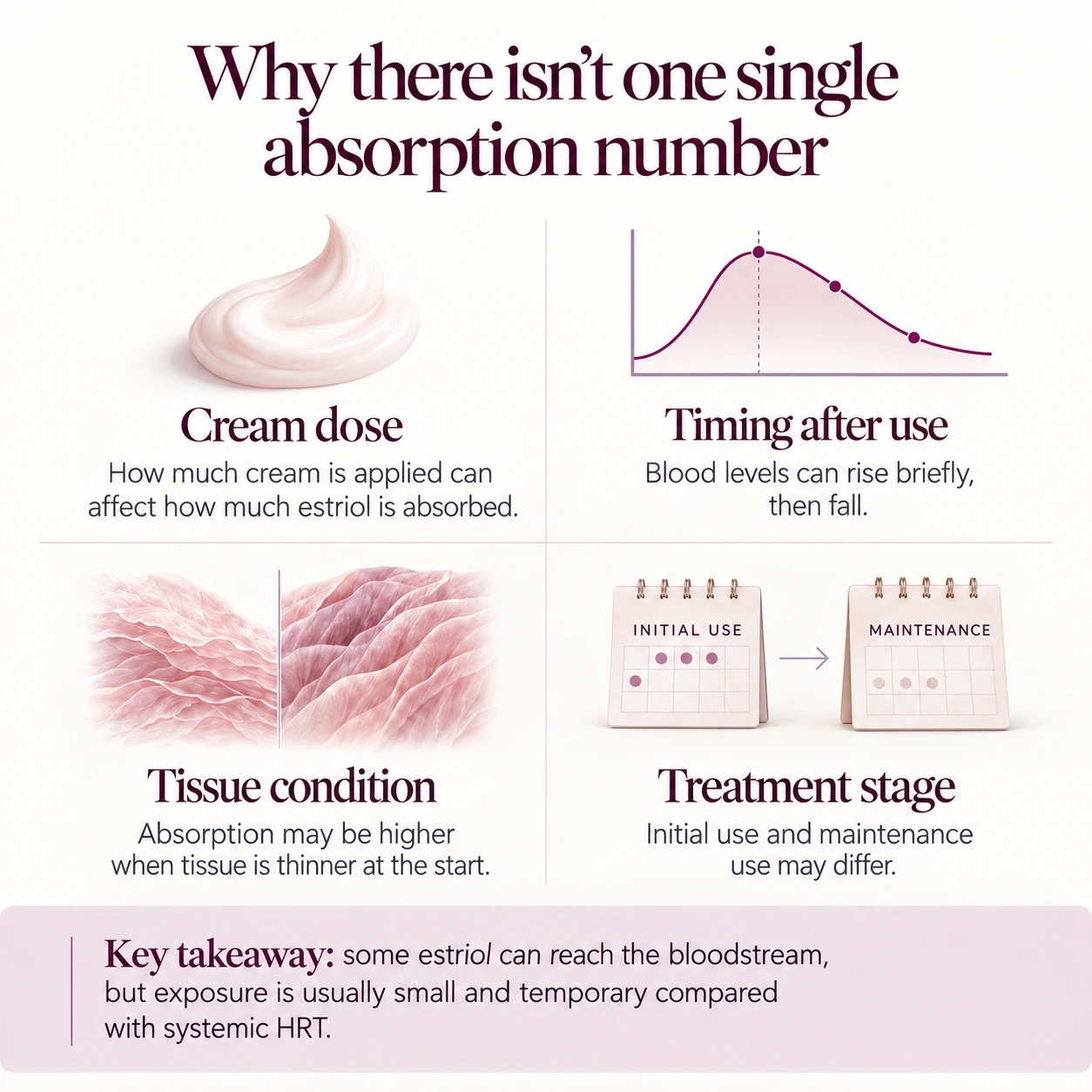
So, can we say exactly how much is absorbed? Not really. There is no single percentage that applies to every woman because absorption can vary depending on the dose, formulation and condition of the vaginal tissue.
Studies do give us an idea of what happens after estriol cream is applied. In one small study, estriol levels in the blood rose after the cream was used, peaked at around two hours, and had dropped substantially by 24 hours in most women. An earlier study found a similar pattern: a temporary rise shortly after application, followed by a decline over the next day.
The important takeaway is simple: vaginal estriol is not completely confined to the vagina, but the amount reaching the bloodstream is usually small and temporary compared with systemic HRT.
(PubMed)
Absorption Can Change After Treatment Begins
There is another reason blood exposure is not identical from the first application onwards.
When estrogen levels fall around and after menopause, vaginal tissue can become thinner and more fragile. According to the British Menopause Society, absorption of local estrogen tends to be greatest when treatment is started and the vaginal epithelium is most atrophic. As the tissue responds to estrogen and becomes healthier, systemic absorption decreases.
That helps explain why many local-estrogen regimens use an initial treatment phase followed by a lower-frequency maintenance phase. The exact dose and schedule depend on the specific product being used.
It also means that seeing evidence of some bloodstream absorption does not automatically make vaginal estriol equivalent to systemic estrogen therapy. The route, dose and resulting exposure are different.
Why Vaginal Tissue Condition Matters
Why would estrogen applied in the vagina have anything to do with urinary infections?
The connection starts with estrogen-sensitive tissue.
With lower estrogen levels, vaginal tissue becomes thinner and produces less glycogen. Lactobacilli, bacteria that normally help maintain the vaginal environment, may decrease. Vaginal pH rises, and organisms such as E. coli can become more predominant. Changes also occur around the urethra and bladder.
That can show up as dryness, burning or discomfort in one woman and urinary urgency, painful urination or repeated UTIs in another. Some women experience both.
Local estrogen works by treating this estrogen-deficient tissue rather than by killing bacteria directly. It can improve tissue maturation, blood flow and the local bacterial environment, which helps explain why the treatment can have effects beyond dryness alone.

Local estrogen can help reduce recurrent UTIs
When estrogen levels fall, changes in vaginal tissue, pH and protective bacteria can make recurrent UTIs more likely.
Local estrogen may help by improving the vaginal environment and supporting the return of protective lactobacilli.
Estriol cream will not prevent every UTI, but it can address one menopause-related factor that contributes to repeated infections.
NICE recommends considering vaginal estrogen for recurrent UTIs around and after menopause, while systemic HRT is not recommended specifically for UTI prevention.
Urinary burning does not always mean another UTI
Burning, urgency and needing to urinate more often can feel exactly like a UTI. But around and after menopause, these symptoms can also come from changes in the vaginal, urethral and bladder tissues caused by lower estrogen levels.
This means repeated urinary symptoms are not always repeated bacterial infections. In some women, both can happen at the same time.
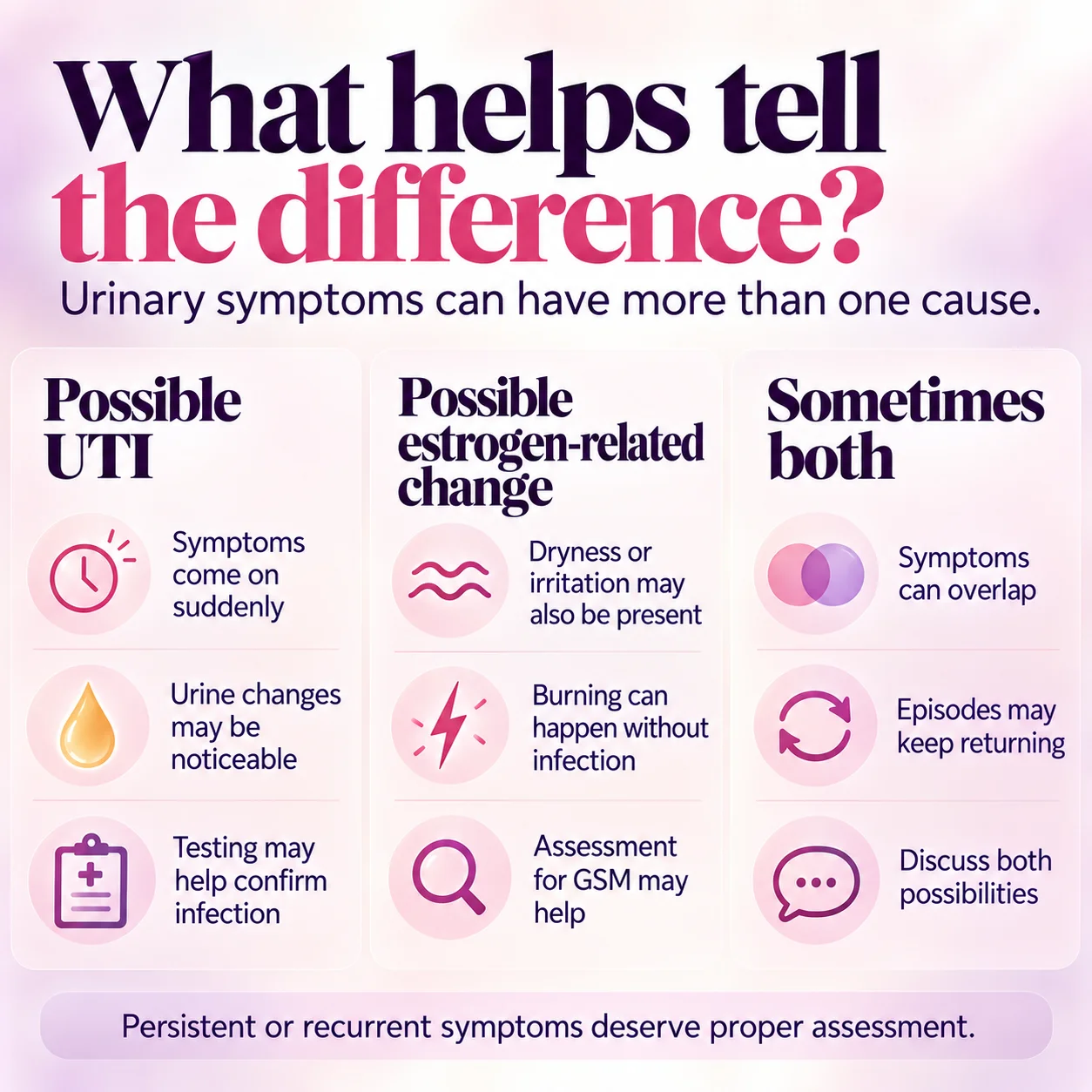
If symptoms keep returning, it is worth checking whether there is an actual infection rather than assuming another course of antibiotics is needed. A urine test or culture may help clarify what is going on.
Minimal absorption still needs individual context
Vaginal estriol is designed to act mainly where it is applied, with much lower systemic exposure than oral or other systemic estrogen treatments.
For most women, this low level of absorption is not expected to have the same whole-body effects as systemic HRT.
But individual medical history still matters. Women with unexplained vaginal bleeding or a history of estrogen-sensitive cancer should discuss vaginal estrogen with their clinician before starting treatment.
The important distinction is this: low absorption does not mean no absorption, but it also does not make vaginal estriol the same as systemic HRT.
What to discuss with your doctor before using estriol cream
Before using estriol cream, the most useful conversation is not only about absorption, but whether the treatment is appropriate for your symptoms and medical history.
Ask what dose of estriol you’re using, how often to apply the cream, and how long the initial treatment phase should last.
If you are having repeated urinary symptoms, it is also worth discussing whether they are confirmed infections, menopause-related tissue changes, or a combination of both.
And if you are already using systemic HRT but still have vaginal or urinary symptoms, local treatment may sometimes still be considered.
The better question is not “Is estriol absorbed?”
Some estriol from vaginal cream can reach the bloodstream, but the exposure is usually much lower than with systemic HRT and tends to be temporary.
What matters more is whether the treatment is appropriate for your symptoms, your medical history and the specific product you are using.
So the better question is not simply, “Is estriol absorbed?” It is, “Does this local treatment give me the benefit I need with an appropriate level of exposure for me?”
If you are unsure whether vaginal estriol is right for you, MIROR’s HRT Centre of Excellence can help review your symptoms and treatment options with a menopause-focused clinician.