

If you have searched for estrogen rich foods for menopause, you have probably seen lists of foods that supposedly “boost estrogen” or “balance your hormones.” But there is an important distinction behind these claims.
Foods do not contain human estrogen. Some plant foods contain phytoestrogens, naturally occurring compounds that can interact with estrogen receptors in the body. They are sometimes described as plant estrogens because of this activity, but they are not the same as the estrogen produced by your body.
This distinction matters during menopause. Phytoestrogen rich foods can be part of a nutritious, well balanced diet, but they should not be viewed as a way to restore declining estrogen levels or as a replacement for medical treatment.
What Are Phytoestrogens and How Do They Work?
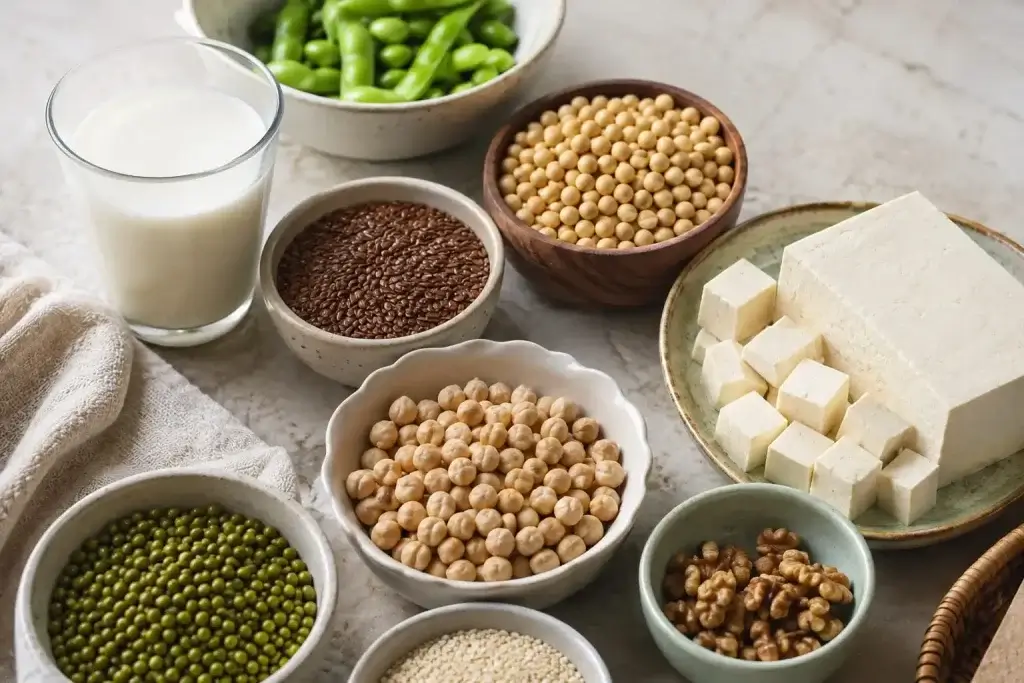
Phytoestrogens are naturally occurring compounds found in a variety of plants. Two commonly discussed groups are isoflavones, found particularly in soy, and lignans, found in foods such as flaxseed, whole grains, legumes, fruits and vegetables.
Their chemical structure allows some phytoestrogens to interact with estrogen receptors. However, their activity is much weaker and more complex than that of human estrogen.
Their effects can also vary depending on the specific compound, the tissue involved and the individual’s hormonal environment. In some situations, a phytoestrogen may have a weak estrogen like effect, while in others it may interfere with estrogen activity.
This is why calling these foods “natural estrogen” can create the wrong expectation. Eating tofu or flaxseed does not mean you are replacing the estrogen your ovaries produce.
Estrogen Rich Foods for Menopause: What Does the Evidence Say?
The phrase estrogen rich foods for menopause is widely used online, but technically, these are foods containing phytoestrogens rather than human estrogen.
Research has looked particularly closely at soy and its isoflavones because soy is one of the richest dietary sources of these compounds. Studies have explored whether soy can influence hot flashes and other menopause symptoms.
The results are mixed. Some research suggests soy isoflavones may provide a small reduction in the frequency or severity of hot flashes for some women, while other research has found little or no meaningful benefit. Differences between studies may relate to the type and amount of soy used, the form of isoflavones studied and individual differences in how people metabolise them.
The practical takeaway is simple: foods containing phytoestrogens can be nutritious additions to your diet, but there is not enough evidence to say that they reliably increase estrogen levels or treat menopause symptoms.
Best Indian Foods That Contain Phytoestrogens
Rather than looking for one “best” food, think about including a variety of natural sources of phytoestrogens in your regular meals.
Soy Foods
Soybeans are particularly rich in isoflavones. Practical options include tofu, tempeh, cooked soybeans and unsweetened soy milk.
For an Indian diet, tofu can easily become tofu bhurji, a curry ingredient or a protein addition to a stir fry. Soy milk can also be used in breakfast foods such as oats or smoothies.
Choose minimally processed soy foods where possible. They provide more than phytoestrogens, including protein and other nutrients.
Flaxseeds and Sesame Seeds
Flaxseed is a notable source of lignans and also provides fibre and healthy fats. Ground flaxseed can be added to oats, poha, curd, smoothies or homemade atta mixes.
Sesame seeds, or til, also contain lignans and can be an easy addition to Indian meals. Try sesame in chutneys, vegetable preparations or sprinkled over dishes for additional flavour and texture.
Neither should be viewed as a hormone treatment. They are nutritious foods that can form part of a balanced diet.
Chickpeas, Lentils and Other Legumes
Chana, rajma, lobia and other legumes contain phytoestrogen compounds while also providing protein and fibre. They already fit naturally into many Indian diets, making them an easy way to include Indian foods rich in phytoestrogens without changing your eating pattern dramatically.
Different lentils, whole grains and other plant foods contain varying amounts of phytoestrogen compounds. Including a variety of dals, whole grains, vegetables, fruits, nuts and seeds is more useful than trying to calculate how much phytoestrogen you are consuming.
Can Phytoestrogen Foods Help With Menopause Symptoms?
This is one of the most common questions about phytoestrogen foods for menopause, particularly when it comes to hot flashes.
Soy is the most extensively studied food source. Some studies have found modest improvements in hot flashes with soy foods or isoflavones, but the overall evidence remains inconsistent. Phytoestrogens have not been clearly established as a reliable treatment for menopause symptoms.
Flaxseed has also been studied for hot flashes, but research has not consistently shown a meaningful benefit.
So if you enjoy soy, flaxseed, sesame or legumes, there is no need to avoid them simply because they contain phytoestrogens. At the same time, there is no reason to force yourself to eat large amounts of these foods expecting them to control your symptoms.
If hot flashes, night sweats, sleep problems or other symptoms are significantly affecting your quality of life, discuss evidence based treatment options with a healthcare professional.
How to Include Phytoestrogen Foods in Your Everyday Indian Diet
You do not need a special “hormone balancing” diet.
A few simple changes can help you include foods that contain phytoestrogens alongside the other foods your body needs:
– Add ground flaxseed to oats, poha, curd or a smoothie.
– Include dal, chana, rajma or other legumes regularly.
– Use tofu in bhurji, curries or vegetable dishes.
– Add sesame to chutneys or cooked vegetables.
– Choose whole grains regularly alongside refined grains.
– Include a variety of vegetables, fruits, nuts and seeds rather than focusing on one particular food.
The aim is a nourishing menopause diet, not a diet built around trying to manipulate your estrogen through food.
What Phytoestrogen Foods Cannot Do
Phytoestrogen rich foods cannot reliably restore the estrogen produced by the ovaries before menopause.
They also cannot be considered equivalent to estrogen therapy. Hormone therapy uses specific hormones at specific doses and may be recommended for some women after considering their symptoms, health history and individual risks.
Food has a different role. A nutritious diet can support overall health, help you meet your protein and fiber needs and contribute important vitamins, minerals and healthy fats. It should not be presented as a substitute for clinically indicated treatment.
This distinction is particularly important if you are experiencing significant menopause symptoms and have been relying only on dietary changes because you believe “natural estrogen” will be enough.
Who Should Discuss Dietary Changes With a Healthcare Professional?
For most women, adding foods such as lentils, chickpeas, flaxseed, sesame and minimally processed soy to a balanced diet can be a practical nutritional choice.
However, individual advice may be appropriate if you have a food allergy, a significant medical condition, specific dietary restrictions or concerns about a particular food or supplement.
Food and concentrated phytoestrogen supplements are also not the same thing. If you are considering an isoflavone or other phytoestrogen supplement, particularly while taking medication, discuss it with your healthcare professional first.
Building a Balanced Menopause Diet
When looking for estrogen rich foods for menopause, it helps to look beyond the idea of “boosting estrogen.”
Soy, flaxseed, sesame, legumes and whole grains contain phytoestrogens and can all have a place in a nutritious Indian diet. But these foods do not contain human estrogen, do not reliably restore declining estrogen levels and should not be promoted as a substitute for hormone therapy.
The goal is not to find one food that can “balance” your hormones. It is to build an overall diet that supports your nutritional needs and wellbeing through menopause.
Want personalized guidance?
Your menopause diet does not have to be built around internet lists or one size fits all advice. If you would like personalized guidance based on your symptoms, nutritional needs and health goals, you can download the MIROR app and book a consultation with me.
FAQs
More is not necessarily better. There is no established need to consume large amounts of phytoestrogen rich foods specifically for menopause, and concentrated supplements are different from eating these foods as part of a normal diet
Some research has explored soy isoflavones and bone health, but the evidence is not strong enough to treat phytoestrogen rich foods as a substitute for established strategies for maintaining bone health. Adequate calcium, vitamin D, protein, physical activity and appropriate medical care remain important.
Soy foods can be included regularly as part of a varied diet. There is no need to consume soy specifically to increase estrogen, and your overall dietary pattern matters more than relying heavily on one food.
Yes. Individual responses can vary because phytoestrogens are metabolized differently and their activity depends on factors such as the specific compound and the body's hormonal environment. This may partly explain why research findings are not consistent across all women.
Phytoestrogen rich foods are not a specific weight loss treatment. However, foods such as soy, lentils, chickpeas, whole grains and seeds can provide protein, fiber and other nutrients that support a balanced eating pattern, which can be helpful when managing weight during menopause.