
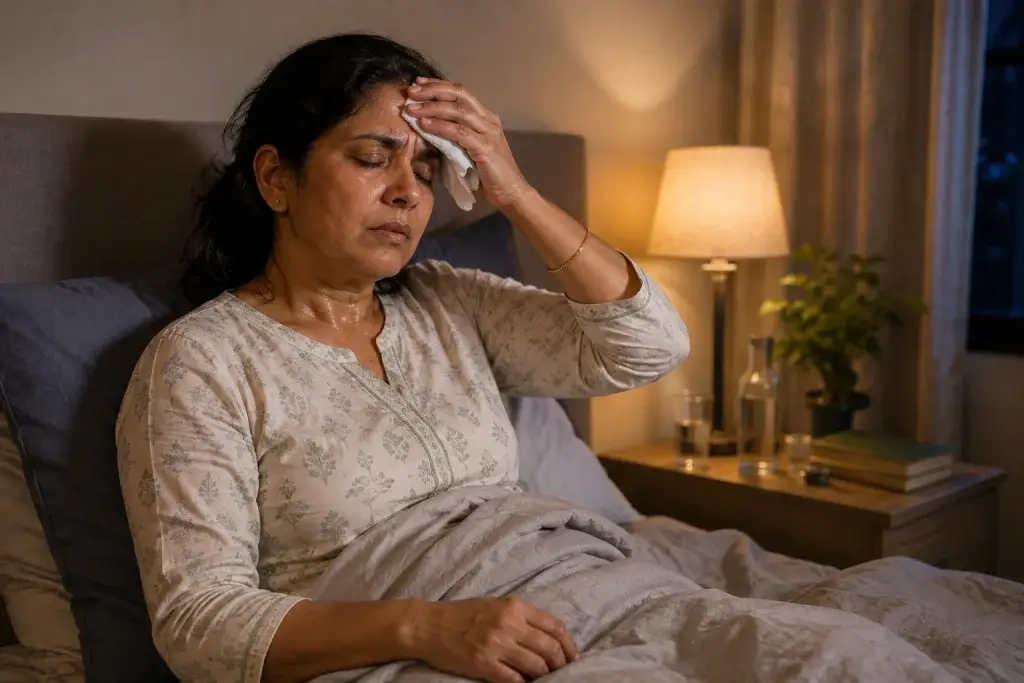
Night sweats menopause symptoms can turn a full night of sleep into a cycle of waking, cooling down and trying to fall asleep again. If this is happening regularly, menopause night sweats may be part of the reason.
Night sweats are a common vasomotor symptom during the menopause transition, and they can interfere with sleep quality and overall wellbeing. But before changing everything you eat or reaching for a supplement, it is worth looking at your evening routine as a whole. What you eat and drink, when you have it, your individual triggers and even the temperature of your bedroom may all influence how comfortable you feel at night.
Understanding your personal night sweats menopause triggers can help you identify which evening habits are worth changing. Instead, it is about identifying practical habits that may help you feel more comfortable at bedtime and support better sleep.
What Are Night Sweats During Menopause?
Night sweats are episodes of intense sweating that occur during sleep and are commonly associated with menopausal vasomotor symptoms. During the menopause transition, changes in the brain’s temperature-regulating system can make the body more sensitive to small changes in temperature, triggering feelings of heat and sweating.
For some women, night sweats may be mild and brief. For others, they can be intense enough to wake them up, leave their clothes or bedding damp, and make it difficult to fall back asleep.
The relationship between vasomotor symptoms and sleep is well established, although the frequency and intensity of symptoms vary considerably between women.
Why Night Sweats Can Disrupt Your Sleep
Night sweats can affect more than comfort. When sweating wakes you during the night, getting back to sleep may take time, particularly if you feel overheated or need to change your clothes or bedding. Repeated disruptions can affect sleep quality and leave you feeling tired the following day.
For this reason, it can be helpful to look beyond the symptom itself and consider what may make sleep more comfortable. Your evening routine, what you eat and drink, and the temperature of your bedroom are all worth considering.
The aim is not to control every factor, but to identify simple changes that may help you sleep more comfortably.
Night Sweats Menopause: Can Evening Habits Affect Symptoms?
There is no universally proven “night-sweat diet”. However, some women notice that certain evening habits coincide with feeling hotter, sweating more or sleeping poorly.
Rather than automatically eliminating foods, it can be more useful to look for patterns in your own routine.
Meal Timing and Heavy Evening Meals
A very large or heavy meal close to bedtime may make some people feel uncomfortable or interfere with sleep, particularly if digestion or reflux becomes an issue.
However, there is not enough menopause-specific evidence to say that eating late directly causes night sweats. If you notice that going to bed very full makes your sleep worse, adjusting the size or timing of your evening meal may be worth trying.
The aim is comfort, not a rigid eating window.
Alcohol and Caffeine
Alcohol and caffeine are worth considering when reviewing evening habits because both can affect sleep, and some women notice that they coincide with more troublesome symptoms.
That does not mean every woman needs to eliminate them completely. Timing, amount and individual sensitivity matter.
If you suspect a connection, changing one factor at a time can help you understand whether it actually makes a difference rather than unnecessarily restricting your diet.
Individual Food Triggers
Some women report particular foods or drinks as personal triggers for hot flashes or night sweats. However, individual experiences should not be turned into a universal list of foods that every woman needs to avoid.
Instead, pay attention to consistent patterns. If a particular evening habit repeatedly seems to precede a difficult night, that is more useful information than an online list of supposed “trigger foods”.
Do “Cooling Foods” Actually Help?
The term “cooling foods” is common in wellness content, but it can be misleading.
Eating a particular fruit, vegetable or other food does not necessarily lower your core body temperature enough to prevent a vasomotor episode. There is also limited evidence that specific foods marketed as “cooling” can treat menopausal night sweats.
That does not mean what you eat in the evening is irrelevant. A balanced, comfortable meal that suits your digestion may support better sleep, while very hot drinks, large meals or personally identified triggers may be worth reconsidering if you notice a consistent pattern.
Think comfortable eating, rather than trying to “cool” your body through food.
Bedroom Temperature vs Nutrition: What Should You Prioritize?
If night sweats are waking you up feeling hot and uncomfortable, your sleep environment is worth considering alongside your evening eating habits. Keeping the bedroom comfortably cool, choosing breathable sleepwear and bedding, and ensuring good airflow can make it easier to cool down and settle back to sleep.
Cooling strategies may help improve comfort during a night sweat, although they are not a treatment for the underlying vasomotor symptoms. The aim is simply to make your surroundings more conducive to sleep when an episode occurs.
Changing your bedroom temperature will not address the hormonal changes that contribute to vasomotor symptoms. However, if you are already waking up overheated, adjusting your sleep environment may be a more immediate and practical step than trying to find a particular “cooling food.”
Nutrition and your sleep environment can work alongside each other. What you eat may influence how comfortable you feel in the evening, while your bedroom environment can help you stay comfortable when a night sweat occurs.
A Practical Evening Routine for Night Sweats
Rather than following a rigid protocol, consider a few simple principles.
Build a Comfortable Evening Meal
Choose an evening meal that is balanced, satisfying and comfortable for you. Avoid unnecessarily restricting foods simply because they are labelled as “warming” or “cooling”.
If large meals close to bedtime leave you uncomfortable, experiment with eating earlier or having a lighter evening meal.
Review Your Personal Triggers
If night sweats menopause symptoms are frequent, pay attention to patterns involving alcohol, caffeine, meal size, timing and other evening habits.
You do not need to track everything indefinitely. A short period of observation may be enough to identify whether a particular habit consistently seems to affect your sleep.
When Night Sweats Need More Than Lifestyle Changes
Not every night sweat is caused by menopause.
If night sweats are new, unusually severe, persistent or accompanied by other concerning symptoms, speak with a healthcare professional rather than automatically assuming they are a menopause symptom.
And if vasomotor symptoms are repeatedly disrupting your sleep or affecting your daily life, you do not have to rely on nutrition alone. Evidence-based medical treatments are available for troublesome menopausal vasomotor symptoms, and a healthcare professional can help determine what may be appropriate for you.
Sleep Through the Night: Start With What You Can Control
There is no single dinner, “cooling food” or supplement that can guarantee a night without sweating.
A more realistic approach is to look at the whole evening: eat in a way that feels comfortable and adequately nourishing, notice your individual triggers, consider the timing of caffeine and alcohol, and make your bedroom as comfortable and cool as possible.
Nutrition can be one supportive piece of the puzzle. It does not need to carry the entire burden of managing menopausal night sweats.
Want more support managing menopause symptoms and improving your sleep? Download the MIROR app for expert-led resources, practical guidance and support designed for women through menopause.
FAQs
Night sweats can feel particularly disruptive at night because you are asleep and less able to adjust your environment as quickly. An episode can wake you from sleep and make it harder to settle again, especially if your bedding or bedroom becomes uncomfortably warm.
Yes. Vasomotor symptoms do not necessarily occur in the same pattern throughout the day and night. Some women may primarily notice sweating or heat episodes while sleeping, while others experience symptoms during both daytime and nighttime.
A stable number on the scale does not necessarily mean your body composition has stayed the same. You can lose some lean mass while gaining fat, or experience a shift in where fat is stored, particularly around the abdomen. This is why waist circumference, strength and overall metabolic health can provide useful information alongside body weight.
Regular exercise can support healthier body composition and reduce measures such as waist circumference and visceral fat. Research suggests that aerobic exercise can help with fat-related outcomes, while resistance training is particularly valuable for maintaining or increasing muscle mass.
There is no single food or supplement proven to reverse estrogen-related fat redistribution or prevent menopause weight gain. Instead, focus on the factors you can influence, including adequate nutrition, physical activity, muscle health, sleep and overall metabolic health. If symptoms or body-composition changes are concerning, discuss your individual options with a healthcare professional.