

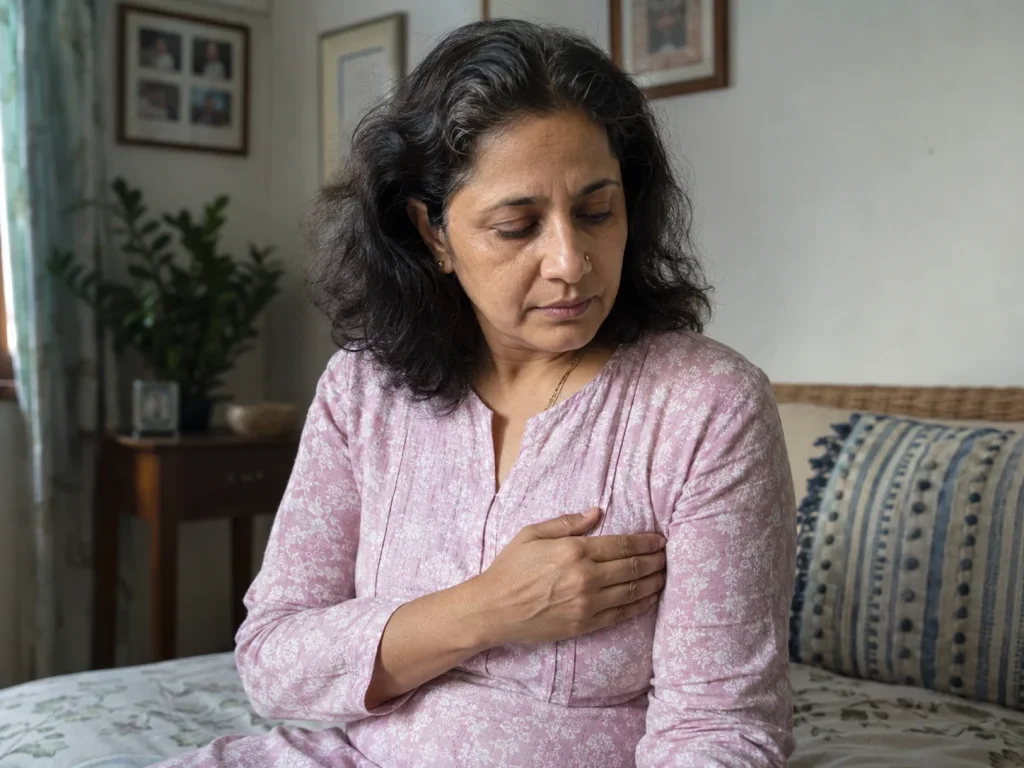
Breast or nipple tenderness can feel particularly worrying during midlife. If your nipples suddenly become sore, sensitive or painful, it is natural to wonder whether hormones are responsible or whether something more serious needs to be checked.
The reassuring news is that painful nipples during menopause and perimenopause can have many non-serious causes, including hormonal fluctuations, general breast tenderness, dry skin, friction or irritation.
At the same time, not every new breast or nipple symptom should automatically be blamed on menopause. The pattern of the pain, how long it lasts and whether there are any other breast changes can help determine whether medical evaluation is needed.
Can Menopause Cause Painful Nipples?
Yes, hormonal changes during the menopausal transition can contribute to nipple and breast tenderness.
During perimenopause, levels of estrogen and progesterone can fluctuate considerably as ovulation becomes less predictable. Breast tissue is sensitive to these hormonal changes, so some women notice tenderness, heaviness, soreness or increased nipple sensitivity.
This can feel similar to the breast tenderness you may previously have experienced before a period, although during perimenopause the pattern can become much less predictable.
After menopause, hormone levels are generally lower and more stable. As a result, cyclical hormonal breast pain usually becomes less common.
However, women taking hormone replacement therapy, or HRT, may still experience breast tenderness, particularly when treatment is first started or adjusted.
This means that nipple pain during menopause can sometimes be hormonal, but new or persistent pain after menopause should not automatically be assumed to be caused by hormones.
What Can Cause Painful Nipples During Menopause?
There are several possible reasons for nipple soreness in midlife. Most are benign, but identifying the likely cause depends on the symptoms and what else is happening.
Hormonal fluctuations
Hormonal changes are particularly relevant during perimenopause.
As estrogen and progesterone levels rise and fall unpredictably, the breasts may temporarily become more tender or sensitive. For some women, this includes the nipple and areola.
Hormonal tenderness may come and go and can occur alongside breast fullness or general soreness.
Friction and irritation
Sometimes the explanation is much simpler.
A poorly fitting bra, rough fabric, exercise clothing, sweating or repeated rubbing can irritate sensitive nipple skin.
If the discomfort appeared after changing your bra, exercising more frequently or wearing different clothing, friction may be contributing.
Dry or sensitive skin
Skin can become drier during menopause, and the nipple area is particularly sensitive.
Soaps, fragranced shower gels, laundry products and skincare ingredients can sometimes irritate the skin and cause soreness, itching or burning.
Skin conditions such as eczema or contact dermatitis can also affect the nipple area and may cause redness, dryness, scaling or irritation.
Physical or sexual stimulation
Repeated rubbing, pressure or sexual stimulation can make the nipples temporarily sensitive.
This type of discomfort generally has an obvious trigger and should improve once the irritation settles.
Medicines and HRT
Some medicines can contribute to breast tenderness.
HRT is one example. Both estrogen and progestogen can cause breast soreness or sensitivity, particularly during the first few months or after a change in treatment.
Hormonal contraception and certain other medicines can also contribute to breast discomfort in some women.
If symptoms begin after starting or changing medication, discuss this with your doctor rather than stopping prescribed treatment on your own.
Pregnancy during perimenopause
If you are still in perimenopause and pregnancy is biologically possible, nipple tenderness may occasionally be an early pregnancy symptom.
Irregular periods do not mean pregnancy is impossible. HRT also does not act as contraception.
If your period is unusually late and pregnancy is possible, taking a pregnancy test may be appropriate.
Infection or another breast condition
Inflammation or infection may cause nipple or breast pain together with redness, warmth, swelling or tenderness.
Other non-cancerous breast conditions can also cause pain, nipple changes or discharge.
Because different conditions can cause similar symptoms, persistent or unusual nipple changes may require a clinical breast examination rather than self-diagnosis.
What Does Menopause-Related Nipple Pain Usually Feel Like?
There is no single type of pain that proves hormones are responsible.
Women may describe:
- tenderness or soreness
- sensitivity when clothing touches the nipple
- mild burning or irritation
- discomfort that comes and goes
- pain affecting one or both sides
- general breast tenderness extending towards the nipple
Hormonal symptoms may be more likely when tenderness fluctuates, affects both breasts or occurs alongside other breast changes during perimenopause.
Skin-related discomfort may feel more like burning, itching or surface irritation.
However, the sensation alone cannot reliably tell us whether nipple pain is harmless or whether it needs further evaluation. The duration, location and associated symptoms are equally important.
Can Painful Nipples Be a Sign of Breast Cancer?
This is understandably one of the biggest concerns women have.
Breast or nipple pain on its own is not usually the most typical presentation of breast cancer, and most breast pain has a benign cause.
However, pain does not rule cancer out.
Breast cancer can occasionally cause breast or nipple discomfort, particularly when other changes are present.
Symptoms that deserve attention include a new breast lump, nipple discharge, a newly inverted nipple, skin dimpling, persistent nipple changes or an unexplained change in the shape or appearance of the breast.
There is also a rare form of breast cancer called Paget disease of the nipple, which can sometimes resemble eczema and cause persistent redness, scaling, crusting, burning or itching around one nipple.
This does not mean that nipple soreness or a rash is likely to be cancer. Most such symptoms have other causes.
The key message is that persistent or unexplained changes should be assessed rather than repeatedly assumed to be hormonal.
When Should Painful Nipples During Menopause Be Checked?
This is where it helps to focus less on fear and more on what has changed for you.
Speak to a healthcare professional if the pain is:
- persistent and not settling
- worsening over time
- focused in one particular area
- consistently affecting only one breast
- new and unexplained after menopause
- significant enough to interfere with your daily life
You should also arrange an assessment if nipple pain occurs alongside:
- a new breast or underarm lump
- spontaneous nipple discharge, particularly if it is bloody or comes from one breast
- a nipple that has newly turned inward
- persistent redness, scaling, crusting or a rash around the nipple
- dimpling, puckering or thickening of breast skin
- an unexplained change in breast shape or size
- redness, warmth or swelling
If a breast becomes rapidly red, hot or swollen, particularly if you feel feverish or unwell, seek medical care promptly as this may suggest infection or significant inflammation.
These symptoms do not automatically mean breast cancer. Many have benign explanations.
The purpose of getting checked is to understand the cause properly rather than relying on assumptions.
What Can Help Relieve Nipple Pain During Menopause?
For mild symptoms without concerning breast changes, some simple measures may help.
Wear a comfortable bra
A properly fitted and supportive bra can reduce movement and friction.
If symptoms are worse during exercise, a well-fitting sports bra may make a noticeable difference.
Reduce irritation
Pay attention to what is touching the nipple area.
Rough fabrics, tight clothing, sweaty sportswear or repeated rubbing can all make soreness worse.
Be gentle with dry skin
Avoid heavily fragranced soaps, shower gels or skincare products around irritated nipple skin.
If dryness is contributing, a simple fragrance-free moisturizer or emollient may help protect the skin barrier.
Persistent skin changes, particularly around only one nipple, should still be medically assessed.
Track the pattern
If you are still having periods, note when the discomfort occurs and whether it changes during your cycle.
It can also help to record:
- whether one or both breasts are affected
- how long the pain lasts
- whether there are visible changes
- whether you recently started or changed HRT or another medicine
You are not trying to diagnose yourself. You are simply gathering useful information to discuss with your doctor.
Address the underlying cause
Treatment depends on why the nipple is painful.
Skin irritation, infection, hormonal tenderness and medication-related symptoms are treated differently.
If breast tenderness developed after starting HRT, for example, that does not necessarily mean HRT is unsuitable for you. Breast tenderness can be a recognized side effect and may improve with time.
Persistent symptoms should be discussed with the clinician managing your treatment.
When Is It More Likely to Be Hormonal?
Hormones become a more likely explanation when nipple tenderness:
- happens during perimenopause while periods are still occurring
- comes and goes
- occurs with general breast tenderness or fullness
- appears to fluctuate with your menstrual cycle
- affects both breasts
- started after beginning or changing HRT or hormonal contraception
- is not accompanied by a new lump, nipple discharge or significant skin change
Even then, symptom patterns cannot provide a diagnosis on their own.
Once you are clearly postmenopausal, particularly if you are not taking HRT, new persistent breast or nipple pain is less likely to represent ordinary cyclical hormonal breast tenderness.
That does not mean something serious is likely. It simply means unexplained symptoms are worth discussing with a healthcare professional.
What I Want You to Take Away
Painful nipples during menopause and perimenopause can absolutely occur because of hormonal changes, particularly while hormones are still fluctuating during perimenopause.
They can also result from dry skin, friction, irritation, medication, inflammation or another breast condition.
So nipple tenderness should not immediately make you fear the worst.
But there is an equally important message: do not ignore every new breast change because you are going through menopause.
Know what is usual for your breasts. Notice when something is new. If nipple or breast pain is persistent, worsening, focused in one area or accompanied by a lump, unusual discharge, nipple inversion, skin changes or swelling, get it checked.
You do not have to choose between worrying unnecessarily and ignoring the symptom. A clinical assessment can often provide both clarity and reassurance.
If you are experiencing painful nipples during menopause, breast tenderness or another menopause-related breast change you are unsure about, download the MIROR app from the Google Play Store or Apple App Store and book an appointment with me, Dr. Archana Nirula.
FAQs
Yes. Sometimes the nipple itself may feel sore or sensitive even when the rest of the breast feels normal. Skin irritation, friction, dryness or local sensitivity can affect the nipple without causing wider breast tenderness. If the pain persists or there is a visible nipple change, it is worth getting assessed.
It can. Hormonal changes, combined with drier or more sensitive skin during midlife, may make the nipple area feel more reactive to fabrics, bras, exercise or touch. Switching to softer fabrics and reducing friction may help if irritation is contributing.
There is no fixed number of days that applies to everyone. Mild discomfort with an obvious trigger may settle once the irritation resolves. However, pain that keeps returning, continues without an obvious explanation, becomes more intense or remains focused in one area should be discussed with a healthcare professional.
Not without speaking to the clinician managing your treatment. Breast tenderness can occur after starting HRT or changing the dose or formulation, and it may improve as your body adjusts. Your doctor can review the timing and severity of your symptoms and decide whether any treatment adjustment is appropriate.
Some women notice that breast discomfort seems to vary with lifestyle factors such as stress, caffeine intake or changes in diet, but these associations are not consistent for everyone. Rather than making major dietary restrictions based on nipple pain alone, it is more useful to track your symptoms and discuss persistent discomfort with your doctor.