


Eight hours of sleep. A normal thyroid report. And you’re still exhausted by lunchtime.
If you’re wondering whether this is thyroid fatigue, a normal TSH makes the most common thyroid problems less likely, but it does not explain persistent tiredness. In midlife, low iron, disrupted sleep, medication, mood changes or the menopause transition can all be part of the picture.
That is what makes this kind of exhaustion so frustrating. The report says “normal”, but you still do not feel like yourself.
The next step is not necessarily another thyroid test. It is understanding the pattern of your fatigue and what else may be contributing to it.
(NHS guidance on tiredness and fatigue;)
What this kind of tiredness can actually feel like
This is often more than feeling sleepy after a long week.
You may sleep for seven or eight hours and still wake up feeling as though you have barely rested. Things that once felt automatic, getting through work, exercising, cooking dinner or concentrating through a meeting, suddenly take much more out of you.
You might notice that:
- you wake up already tired
- your concentration disappears halfway through the day
- you struggle to find words or stay focused
- exercise leaves you wiped out rather than energized
- you need more recovery time after ordinary tasks
- you are sleeping, but you do not feel restored
The frustrating part is that your body is telling you something is off while your thyroid report is telling you everything looks fine.
A normal thyroid result does not make the fatigue any less real. It simply means the next question needs to look beyond the thyroid. If tiredness has been persistent, unexplained or is affecting daily life, it is worth getting it checked.
(NHS)
What does a normal TSH actually tell you?
TSH stands for thyroid-stimulating hormone.
Think of it as a message your brain sends to your thyroid, telling it how hard it needs to work.
When your thyroid is not producing enough hormone, TSH usually rises. When it is producing too much, TSH usually falls. That is why TSH is commonly used as the first thyroid blood test.
You may also hear your doctor mention free T4. T4 is one of the main hormones produced by the thyroid. Measuring it gives doctors another piece of information about how much thyroid hormone is circulating in your blood.
For most adults, NICE recommends checking TSH first. Other thyroid tests may be added if the result, symptoms or medical history suggest they are needed.
So, in plain English:
A normal TSH makes it less likely that your thyroid is causing the tiredness. But it does not tell you what is causing it instead.
What a normal TSH can and cannot tell you
| What a normal TSH makes less likely | What a normal TSH does not explain |
|---|---|
| The common form of an underactive thyroid | Iron deficiency or anaemia |
| The common form of an overactive thyroid | Poor-quality or disrupted sleep |
| Major thyroid dysfunction in most adults | Medication effects, vitamin deficiencies or mood changes |
| Your thyroid being the main explanation for the fatigue | Perimenopause, menopause or other health conditions that can cause fatigue |
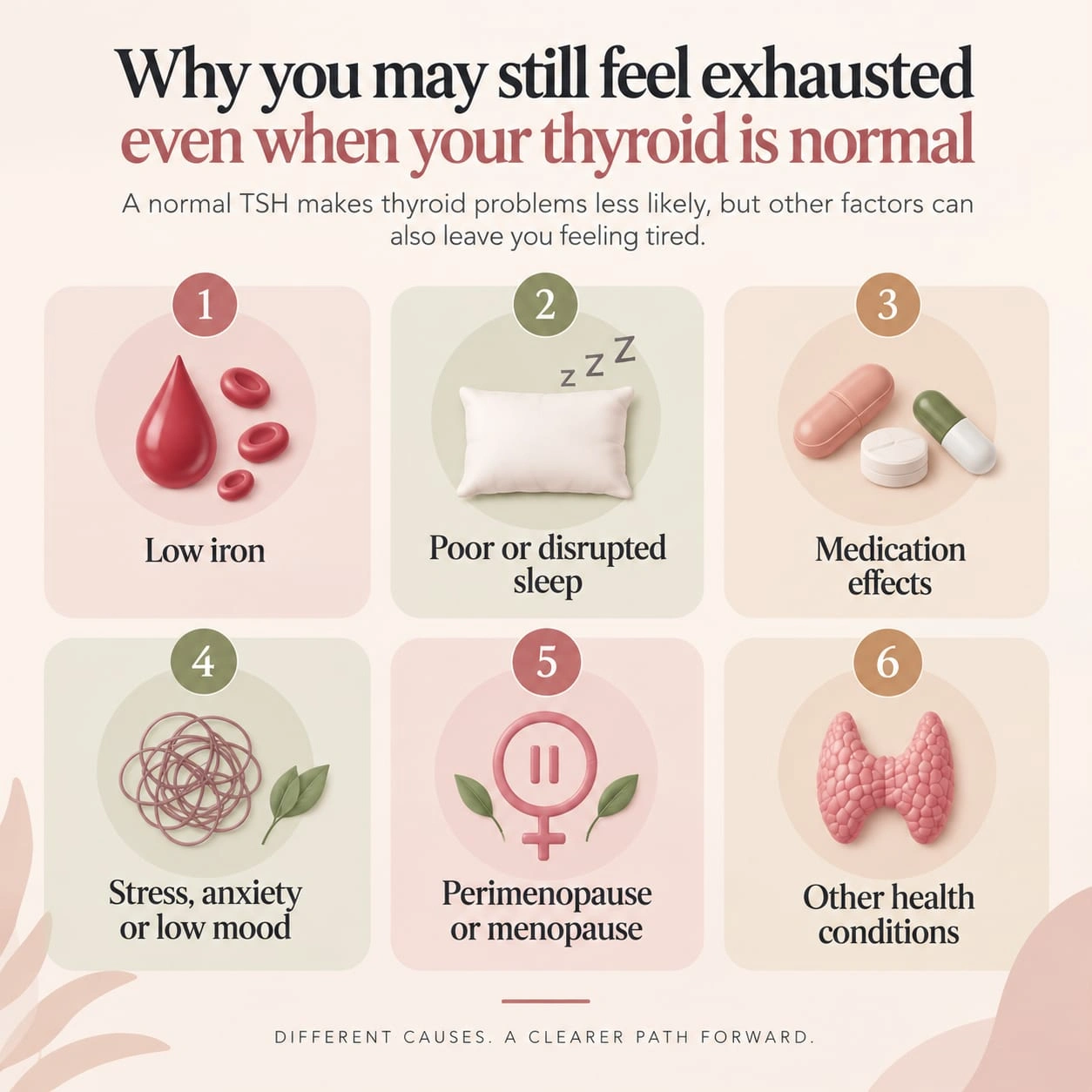 If you are already being treated for a thyroid condition, the picture can be slightly different. Your doctor may consider your symptoms, thyroid results, medication dose and how you are taking the medication, rather than assuming the answer is simply to increase the dose.
Fatigue is a symptom, not a diagnosis.
The other symptoms happening alongside it often give doctors some of the most useful clues.
| Possible pattern | Other clues you might notice | What may help clarify it |
|---|---|---|
| Thyroid-related | Feeling unusually cold, constipation, dry skin, weight changes or slower thinking | Thyroid blood tests interpreted alongside symptoms and medical history |
| Iron deficiency or anaemia | Breathlessness, noticeable heartbeats, headaches, paler skin, hair shedding or heavy periods | Full blood count and, when appropriate, iron studies |
| Poor or disrupted sleep | Waking unrefreshed, daytime sleepiness, morning headaches, repeated waking or loud snoring | Sleep history and further assessment if sleep apnoea is suspected |
| Mood, anxiety or prolonged stress | Low mood, loss of interest, irritability, poor sleep or feeling exhausted from the start of the day | Clinical assessment rather than one specific blood test |
| Perimenopause or menopause | Cycle changes, hot flushes, night sweats, disturbed sleep or mood changes | Symptoms and medical history, particularly from age 45 onwards |
More than one of these can be happening at the same time.
For example, someone in perimenopause may have heavier periods that contribute to iron deficiency and night sweats that repeatedly disturb sleep. Both can leave her exhausted the following day.
That is why the pattern around your fatigue matters as much as the fatigue itself.
What might your doctor want to check next?
There is no single set of tests that every person with fatigue needs.
A useful assessment starts with your symptoms, periods, sleep, medications, diet and medical history. Testing can then be chosen based on what your doctor is actually looking for.
Iron deficiency and anaemia
For women who are still having periods, this deserves particular attention.
Heavy menstrual bleeding can contribute to iron deficiency anaemia. Symptoms may include tiredness, lack of energy, breathlessness, noticeable heartbeats, headaches and paler skin.
A full blood count is often one of the first tests used when anaemia is suspected. Your doctor may recommend additional iron testing depending on the results and your history.
(NHS guidance on iron deficiency anaemia.)
Vitamin B12 or folate deficiency
Vitamin B12 or folate deficiency can also cause significant tiredness.
Other symptoms can include pins and needles, muscle weakness, a sore or red tongue and problems with concentration or memory.
Because these symptoms overlap with many other conditions, testing should be guided by your history rather than assuming every case of fatigue needs supplements.
(NHS guidance on vitamin B12 and folate deficiency.)
Sleep that is not actually restorative
Eight hours in bed does not necessarily mean eight hours of restorative sleep.
If you wake repeatedly, snore heavily, wake with headaches or someone has noticed gasping, choking or pauses in your breathing while you sleep, tell your doctor.
Sleep apnoea can cause significant daytime tiredness and difficulty concentrating, even when you feel you have spent enough time in bed.
(NHS guidance on sleep apnoea.)
Medication and mood
Some medicines can contribute to tiredness. Stress, anxiety and depression can too.
This does not mean physical symptoms should be dismissed as emotional. It simply means mood, medication and physical health may all need to be considered when fatigue persists.
If you take levothyroxine
How you take levothyroxine matters.
It is usually taken on an empty stomach before breakfast. Food, caffeine, iron, calcium and some other medicines or supplements can interfere with its absorption.
If you take levothyroxine differently from day to day, or take other medicines or supplements around the same time, mention this to your doctor or pharmacist before assuming your thyroid dose is wrong.
(NHS guidance on levothyroxine.)
Could perimenopause be part of the picture?
It can be, particularly when fatigue appears alongside changes in your periods, hot flushes, night sweats, disturbed sleep or mood changes.
For otherwise healthy women aged 45 and over with menopause-related symptoms, NICE recommends identifying perimenopause mainly from symptoms and menstrual history rather than routinely relying on hormone blood tests.
Other tests can still be appropriate when another cause of the symptoms is suspected.
This distinction matters because “menopause fatigue” is not always one isolated symptom directly caused by hormones.
Sometimes the pattern looks more like this:
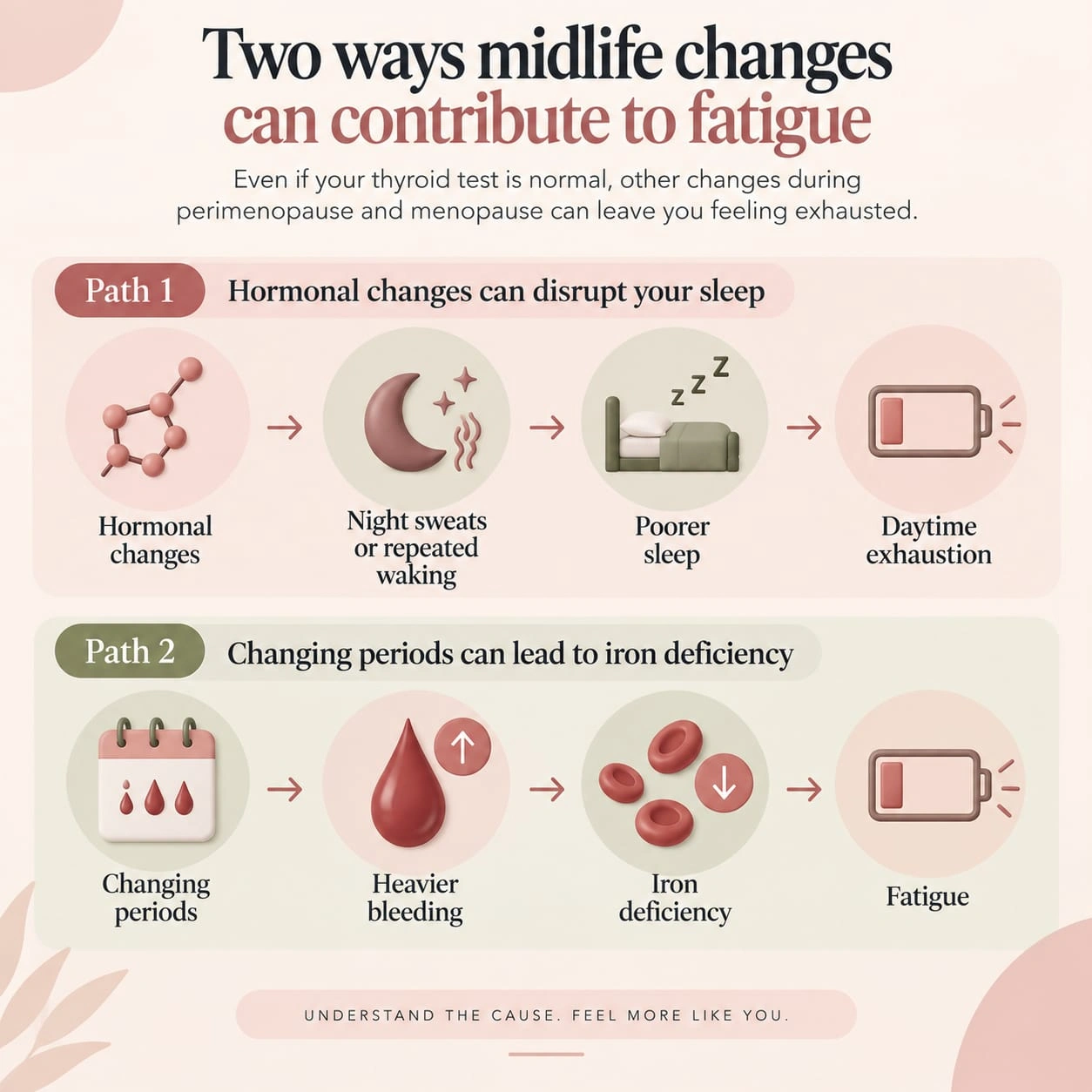
The goal is to understand what may be behind your fatigue, so you can address the right cause.
When should tiredness be checked sooner?
Do not keep writing persistent exhaustion off as being busy, getting older or “just hormones”.
Book a medical appointment if:
- your tiredness has lasted several weeks and is not improving
- it is affecting work, exercise, concentration or normal daily activities
- you are losing weight without trying
- you have persistent breathlessness or noticeable heartbeats
- you look unusually pale or have very heavy bleeding
- you snore loudly and experience significant daytime sleepiness
- someone has noticed gasping, choking or pauses in your breathing while you sleep
Persistent unexplained tiredness, particularly when it affects everyday life or appears with other symptoms, deserves medical assessment.
Seek urgent medical help for chest pain, severe or sudden breathlessness, fainting, or new weakness, numbness or difficulty speaking.
What actually helps?
Start by working out what is causing the fatigue
There is no universal “energy fix”.
Iron treatment helps when iron deficiency is present. Sleep apnoea needs its own assessment and treatment. Mood changes may need specific support. Thyroid medication needs to be reviewed in the context of your thyroid results.
Treating the reason for the fatigue is more useful than simply trying to push through it.
If you take thyroid medication
Take levothyroxine consistently and as prescribed.
If your TSH is normal but symptoms continue, do not change the dose yourself. Your doctor can review your thyroid results, medication routine and whether something else could be contributing to the fatigue.
If perimenopause is disrupting your sleep
For suitable women, HRT can be one of the most effective treatments for menopausal symptoms such as hot flushes and night sweats. If night sweats are disrupting sleep, treating them may help you sleep better too.
At MIROR, our menopause specialists can help you understand whether HRT is right for you, based on your symptoms, medical history and individual risks.
NICE also recommends considering menopause-specific CBT for some sleep problems linked to menopausal symptoms.
Do not treat a guess with supplements
Feeling tired does not automatically mean you need iron, B12 or another supplement.
If a deficiency is suspected, testing can help identify whether there is actually something to correct and what treatment is appropriate.
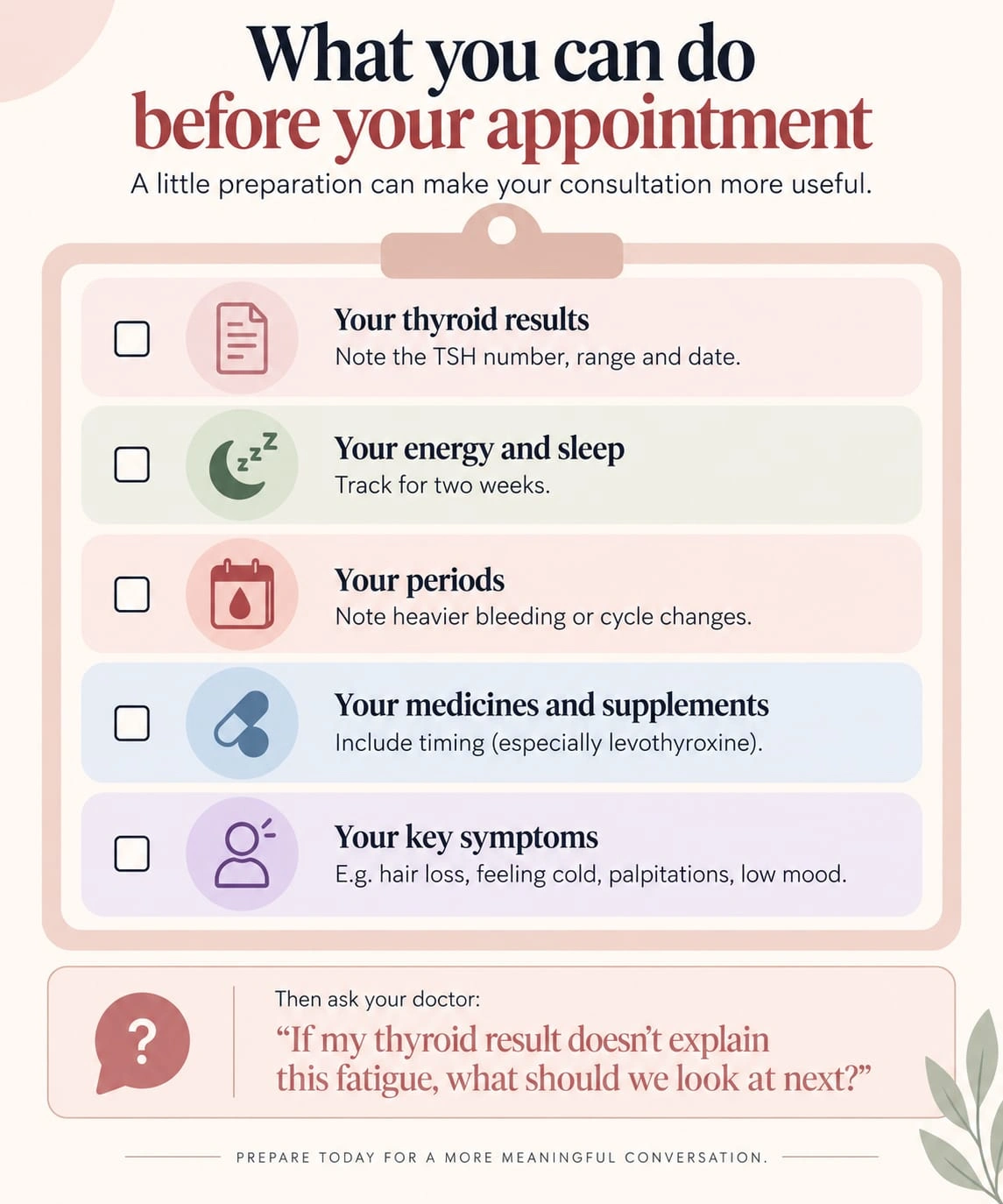
Where Miror fits in
If your exhaustion is happening alongside cycle changes, hot flushes, night sweats, disrupted sleep, brain fog or mood changes, a midlife assessment can help look at those symptoms together rather than treating each one in isolation.
At Miror, a menopause consultation can review your symptoms, menstrual history, existing health conditions and medications, and help identify whether perimenopause or menopause may be contributing to what you are experiencing.
Where investigations or treatment outside Miror’s scope are needed, you should be directed to the appropriate doctor.
Miror does not treat thyroid disease, and HRT is not a treatment for hypothyroidism. Thyroid conditions should be assessed and managed by an appropriate physician or endocrinologist.
A final word
A normal TSH is reassuring information. But if you still feel exhausted, the conversation does not have to end there.
Your fatigue may be connected to sleep, iron levels, medication, mood, menopause symptoms or another health issue that deserves attention.
You do not need to keep guessing why you are tired. The useful question now is what should be checked next?
Looking for personalised guidance on your midlife health? Download the MIROR app to connect with menopause experts and explore the right care for you.