


Before HRT, do both scans really need to come first?
If you have reached the point of considering HRT, you may already have a long list of things to think about.
Your symptoms. Your periods. Your medical history. Your family history.
And then your doctor mentions two more things: a transvaginal ultrasound and a mammogram.
Suddenly, it can feel as though you need to pass a series of tests before you are even allowed to start treatment.
But that is not quite how HRT assessment works.
A TVS or mammogram may be recommended for a very good reason. But neither is a universal “clearance test” that every woman must complete before starting HRT.
The more useful question is not “Do all women need these scans?”
It is:
“Why has my doctor recommended this test for me?”
Before You Book the Scan, Start With the Reason
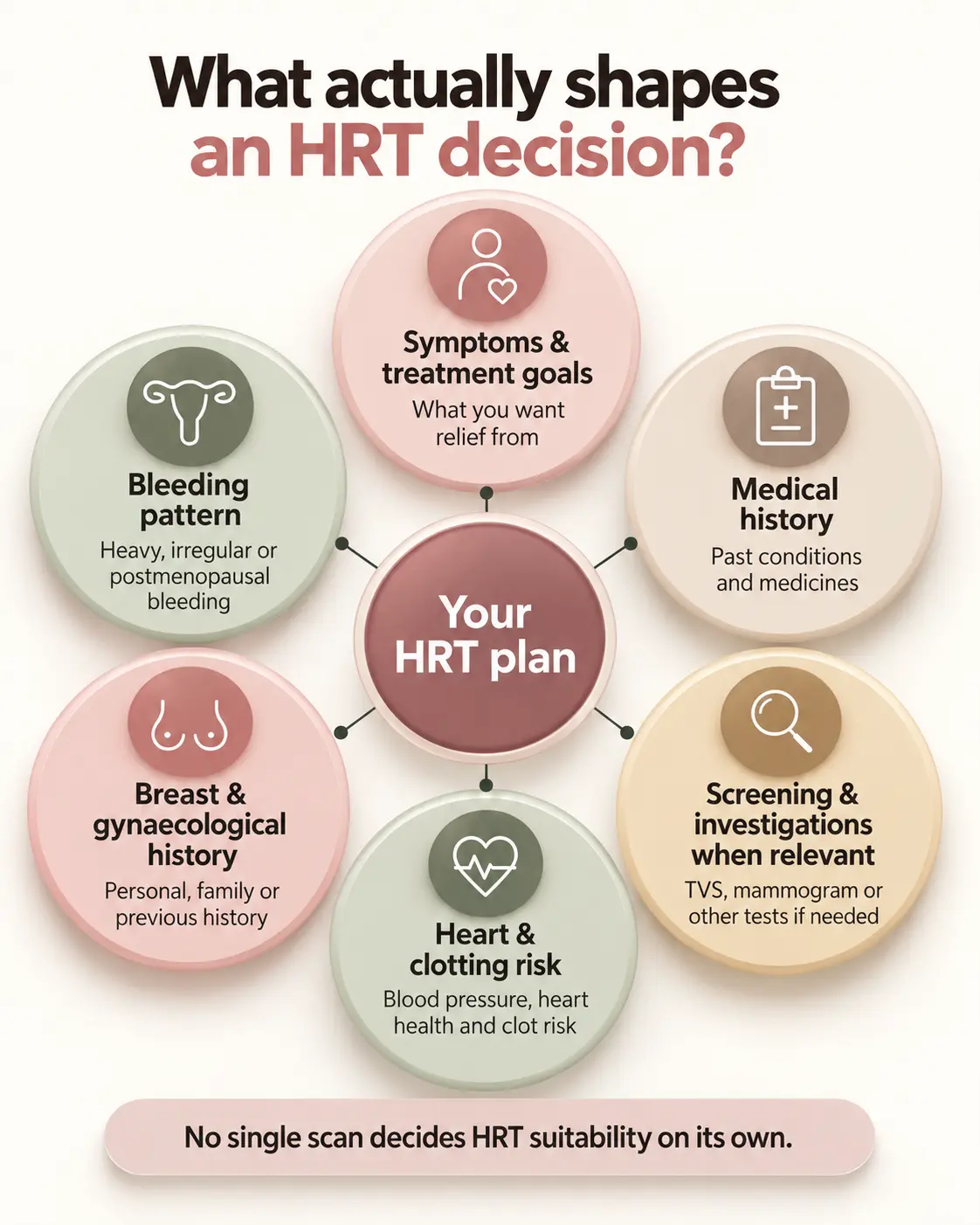
HRT is not prescribed based on one scan result.
Your clinician will usually look at your symptoms, menstrual and bleeding history, age, medical and family history, medicines, blood pressure, relevant risk factors and what you are hoping to achieve from treatment.
Current menopause guidance recommends an individualized approach when discussing HRT, with the benefits and risks considered in the context of your age, circumstances and potential risk factors. (NICE)
Where a Transvaginal Ultrasound Actually Fits
A transvaginal ultrasound, commonly called a TVS, is a type of pelvic ultrasound. It uses a slim ultrasound probe placed in the vagina to produce detailed images of the uterus, endometrium, ovaries and surrounding pelvic structures.
Because it gives a close view of the uterus and womb lining, TVS can be particularly useful when there is a concern about bleeding or another gynaecological problem.
But that does not make it a routine first step for every woman considering HRT. So if someone has written “TVS before HRT” on your list of investigations, it is completely reasonable to ask: “What are we looking for with the scan?”
That one question can tell you much more than the scan itself. (NICE)
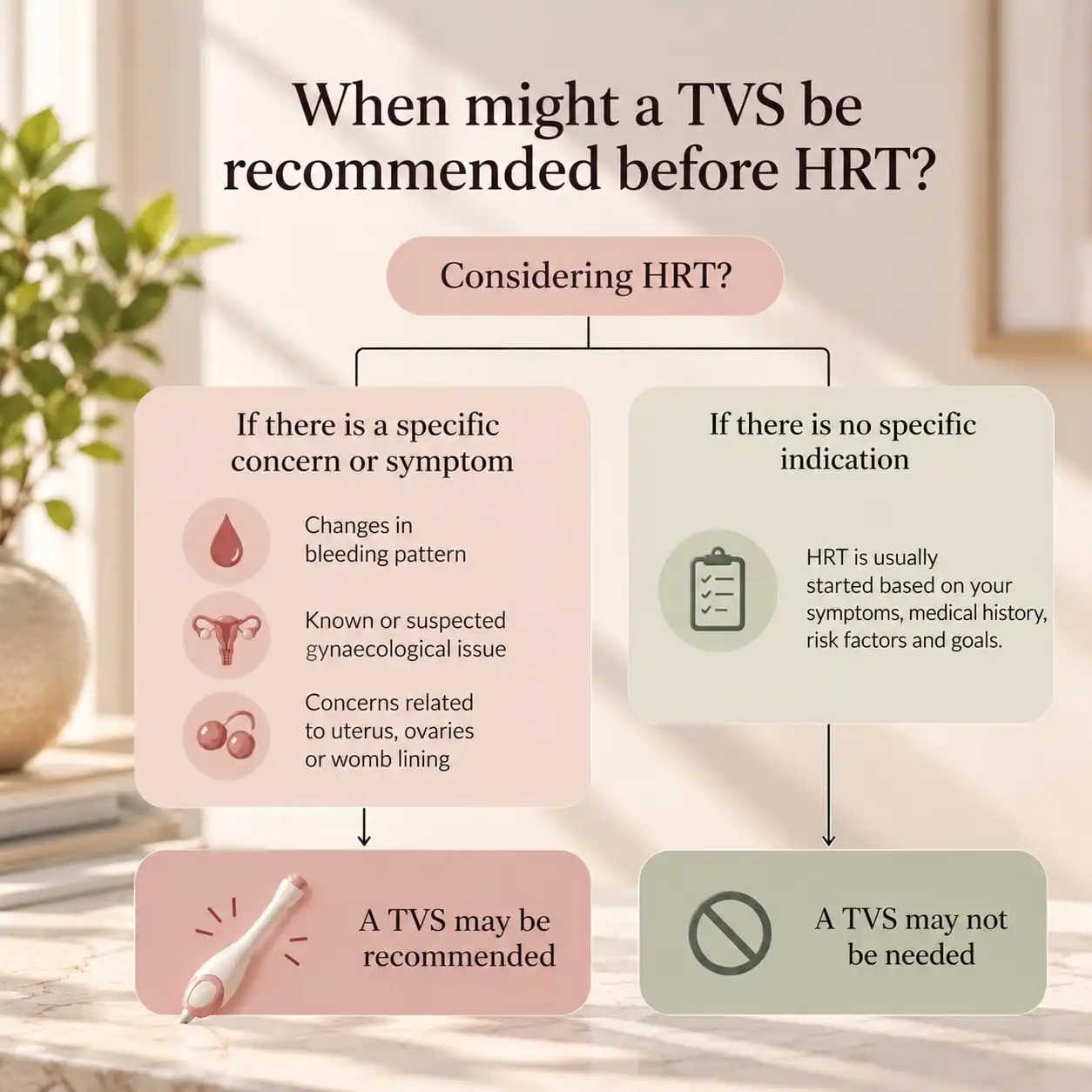
Bleeding Changes the Conversation
Bleeding is one of the clearest reasons your doctor may recommend a transvaginal ultrasound.
During perimenopause, periods can naturally become irregular. But bleeding that becomes unusually heavy, lasts much longer than usual, happens between periods, or changes significantly from your normal pattern may need further assessment.
Bleeding after menopause is different. If you have gone 12 months without a period and then experience bleeding or spotting, it should be checked rather than assumed to be part of menopause.
A transvaginal ultrasound can help your doctor look at the uterus and womb lining and check for possible causes such as fibroids, endometrial polyps or other gynaecological changes.
Sometimes the ultrasound is enough to reassure your doctor. In other situations, depending on your symptoms, risk factors and what the scan shows, further tests such as an endometrial biopsy or hysteroscopy may be recommended.
The key point is that the TVS is being done to investigate the bleeding or another specific concern, not simply because you want to start HRT.
Bleeding is one of the clearest reasons a TVS may be recommended. Breast imaging, however, answers a different question altogether.
Mammography Has a Different Role
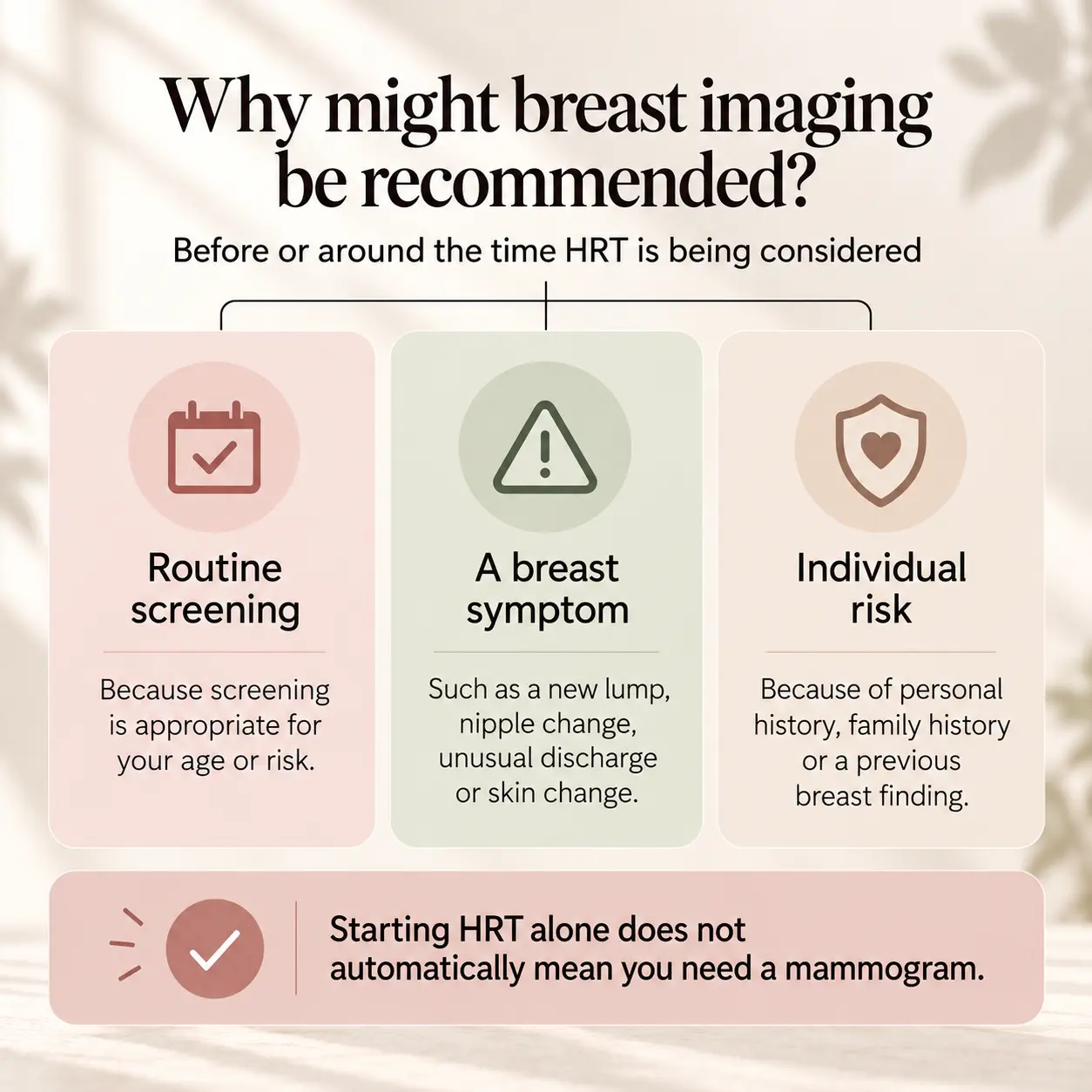
A mammogram is an X-ray of the breasts used either for routine breast cancer screening or to investigate a specific breast concern.
Whether you need one before HRT depends on your age, screening history, breast symptoms, personal and family history and individual breast cancer risk.
This is especially relevant in India because breast-screening practices differ between countries. A screening timetable used elsewhere should not automatically be treated as an Indian pre-HRT requirement.
A new lump, nipple change, unusual discharge or skin change should be assessed whether or not you are considering HRT.
HRT and Breast Risk Are Part of the Same Conversation
HRT does affect the breast-risk conversation, but it does not automatically create a separate mammography schedule.
Breast cancer risk varies according to factors including your baseline risk, the type of HRT used and duration of treatment. Combined estrogen-progestogen HRT has a different breast-risk profile from estrogen-only HRT.
That is why a normal mammogram is useful information when clinically appropriate, but it is not a universal certificate showing that HRT is suitable.
Women with a personal history of breast cancer or significant inherited or familial risk may need specialist advice before systemic HRT is considered.
If Your Doctor Recommends Both Scans
If your doctor recommends both a TVS and mammogram, the two tests may be answering completely different questions.
The transvaginal ultrasound may be investigating unusual bleeding or another pelvic concern, while the mammogram may relate to screening, a breast symptom or individual breast risk.
If either scan finds something that needs clarification, further investigation may be advised before the HRT plan is finalised.
An abnormal result does not automatically mean cancer or permanently rule out HRT. It means the finding needs to be understood first.
What Actually Matters Before Starting HRT
A proper HRT assessment is much broader than a TVS or mammogram.
Your clinician will consider your menopause symptoms, bleeding pattern, medical and family history, breast and gynaecological history, cardiovascular and clotting risk, current medicines and other health conditions.
Tests, scans or specialist review are then added when there is a clinical reason for them.
The aim is not to avoid testing. It is to test for a reason.
A Few Questions Worth Asking
- Why are you recommending this test for me?
- What exactly are you looking for?
- Is this routine screening or because of my symptoms or history?
- Will the result change my HRT plan?
- If something is found, what happens next?
How MIROR Can Help With Your HRT
At MIROR’s HRT Centre of Excellence, HRT assessment looks at the wider clinical picture rather than reducing treatment suitability to one scan result.
If a TVS, mammogram or another investigation is relevant, it should have a clear clinical reason and fit into your individual treatment plan.
What You Actually Need Before Starting HRT
So, do you need a TVS and mammogram before HRT?
Not simply because you are considering HRT.
A transvaginal ultrasound may be appropriate when bleeding, postmenopausal bleeding or another gynaecological concern needs investigation.
Neither should automatically be treated as a universal prerequisite for every woman starting hormone replacement therapy.
A better question to ask is:
“Based on my symptoms, history and risks, is there anything we actually need to investigate before deciding on HRT?”
That is a much more useful starting point than working through the same checklist of scans for every woman.
If you would like personalized guidance, talk to MIROR’s expert panel of doctors and book a consultation through the MIROR app.