


Anxiety and depression in perimenopause may not always manifest as an intense sense of fear or profound sadness.
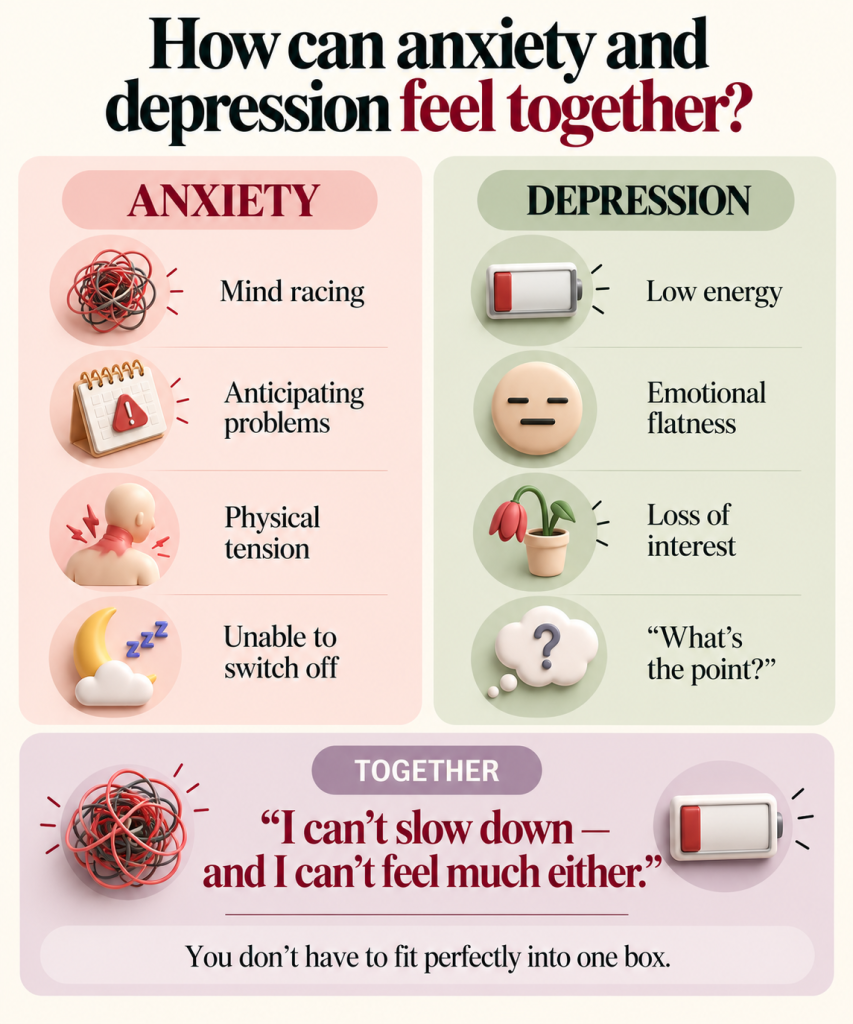
You may feel constantly on edge. Your mind won’t switch off. You wake early with your thoughts already racing.
And at the same time, you feel strangely flat.
Things you used to enjoy feel like chores. Seeing friends takes effort. Even things you once looked forward to can feel emotionally distant.
Then comes the thought:
“How can I be anxious and numb at the same time?”
You can.
Anxiety and depression can overlap, and during perimenopause they may be accompanied by sleep problems, irritability, physical symptoms and the pressures of midlife.
(ACOG)
You are not failing at two different things. Sometimes these experiences become connected.
1. You Can Feel “Wired and Flat” at the Same Time
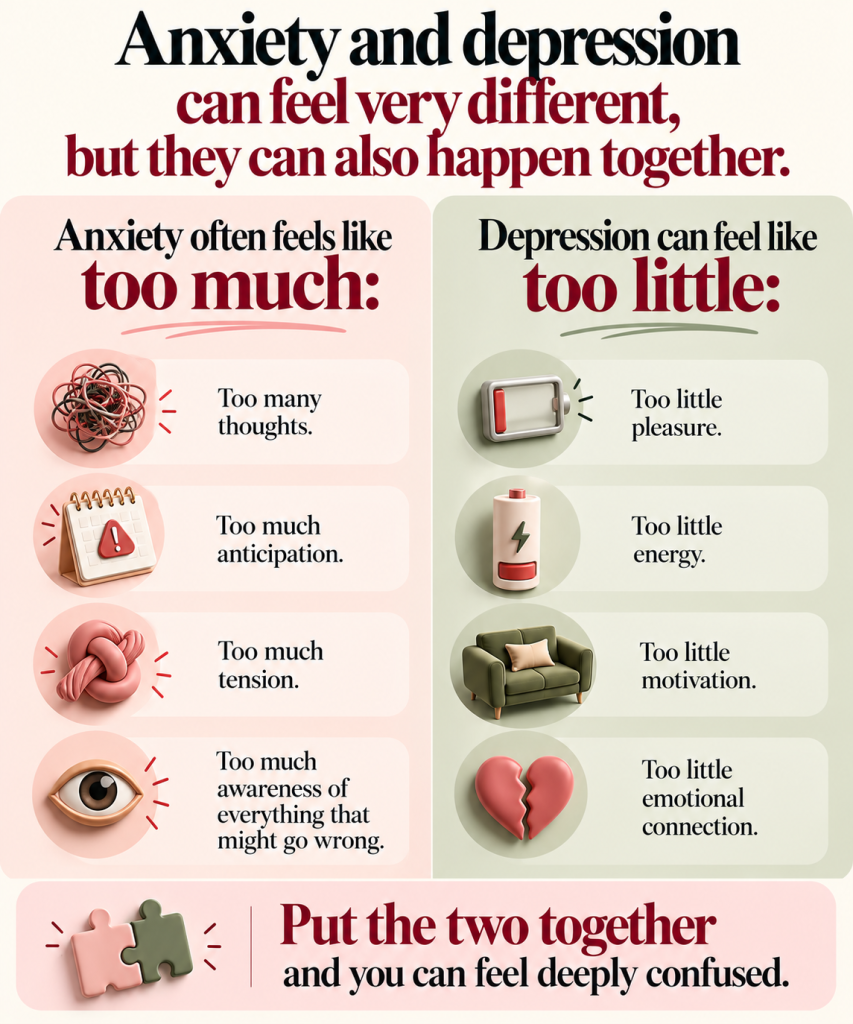
Your body is saying “go, go, go.”
While another part of you is saying: “I don’t want to go anywhere.”
That combination is more common than people realise.
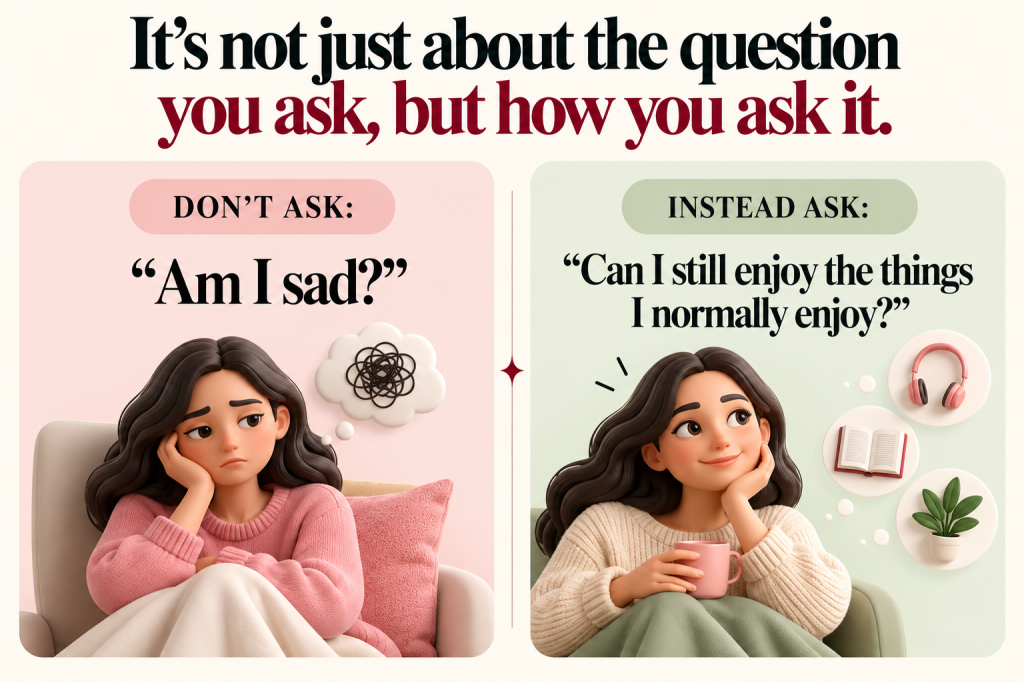
2. Look for What Has Happened to Your Ability to Enjoy Things
This is one of the most useful questions in the whole article.
A favourite friend.
Cooking.
Music.
A holiday you’ve been planning.
A Sunday morning by yourself.
A film you would normally lose yourself in.
If you still do those things but feel a little tired or distracted, that’s different from losing the ability to feel pleasure altogether.
Loss of interest or pleasure: anhedonia — is one of the key features clinicians look for when assessing depression.
(Cleveland Clinic)
And it can be much harder to notice than tears.
3. Anxiety Can Quietly Shrink Your Life
This is the bridge between the two.
Anxiety can make you avoid things.
You stop going to gatherings.
You put off the trip.
You don’t volunteer for the project.
You stop driving somewhere that makes you uncomfortable.
You say no to things because you are already exhausted by thinking about them.
Each decision can feel completely reasonable.
But look at what disappears with it:
Connection,
Pleasure,
Achievement,
Novelty and
Confidence.
And when your life becomes smaller, there are fewer opportunities to experience the things that usually make you feel good.
This can leave you feeling increasingly flat. Not because you chose depression.
Because little by little, your world became quieter.
4. Poor Sleep Can Sit Right Between Anxiety and Depression
Perimenopause can already make sleep difficult.
Hot flushes.
Night sweats.
Waking in the early hours.
Broken sleep.
Then anxiety arrives at night and keeps your mind working when your body desperately wants rest.
The next day, you have less patience, less energy and less emotional room.
You worry more.
You withdraw more.
You sleep badly again.
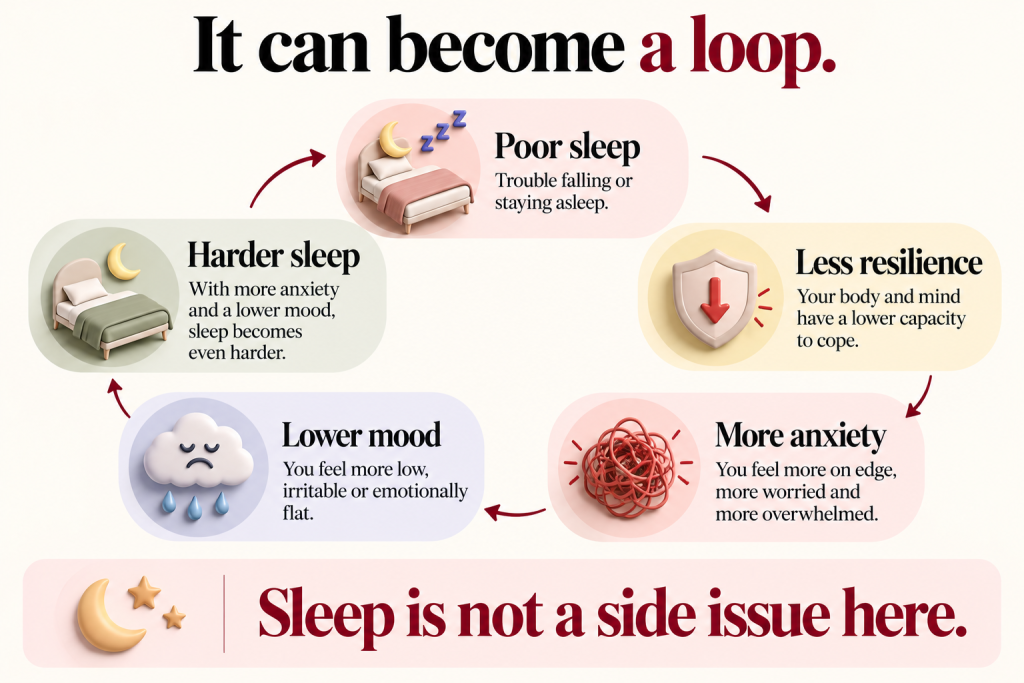
It can be one of the biggest pieces of the picture. ACOG notes that poor sleep during the menopausal transition can make it harder to regulate emotions and cope with stress.
5. Irritability May Be the Part Everyone Notices First
Sometimes depression doesn’t announce itself as sadness.
It looks like:
“Leave me alone.”
“I cannot deal with one more thing.”
“Why is everyone asking me something?”
You may find yourself snapping at your partner, children, colleagues or parents.
Then, when the moment passes, you feel awful about how you behaved.
That guilt can create another layer of distress.
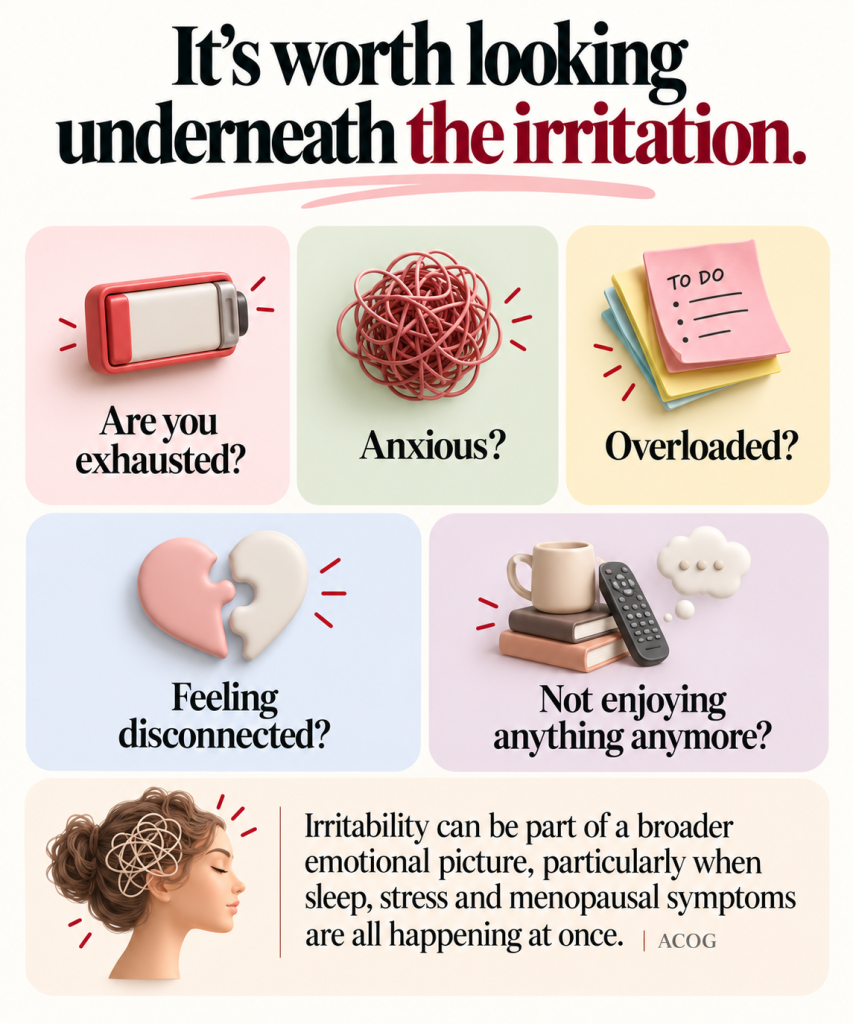
It’s worth looking underneath the irritation.
Are you exhausted?
Anxious?
Overloaded?
Feeling disconnected?
Not enjoying anything anymore?
Irritability can be part of a broader emotional picture, particularly when sleep, stress and menopausal symptoms are all happening at once.
6. You May Be Carrying Anxiety and Depression Without Realising It
Sometimes the clearest sign isn’t how you feel.
It’s what has changed.
You’re cancelling more plans. You don’t answer messages. You have stopped doing things that used to be part of your life. Work takes twice as much effort.
You lie awake worrying, then spend the next day feeling completely drained.
You tell people you’re “fine” because explaining everything feels exhausting.
This is worth noticing.
Depression can affect thoughts, feelings, behaviour, relationships and physical health — not just mood.
You do not need to look visibly miserable for your experience to deserve help.
7. You Don’t Have to Decide Which One Came First
This is perhaps the most important thing to take from this article.
Maybe anxiety came first.
Maybe your mood dropped first.
Maybe poor sleep came first.
Maybe perimenopause changed several things at once.
There may not be a neat beginning.
And you don’t need one.
The useful questions are:
What has changed?
How long has it been happening?
What am I avoiding?
What do I no longer enjoy?
How is it affecting my life?
Those questions can tell you much more than arguing with yourself about whether you are “really” anxious or “really” depressed.
What Can Help?
The good news is that you do not have to treat these experiences as completely separate problems.
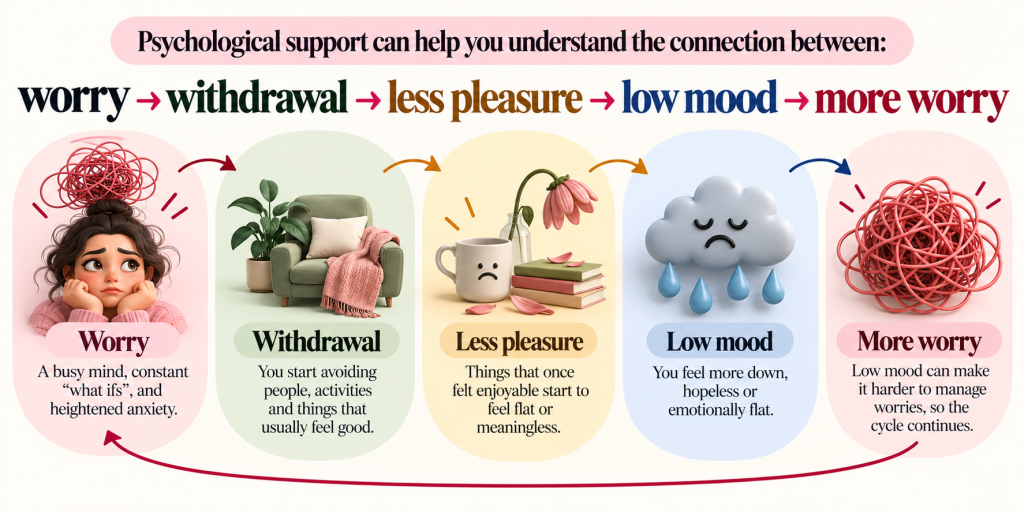
It can help you gradually bring meaningful activities back into your life, work with persistent worry, understand emotional patterns, rebuild confidence and reduce the self-criticism that so often appears when you’re no longer functioning the way you used to.
Medical support may also matter.
Your doctor or gynaecologist can assess menopausal symptoms, sleep problems and possible physical contributors. Depending on your symptoms and their severity, medication may also be appropriate.
Sometimes the best care is more than one kind of care.
The 2026 Indian Menopause Society guidance supports multidisciplinary care when psychological symptoms, sleep problems and menopausal symptoms overlap.
(PMC)
Please Don’t Wait Until You’re Completely Depleted
You don’t need to wait until you cannot work.
Or until your relationships are falling apart.
Or until you have stopped doing everything you enjoy.
Persistent low mood, loss of interest, anxiety that is becoming difficult to control, or increasing withdrawal are all reasonable reasons to ask for help.
And if you are having thoughts of harming yourself, feeling hopeless, or feeling that the people around you would be better off without you, please tell someone today.
Speak to a doctor or mental-health professional. In India, Tele-MANAS is available 24×7 on 14416.
(DGHS)
You don’t have to wait for things to become unbearable.
You Are Not Failing at Two Things
Anxiety and depression can arrive together.
One can feed the other.
And perimenopause can add another layer of physical, hormonal, sleep and life changes to the picture.
That does not mean your mind is broken.
It means you may need more support than you’ve been giving yourself.
So rather than asking:
“What’s wrong with me?”
Try:
“What has changed and what would help me feel like myself again?”
That is a much kinder question.
How Miror Can Help
When anxiety, low mood, sleep changes and perimenopause start overlapping, it can be difficult to know where to begin.
Miror is India’s largest and only 360-degree integrative women’s wellness ecosystem and community, bringing expert guidance, trusted health information and support together across the different stages of a woman’s life. With 95,000+ women, Miror has helped women access expert help and insights at the tip of a button.
Whether you’re navigating perimenopause depression, anxiety, sleep changes or simply feel unlike yourself, you can connect with Miror doctors, health experts and mental-health experts through the app.
Talk to someone who can help you make sense of what’s happening. Consult Miror doctors. Talk to Miror experts and mental-health professionals today.