
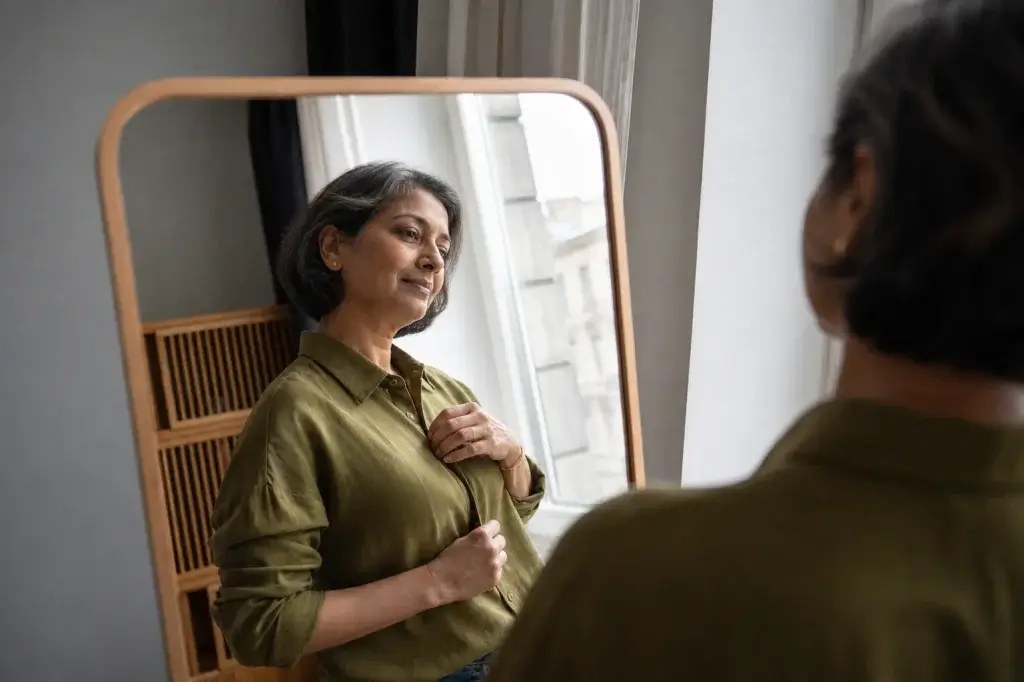
“I Don’t Feel Like Myself Anymore.”
A woman can be highly capable and still lose confidence.
She can have led teams for years, raised children, managed a home, supported parents and navigated crises without falling apart.
And then, somewhere in her 40s or 50s, she starts hesitating.
She forgets a word in a meeting.
She feels more anxious about being judged.
Her sleep is poor.
Her body is changing.
She doesn’t have the same energy.
And quietly, a thought begins to form:
Maybe I’m not as good as I used to be.
This is where self-esteem in menopause deserves a more compassionate conversation.
Menopause does not automatically cause low self-esteem. But hormonal fluctuations can occur alongside changes in mood, sleep, cognition, physical symptoms and stressful life circumstances. Those experiences can affect how capable, attractive, secure or “like yourself” you feel.
(MMC)
And for many women, particularly in India, all of this happens during an already demanding stage of life.
Confidence Is More Than a Personality Trait
We often talk about confidence as though it is something permanent.
She’s always been confident.
She’s just not a confident person.
But confidence also depends on how you are functioning and how safe and capable you feel in your own life.
When sleep is broken, concentration is harder.
When your body feels unfamiliar, you may become more self-conscious.
When anxiety rises, you may second-guess yourself.
When you are emotionally exhausted, ordinary decisions can feel harder.
None of these automatically means your confidence has disappeared.
Sometimes your confidence is still there. It is simply harder to access.
And that distinction matters.
5 Essential Reasons Your Self-Esteem Can Feel Different During Menopause
1. Your Brain May Not Feel as Reliable as It Used To
For many women, one of the most unsettling parts of peri/menopause is brain fog.
You lose a word. Forget what you were about to say. Read something twice. Walk into a room and forget why.
Cognitive complaints such as difficulty concentrating and remembering are common during the menopause transition, and sleep and mood symptoms can make them more noticeable.
The psychological problem begins when a temporary cognitive slip becomes a statement about your identity: “I forgot the word” → “I’m becoming less intelligent.”
That second sentence is where self-esteem takes the hit.
The symptom is one thing.
The story you build around it is another.
2. Poor Sleep Can Quietly Erode Confidence
Imagine trying to feel sharp, patient and capable after several nights of broken sleep.
You are more tired.
More irritable.
Less focused.
You recover more slowly from stress.
Then you judge yourself for not performing at your usual level.
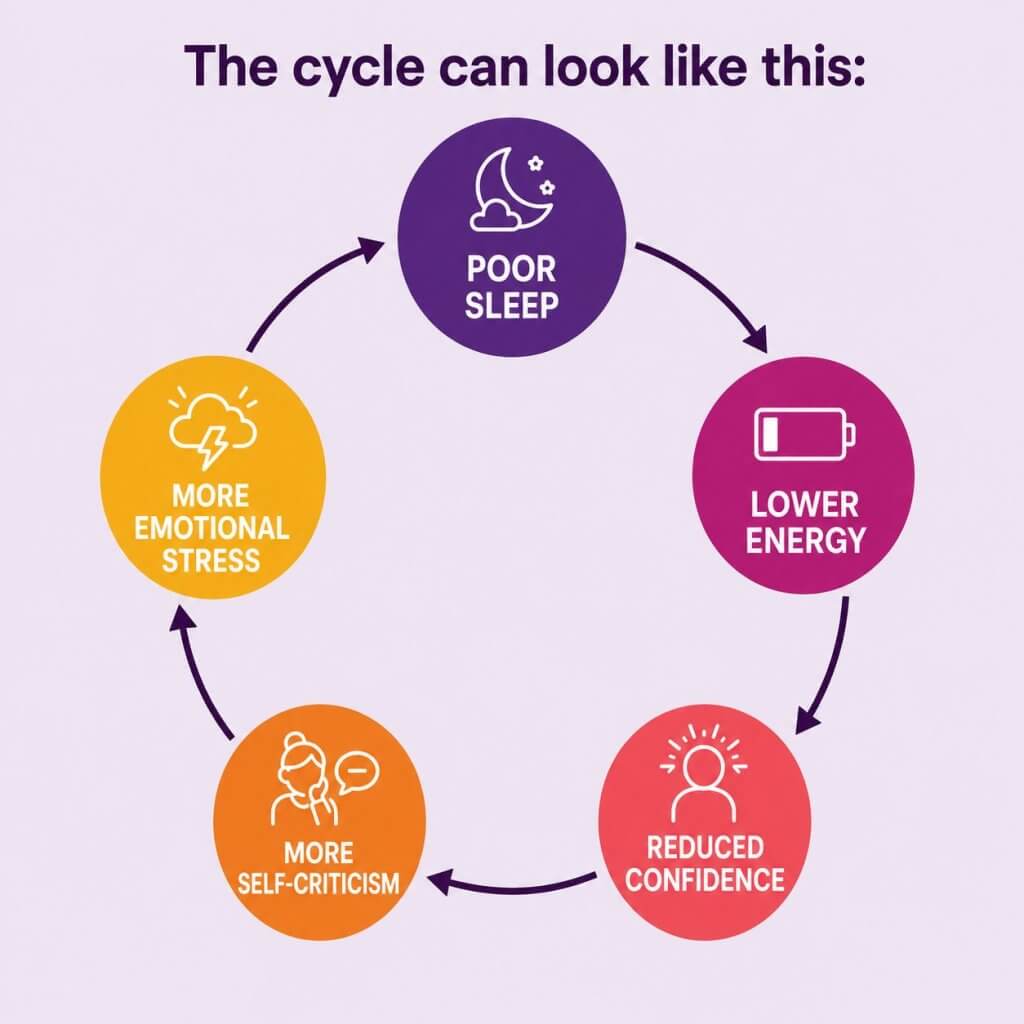 Self-esteem in menopause can be affected by a cycle of poor sleep, lower energy, reduced confidence, self-criticism and emotional stress.
Sleep problems are common during the menopause transition, and they can affect mood and cognitive functioning.
So before asking, “Why am I not confident anymore?”
Ask: “How supported and rested am I?”
3. Your Body May Feel Unfamiliar
Weight changes.
Changes in skin and hair.
Hot flashes.
Changes in sexual wellbeing.
A body that suddenly seems to have its own agenda.
For some women, these changes affect how they see themselves, not because their worth has changed, but because the relationship they have with their body is changing.
And Indian women often grow up in environments where women’s bodies are openly commented on.
At weddings. At family gatherings. By relatives. By colleagues.
There can be constant commentary about weight, ageing, appearance and how a woman “should” look.
So when menopause changes the body, it can hit an already sensitive cultural nerve.
Your body changing is not the same thing as your value changing.
4. Midlife Can Change Your Identity Alongside Your Hormones
Menopause rarely arrives alone. It may arrive when children are becoming independent, parents are ageing, careers are changing and relationships are entering a new phase.
For many Indian women, there can be an additional layer: years of being the person who adjusts, remembers, accommodates and holds the family together.
(Mirorpedia)
And then you reach a point where you quietly ask: Who am I when everyone doesn’t need me in the same way?
This is not necessarily a crisis.
It can be an identity transition.
But transitions are uncomfortable because the old version of you is no longer quite enough, while the new version has not fully emerged.
That in-between space can feel surprisingly lonely.
Dr Louise Newson also notes that emotional wellbeing during perimenopause has to be understood alongside women’s work, caregiving responsibilities and broader life stressors.
5. The Biggest Threat to Self-Esteem May Be Self-Judgement
This is the part I most want women to notice.
You have a difficult day.
You forget something.
You lose your patience.
You don’t feel attractive.
You say no because you are exhausted.
And instead of responding with curiosity, you respond with criticism:
I’m slipping.
I’m lazy.
I’m difficult.
I’m not who I used to be.
That inner commentary can become more damaging than the original symptom.
Try changing one question:
Instead of: “What’s wrong with me?”
Ask: “What is making this harder for me right now?”
That shift sounds small.
Psychologically, it is enormous.
It moves you from self-judgement to self-understanding.
A Quick Confidence Check:
| If you notice… | Ask yourself… |
|---|---|
| More forgetfulness | Am I sleeping enough? |
| More self-consciousness | What has changed in how I see my body? |
| More hesitation | Am I anxious, exhausted or genuinely uncertain? |
| More irritability | What have I been carrying without recovery? |
| Feeling “invisible” | Where do I feel seen and valued outside my roles? |
The point is not to find one explanation.
It is to look at the whole woman, not just the symptom.
What Can Help You Feel Like Yourself Again?
You do not need to reinvent your personality. Start by separating the symptom from the identity.
Notice the difference:
“I am struggling with concentration” is very different from “I am becoming incapable.”
Take the physical symptoms seriously:
Sleep problems, persistent fatigue, troublesome menopause symptoms and other health concerns deserve proper medical attention rather than being treated as personal weakness.
Rebuild capability:
Movement, learning something new, returning to an old interest or doing something that makes you feel physically and mentally capable can help rebuild confidence through experience—not forced positivity.
Let someone know:
Talk to a sister, friend, partner, psychologist or another woman going through the same transition. You may discover that what felt deeply personal is actually widely shared.
Make room for a life beyond responsibility:
One hour that belongs to you is not selfish. It is a reminder that your identity is larger than what you do for everyone else.
When Should You Seek Support?
Consider speaking to a healthcare or mental-health professional if changes in confidence, mood or self-worth are persistent or begin affecting your work, relationships or daily life.
Seek support particularly if you notice:
Persistent anxiety or low mood
Loss of interest in things you normally enjoy
Severe sleep disruption
Withdrawal from people you care about
Intense self-criticism or hopelessness
Difficulty functioning at work or home
Thoughts of self-harm
You don’t need to wait until your confidence has completely disappeared.
Early support can help you understand what is hormonal, what is psychological, what is circumstantial; and what needs attention across all three.
Where Miror Can Help
At Miror, we believe women’s health cannot be separated into neat boxes.
Hormonal changes can affect physical wellbeing.
Physical symptoms can disrupt sleep.
Sleep can affect mood and concentration.
Those changes can affect confidence and relationships.
And the emotional stress that follows can feed back into the body.
That is why Miror is built as a 360-degree integrative women’s health ecosystem, bringing together doctors, psychologists, health experts and a community of thousands of women navigating different stages of their health journey.
Sometimes you need medical guidance. Sometimes you need a psychologist. And sometimes you need a community where another woman simply says: “I thought it was only me.”
The Miror Community gives women a space to ask questions, share experiences and access expert-led support without having to navigate this transition alone.
For women navigating perimenopause, Miror Bliss can be explored as part of a broader wellness routine. Miror Thrive, on the other hand, is curated for life after menopause with phytoestrogens, adaptogens, and nutrients that support hormonal clarity, bone strength, and inner calm.
But the bigger support is the ecosystem around you.
If changes in confidence, self-esteem or emotional wellbeing are affecting your daily life, speak to a Miror expert and connect with a community that understands the whole picture.
Remember..
Maybe you have not lost yourself.
Maybe the version of you that worked perfectly for the last twenty years is simply changing.
You do not have to become who you were at 35.
You get to discover who you are now.
And that woman deserves to like herself, too.
Medical Disclaimer
This article is for educational purposes only. It does not provide a diagnosis, treatment plan or replacement for psychological, psychiatric or medical care. Changes in mood, cognition, sleep, body image or self-esteem can have multiple causes. If symptoms are persistent, worsening or affecting daily functioning, please speak to a qualified healthcare or mental-health professional.