

“But I’m Not Actually Alone. So Why Do I Feel So Lonely?”
You have people around you.
A partner. Children. Parents who call. Colleagues. Friends. Family WhatsApp groups that never seem to stop.
Your phone is rarely silent.
And yet, sometimes, you feel completely alone.
Loneliness in menopause can feel especially confusing because you may be surrounded by people and still feel emotionally disconnected.
Not physically alone.
Emotionally alone.
You may find yourself thinking:
Why does nobody really ask how I am?
Why am I always the one listening?
Why do I feel disconnected when my life is so full?
If this sounds familiar, I want you to know something first:
Feeling lonely does not mean you are ungrateful, difficult or doing something wrong.
Menopause does not automatically make a woman lonely. But hormonal changes, sleep disruption, physical symptoms, anxiety, mood changes and major life transitions can all affect how much emotional energy you have for connection.
(Mirorpedia)
Sometimes, menopause doesn’t create the loneliness. It expands what was already there.
Loneliness Is Not the Same as Being Alone
There is an important difference between being alone and feeling lonely.
Social isolation is about how much contact you have with other people.
Loneliness is the subjective feeling that you are not sufficiently seen, understood or emotionally connected.
You can have a very full social calendar and still feel lonely.
In fact, midlife can create a particularly strange version of loneliness:
You are needed by everyone, but known by very few.
You may spend your days solving problems, remembering appointments, managing family emotions and supporting other people.
People come to you when they need something.
But who do you go to?
(PubMed NIH)
Why Loneliness in Menopause Can Feel More Intense
Menopause is not happening in isolation.
Think about what may be happening at the same time. You are dealing with hormonal fluctuations. Perhaps you are sleeping badly because of night sweats or early waking.
You feel physically exhausted.
Your patience is lower.
Your anxiety is higher.
You have less energy for socialising.
You stop replying to messages because even conversation feels like work.
Your friends assume you are busy.
You assume they are busy.
And gradually, the distance grows.
(Science-Direct)
This is the convergence that matters:
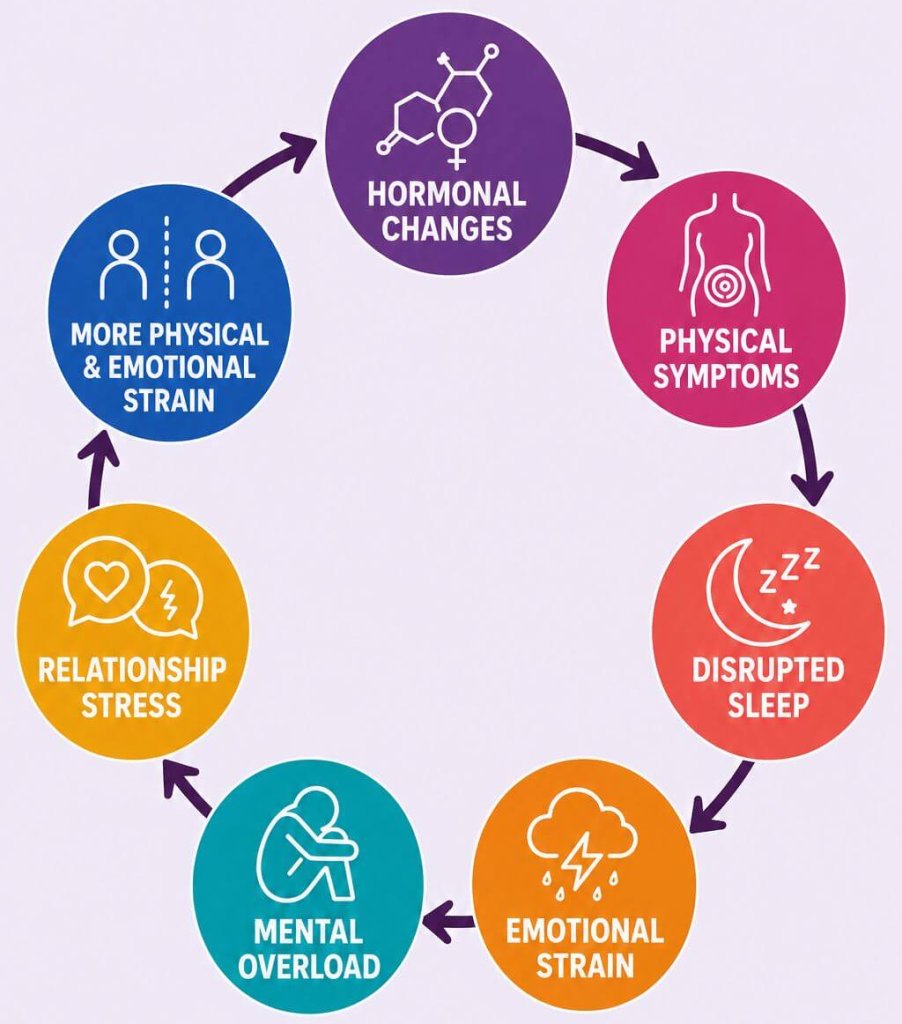
And it can work in the opposite direction too.
Loneliness can increase emotional distress. Emotional distress can affect sleep. Poor sleep can make physical and mental symptoms harder to manage.
So menopause mental health cannot be separated neatly from relationships and social connection.
The pieces keep influencing one another. Research has also linked loneliness and social isolation with subjective cognitive difficulties during the perimenopause transition.
(The Menopause Society)
7 Powerful Ways to Feel Less Alone During Menopause
You do not necessarily need more people.
You may need more meaningful connection.
1. Name What You’re Feeling
The first step is often surprisingly simple: call it what it is.
Instead of telling yourself:
I’m just tired.
I’m being antisocial.
Everyone is busy.
Try:
“I think I’m feeling lonely.”
Naming the experience takes it out of the category of personal failure and puts it into the category of something you can respond to.
You don’t have to solve it immediately.
You just have to stop pretending it isn’t there.
2. Tell One Person the Truth
You don’t need to announce your loneliness to everyone you know.
Choose one person you trust.
Try saying: “I’ve been feeling lonely lately, even though I’m around people all the time.”
That sentence can feel surprisingly vulnerable.
It can also change the relationship.
Because instead of allowing someone to interact only with the functional version of you—the woman who manages everything; you give them an opportunity to meet the woman underneath it.
3. Choose Depth Over Quantity
If your life is already full of conversations, adding more conversations may not help.
What may help is reciprocity.
Who asks how you are?
Who remembers what you told them last week?
Who can sit with you without needing you to fix something?
One relationship where you feel genuinely known can be more nourishing than a calendar full of social obligations.
5. Pay Attention To What The Body Is Going Through
This is an important part of loneliness in menopause that is easy to miss.
If poor sleep, hot flashes, anxiety, pain or other menopause symptoms are exhausting you, social interaction may start feeling like another task.
You may withdraw because you genuinely do not have the energy.
That does not mean you have suddenly stopped caring about people.
It may mean your body needs attention too.
Menopause symptoms such as sleep disturbance and mood changes can influence emotional wellbeing, and addressing troublesome symptoms can be an important part of broader menopause care.
(The Menopause Society)
6. You Don’t Have To Be The Strong One Everytime
If you have spent decades being the person who remembers, organises, absorbs and adjusts for everyone else, receiving care can feel strangely uncomfortable.
You may automatically say:
“I’m fine.”
“Don’t worry about me.”
“It’s okay, I’ve got it.”
Sometimes connection begins when you stop saying those things.
Let someone help.
Let someone check in.
Let someone know you are having a difficult day.
Being supported is not the opposite of being strong.
7. Ask for Professional Support When You Need It
Loneliness does not always need therapy.
But if it is persistent, worsening or beginning to affect your sleep, work, relationships or ability to enjoy your life, it deserves attention.
A psychologist can help you explore loneliness alongside anxiety, low mood, identity changes, relationship patterns, grief or the stress of midlife.
And if loneliness is accompanied by persistent sadness, loss of interest, hopelessness or thoughts of self-harm, please seek professional help rather than waiting for it to pass.
(This Is Menopause).
The Midlife Squeeze Nobody Talks About
Your 40s and 50s can be an unusually crowded decade.
Children may be growing up or leaving home.
Parents may need more care.
Your career may be demanding more from you or forcing you to reconsider what you want.
A long-term relationship may have quietly become more about logistics than intimacy. Friendships that once felt effortless may now require planning around everyone’s schedules.
You can be surrounded by responsibilities and still feel that something important is missing.
Sometimes what is missing is not people. It is reciprocity.
You are always giving.
Someone else is always needing.
You rarely get to be the one who says: “I’m struggling today.”
(Preserva Wellness)
When Loneliness Becomes a Mental Health Concern
Loneliness and depression are not the same thing.
You can feel lonely and still enjoy your life.
But persistent loneliness can coexist with anxiety, low mood, sleep difficulties and other emotional challenges:
Stop doing things you once enjoyed
Withdraw from people you care about
Feel persistently hopeless or low
Struggle to function at work or home
Experience significant sleep disruption
Feel that life has lost its meaning
These are signs that you may need more than social connection alone.
You do not need to wait until you are in crisis to ask for help.
Where Miror Can Truly Help
At Miror, we believe women’s health is not a collection of separate symptoms.
Your hormonal health affects your physical wellbeing.
Your physical wellbeing affects your sleep.
Sleep affects your mood and mental health.
Your mental health affects your relationships.
And your relationships affect how supported you feel while navigating all of it.
That is why Miror is built as a 360-degree integrative women’s health ecosystem; bringing together doctors, psychologists, health experts and a community of thousands of women navigating different stages of their health journey.
Sometimes you need expert medical guidance.
Sometimes you need a psychologist.
And sometimes you need a community where you can simply say: “Me too.”
That sense of being understood matters. For women in postmenopause, Miror Thrive is designed to support postmenopausal wellness.
But the heart of Miror is bigger than any one product.
If loneliness, anxiety or emotional disconnection is affecting your daily life, speak to a Miror expert and connect with a community where you don’t have to navigate midlife alone.
A Final Word
You can be surrounded by people and still need more connection.
That does not make you needy.
It makes you human.
Maybe this stage of life is not asking you to become more independent.
Maybe it is asking you to let yourself be known.
Medical Disclaimer
This article is for educational purposes only. It does not provide a diagnosis, treatment plan or replacement for psychological, psychiatric or medical care. If loneliness is persistent, significantly affecting daily functioning, or accompanied by depression, hopelessness or thoughts of self-harm, please seek professional support promptly.